What the studies actually found
In one human study, 11 of 12 patients receiving BPC-157 alone reported significant improvement — and 7 of those 12 (58%) said the relief lasted 6 months to a year.
READ THE RESEARCH →10 of 12 patients reported complete symptom resolution, while the remaining 2 reported about 80% improvement — all had previously failed the only FDA-approved treatment for the condition.
READ THE RESEARCH →In lab research on tendon tissue, BPC-157 accelerated fibroblast outgrowth and migration in a dose-dependent way — activity the researchers linked to the FAK–paxillin signaling pathway.
READ THE RESEARCH →A 2025 narrative review of the musculoskeletal literature found accelerated healing reported consistently across every soft-tissue injury model tested, alongside a clear-eyed look at what's still missing before it's clinical proof.
READ THE RESEARCH →Researchers are investigating whether it influences blood-vessel formation, fibroblast movement, cell survival and tissue remodeling — potentially helping injured tissue create the conditions it needs to repair itself.
EXPLORE THE SCIENCE →Few investigational peptides have this much research behind them — decades of lab evidence, a plausible mechanism, and small but real human signals. It's genuinely promising science, still working toward the large human trials that would make it proven medicine.
Read the full research ↓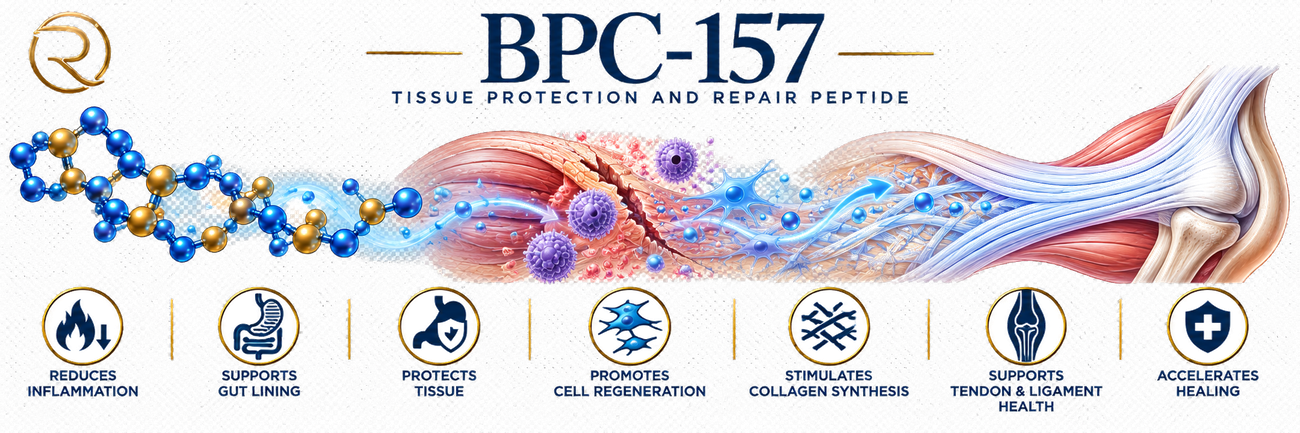
BPC-157 — Overview
What Is BPC-157?
BPC-157 is a synthetic 15-amino-acid peptide — a pentadecapeptide (“penta” for five, “deca” for ten, totaling fifteen amino acids). Its name stands for Body Protection Compound, describing the protective biological responses observed in early laboratory research. It was identified as a small, biologically active fragment isolated from a larger protective-compound family found in human gastric juice. Unlike many peptides discovered as circulating hormones (insulin, growth hormone, glucagon), BPC-157 is not itself a naturally circulating human hormone — it is a synthetic sequence modeled after that naturally occurring gastric fragment, synthesized so scientists could study its biological activity consistently.
Its amino acid sequence is: Gly–Glu–Pro–Pro–Pro–Gly–Lys–Pro–Ala–Asp–Asp–Ala–Gly–Leu–Val.
Unlike peptides engineered to activate one known receptor, early research suggested BPC-157 might interact with several pathways involved in tissue communication, vascular signaling, inflammation, and repair — though its exact mechanisms remain under active investigation (see the Science page). Its scientific interest lies less in its size than in early findings suggesting this one small sequence could influence protective responses across multiple biological systems at once.
Discovery and Development
Research into BPC-157 began with a broader question: how does the gastrointestinal system — one of the body’s most chemically hostile environments — protect itself against constant acid, enzyme, and physical stress? Croatian physician-researcher Predrag Sikiric and colleagues, working through the University of Zagreb School of Medicine, investigated this question beginning in the 1970s–80s, isolating a family of protective peptides from gastric juice; one 15-amino-acid sequence within that family became known as BPC-157.
Early work concentrated on the gastrointestinal tract — ulcers, intestinal injury, inflammatory damage — but researchers soon observed effects extending beyond the stomach into vascular function, wound healing, and tissue repair more broadly. That unexpected breadth reframed the research question: could a peptide identified for gastric protection influence the body’s injury response elsewhere? That question has shaped more than three decades of subsequent research (the full research arc is on the Research page).
The scientific path followed a familiar sequence: observation of protective activity in gastric compounds → isolation of the active fragment → identification of its 15-amino-acid sequence → synthesis for consistent laboratory study → expansion of research beyond the digestive system into broader tissue-repair and cell-communication biology.
Current Scientific Status
BPC-157 remains an investigational research peptide, not an FDA-approved medication. No FDA-approved drug product containing it exists, and it has not completed the clinical development process — evaluation of safety, effectiveness, manufacturing quality, appropriate medical use, and benefit-versus-risk — required for approval. Most published research remains laboratory and animal work rather than large, controlled human clinical trials; current research continues to examine whether findings from experimental models translate into meaningful human applications. At this stage, BPC-157 should be understood as a scientifically interesting investigational peptide, not an approved medical therapy.
Why It Draws Scientific Interest
The underlying observation is that living organisms have built-in systems to protect tissue and restore balance after stress or injury. BPC-157 became scientifically interesting because experiments suggested this small peptide fragment could affect multiple biological processes rather than acting in one isolated location — prompting questions about how tissues communicate during injury, how the body coordinates repair signals, what role blood vessels play in tissue recovery, and whether naturally inspired peptides can help explain the body’s own communication networks. Its appeal was never a single claimed effect; it was the possibility that one small peptide could touch several interconnected systems — tissue communication, blood-vessel formation, inflammatory signaling, cellular stress responses, and repair-related pathways — rather than acting through one traditional hormone-receptor pathway. This placed BPC-157 within a larger field of research exploring whether peptides can help illuminate, and potentially influence, the body’s own communication networks.
Areas of Biological Interest
- Tissue repair and regeneration — whether BPC-157 influences cellular communication, blood-vessel development, and structural repair processes following muscle, tendon, ligament, and other tissue injury; findings so far come from experimental models and have not been confirmed at the same scale in humans.
- Gastrointestinal biology — the foundational area, given its origin in gastric-protection research; studies examine how it interacts with the digestive system’s response to chemical and physical stress.
- Vascular and cellular signaling — whether it influences the formation and maintenance of blood-vessel networks, including signaling related to endothelial cells (the cells lining blood vessels) — processes central to tissue adaptation and repair.
- Nervous system research — earlier-stage, primarily experimental investigation into nerve signaling and nervous-system function, reflecting broader interest in how peptides may influence communication across different biological systems.
Research has developed internationally, with major early contributions from Croatia and Europe (particularly the University of Zagreb group) and has since expanded to laboratories studying the peptide across many experimental models worldwide — part of a broader trend in peptide science of identifying naturally inspired molecules, characterizing them, and testing whether laboratory discoveries translate into clinical application. Although BPC-157 is widely discussed in health, performance, and longevity communities, the scientific investigation itself remains focused on understanding its biology and establishing stronger evidence.
Why This Matters
BPC-157’s significance traces back to the question that started it: how does the body protect itself and coordinate repair? From its origins in gastric research to decades of experimental study across vascular, connective-tissue, gastrointestinal, and neurological systems, it has drawn attention because it appears to interact with multiple biological communication networks rather than a single target. Its importance isn’t that it’s an approved therapy — it isn’t — but what it reveals about the relationship between peptides, cells, and biological repair processes, and what that may contribute to future biomedical research. Continue to the Research page for the evidence behind these ideas.
BPC-157 — The Research
How Was BPC-157 Discovered?
The story began not with a search for an injury-repair peptide, but with a broader question about how the body protects itself from stress. In the 1970s, Croatian physician-researcher Predrag Sikiric became interested in the observation that severe physiological stress could damage the stomach, and began asking the reverse question: if the stomach responds to injury and stress, could it also produce substances that help protect itself? That idea led researchers at the University of Zagreb School of Medicine to investigate gastric secretions. In the 1980s and early 1990s, Sikiric and colleagues reported isolating a family of peptides from gastric juice with protective biological activity; one sequence became known as Body Protection Compound-157, or BPC-157.¹
Early research concentrated on the gastrointestinal tract, in experimental models of ulcers, intestinal injury, and inflammatory damage. But an unexpected pattern emerged: the effects weren’t confined to the stomach. BPC-157 was repeatedly associated with changes in vascular function, wound healing, and tissue repair elsewhere in the body — raising the question that would shape more than three decades of subsequent research: could a peptide investigated for gastric protection influence the body’s response to injury in other tissues?
Evolution of the Research
Early gastrointestinal research (1990s–early 2000s) — the University of Zagreb group concentrated on gastrointestinal protection, examining gastric ulcers, intestinal lesions, inflammatory bowel disease models, and damage from substances like alcohol and NSAIDs. BPC-157 repeatedly produced protective or reparative effects across these injury models, leading researchers to propose that its activity might extend beyond a conventional anti-ulcer effect toward a broader tissue-protection and repair process.
Expansion into tissue repair — research then moved beyond the digestive system into skin wounds, tendons, ligaments, muscle, bone, blood vessels, and nervous tissue. Across these models, researchers repeatedly observed changes in blood-vessel formation, fibroblast activity, collagen organization, and recovery after injury — suggesting the peptide’s effects weren’t tied to one particular organ, but to systems involved in the body’s broader response to tissue damage.
Mechanistic expansion (2010s) — research increasingly focused on angiogenesis, vascular signaling, nitric-oxide pathways, and growth-factor activity, shifting the field from observing that injured tissue healed faster toward asking why. Studies associated BPC-157 with VEGF and nitric-oxide signaling pathways (detailed on the Science page).
The human research gap — the most important recent development is the recognition that preclinical evidence far outweighs human evidence. Reviews published in 2025–2026 describe more than three decades of predominantly laboratory and animal research, while emphasizing that controlled human clinical evidence remains extremely limited. A 2026 review concluded there is still no approved formulation, validated human dosing regimen, or completed Phase II clinical program.⁸ That distinction matters: BPC-157 has generated a large scientific literature, but most of it doesn’t represent clinical evidence in humans.
The Most Important Research Findings
Gastrointestinal protection — among the earliest and most extensive work, using animal models of ulcers, inflammatory injury, intestinal damage, and chemically induced lesions. BPC-157 was consistently associated with reduced tissue damage and accelerated recovery, and researchers began observing that it appeared to influence several processes involved in tissue recovery simultaneously, including vascular responses and tissue organization — establishing gastrointestinal protection as the foundation of the research program.
Wound, tendon, and musculoskeletal research — one of the most influential expansions, testing BPC-157 in models of injured tendons, muscles, and other connective tissue. Animal studies reported increased fibroblast activity, improved collagen-related responses, and enhanced recovery following tendon or muscle injury, including effects in poorly vascularized tissue where restoring blood supply is an important part of repair.⁷ This suggested involvement in the repair environment itself — vascular recruitment and cellular responses associated with rebuilding damaged tissue — though these findings remain predominantly preclinical; positive results in rodents don’t establish the same degree of repair in humans.
Vascular and endothelial research — BPC-157 has been shown to influence blood-vessel formation and endothelial function in experimental models, including studies of vascular injury and thrombosis suggesting it can affect the body’s response to impaired circulation. This is a key link to the tissue-repair findings elsewhere, since damaged tissue requires an adequate vascular response to deliver oxygen, nutrients, and signaling molecules. Research has connected BPC-157 to VEGF/VEGFR2 and nitric-oxide signaling, though the precise pharmacological picture remains incompletely established.⁶
Neurological and other organ systems — as research expanded, investigators tested BPC-157 in models involving the nervous system, liver, cardiovascular system, and other organs, examining neurological injury, neurochemical disturbances, ischemia-reperfusion injury, and various forms of organ damage. A 2026 rat study, for example, examined lower-limb ischemia-reperfusion injury and reported changes in oxidative-stress markers, inflammatory signaling, VEGF, eNOS, and apoptosis-related pathways.⁹ The point of this body of work isn’t that BPC-157 has been “proven” to treat all of these conditions — it hasn’t — but that similar biological patterns have appeared across many experimental systems, which continues to expand the preclinical research landscape while remaining animal evidence.
Human Research & Clinical Evidence
This is where the story changes substantially: compared with the large body of animal research, human studies of BPC-157 are remarkably small and limited.
A 2021 retrospective study examined intra-articular BPC-157 for different types of knee pain.² Sixteen of 17 patients were successfully contacted for follow-up; among the 12 who received BPC-157 alone, 11 reported significant improvement, and of four additional patients who received BPC-157 combined with thymosin beta-4, three reported improvement. The finding is interesting but can’t establish efficacy — it was retrospective, involved a very small number of patients, lacked a placebo control, and didn’t use standardized measures of function or structural healing. It represents an early clinical observation, not confirmation that BPC-157 repairs damaged cartilage, tendons, or ligaments.
A separate small pilot study examined BPC-157 in 12 women with interstitial cystitis who hadn’t responded to pentosan polysulfate.³ Following a single procedure involving local injection, all participants reported improvement, with 10 reporting complete symptom resolution. Again, the study was small and uncontrolled, so it can’t determine how much of the improvement was specifically attributable to BPC-157.
A 2025 pilot study examined intravenous BPC-157 in just two healthy adults, who received 10 mg on one day and 20 mg on another.⁴ No measurable changes were reported in tested heart, liver, kidney, thyroid, or glucose biomarkers, and no adverse effects were reported during the short observation period. The study is a useful early human safety observation, but its size and design make it impossible to establish broader safety or efficacy conclusions.
Together, these studies illustrate the current human evidence: interesting signals, but not the kind of controlled clinical evidence required to establish a medical treatment.
Preclinical Research
The strongest part of the BPC-157 evidence base remains preclinical. Across rodents and laboratory models, researchers have repeatedly investigated gastrointestinal injury, tendon and ligament damage, wounds, muscle injury, vascular damage, neurological injury, and inflammatory conditions.⁵ ⁶ ⁷ ⁹ The consistency across these models is one reason BPC-157 continues to attract scientific attention — but the breadth of findings also creates the field’s central translational question: why does a peptide produce such broad effects in animals, and can those effects be reproduced safely and predictably in humans? That question remains unanswered. The most recent reviews emphasize the field needs better pharmacokinetic characterization, standardized formulations, controlled human trials, and independent replication before the extensive preclinical findings can translate into established clinical applications.⁸
Current Research Stage
BPC-157 remains investigational and is not FDA approved — it is not an approved treatment for tendon injuries, gastrointestinal disease, joint pain, inflammation, neurological disease, or any other medical indication.
Its regulatory status has become an active policy issue. On July 23–24, 2026, the FDA’s Pharmacy Compounding Advisory Committee (PCAC) considered BPC-157-related substances for potential inclusion on the federal 503A bulk-drug list, including a proposed use for ulcerative colitis.¹⁰ The committee voted in favor of allowing compounding for BPC-157 and several other peptides — a notable outcome, since it went against the position of the FDA’s own agency scientists, who had recommended against inclusion.¹¹ It’s important to be precise about what this means: a PCAC recommendation concerns pharmacy compounding eligibility, not FDA approval of BPC-157 as a drug, and the FDA itself is not bound to follow the committee’s recommendation. The FDA has also stated that available safety information for proposed compounded routes is limited and has identified concerns involving immunogenicity and peptide characterization.¹⁰
The current scientific position is therefore straightforward: BPC-157 has a substantial preclinical research history, very limited human clinical evidence, no established therapeutic indication, and no validated human dosing regimen — regardless of how the compounding-eligibility question is ultimately resolved.
What the Evidence Shows
Stronger evidence comes from repeated preclinical findings showing biological activity in gastrointestinal injury, tissue repair, vascular biology, and several experimental injury models. Emerging evidence includes human observations involving knee pain, interstitial cystitis, and intravenous administration, which provide early clinical signals but are too small and methodologically limited to establish effectiveness. Early or experimental evidence covers claims involving broader regenerative, neurological, cardiovascular, or systemic effects, which remain primarily supported by laboratory and animal research. The central evidence gap isn’t a lack of scientific interest — it’s the lack of sufficiently large, controlled, independently replicated human trials.
What Researchers Are Studying Now
Current research is moving toward a more fundamental question: can the biological effects observed repeatedly in experimental models be translated into a reproducible human therapy? Researchers are increasingly focused on pharmacokinetics, formulation, delivery, dose-response relationships, and the relationship between exposure and biological effect, while preclinical work continues to explore vascular signaling, tissue repair, gastrointestinal protection, musculoskeletal injury, and organ protection. This marks an important transition: the question is becoming less about whether BPC-157 can produce interesting effects in experimental models, and more about whether those effects can be measured, reproduced, and clinically validated in humans.
Future Scientific Potential
BPC-157 remains scientifically interesting because the research doesn’t fit neatly into a single biological category — the same experimental peptide has been investigated in gastrointestinal injury, connective-tissue repair, vascular biology, and neurological models. That breadth raises the possibility that its effects arise from interactions with fundamental processes involved in tissue response and recovery, rather than from one narrowly defined action — but that possibility remains a research question, not a demonstrated clinical fact. The next meaningful stage for BPC-157 isn’t discovering another animal model with an interesting result; it’s determining which findings translate to humans, at what exposure, through which biological pathways, and with what clinical significance. That is ultimately what will determine whether BPC-157 remains an intriguing research peptide or becomes a clinically useful therapeutic.
Why This Matters
More than three decades of research have transformed BPC-157 from an experimental gastric peptide into a compound studied across multiple areas of regenerative and protective biology. The preclinical evidence is broad and repeatedly interesting — effects involving gastrointestinal protection, vascular responses, tissue repair, and recovery from injury across numerous experimental models. But the human evidence hasn’t advanced at the same pace, and that contrast is itself the most important finding: BPC-157 has generated enough biological evidence to justify continued investigation, yet not enough clinical evidence to establish what those effects mean for patients. The next chapter depends on rigorous human research capable of separating promising biology from proven medicine.
References
- Historical account of BPC-157’s discovery (Sikiric et al., University of Zagreb, 1980s–90s) — drawn from review literature; confirm exact original citation(s) against a primary source before publishing, as this session verified the surrounding research history but not one single 1993 paper.
- Intra-Articular Injection of BPC 157 for Multiple Types of Knee Pain. Alternative Therapies in Health and Medicine. 2021. https://pubmed.ncbi.nlm.nih.gov/34324435/
- Effect of BPC-157 on Symptoms in Patients with Interstitial Cystitis: A Pilot Study. 2025 (confirm exact publication date/venue before publishing — coverage of this study appeared in late 2025, one year later than the original draft’s “2024”).
- Safety of Intravenous Infusion of BPC157 in Humans: A Pilot Study. 2025. https://pubmed.ncbi.nlm.nih.gov/40131143/
- Pharmacokinetics, distribution, metabolism, and excretion of body-protective compound 157 in rats and dogs. Frontiers in Pharmacology. 2022. https://pubmed.ncbi.nlm.nih.gov/36588717/
- Therapeutic potential of pro-angiogenic BPC157 is associated with VEGFR2 activation and up-regulation. Journal of Molecular Medicine. 2016. https://pubmed.ncbi.nlm.nih.gov/27847966/
- Pentadecapeptide BPC 157 enhances the growth hormone receptor expression in tendon fibroblasts. Molecules. 2014. https://pubmed.ncbi.nlm.nih.gov/25415472/
- BPC-157 as an Investigational Peptide Therapeutic: Biopharmaceutical Challenges, Formulation Strategies, and Translational Development Barriers. 2026. https://pubmed.ncbi.nlm.nih.gov/42198317/
- Protective effects of BPC 157 in rats with experimentally induced lower extremity ischemia-reperfusion injury. Scientific Reports. 2026. https://www.nature.com/articles/s41598-026-55449-1
- FDA Briefing Document, Pharmacy Compounding Advisory Committee Meeting, July 23–24, 2026. https://www.fda.gov/media/193343/download
- Reporting on the PCAC’s July 2026 vote in favor of compounding BPC-157 and related peptides despite FDA staff opposition: AJMC / RAPS — confirm final committee scope/wording against the FDA’s own meeting summary before publishing.
BPC-157 — The Science
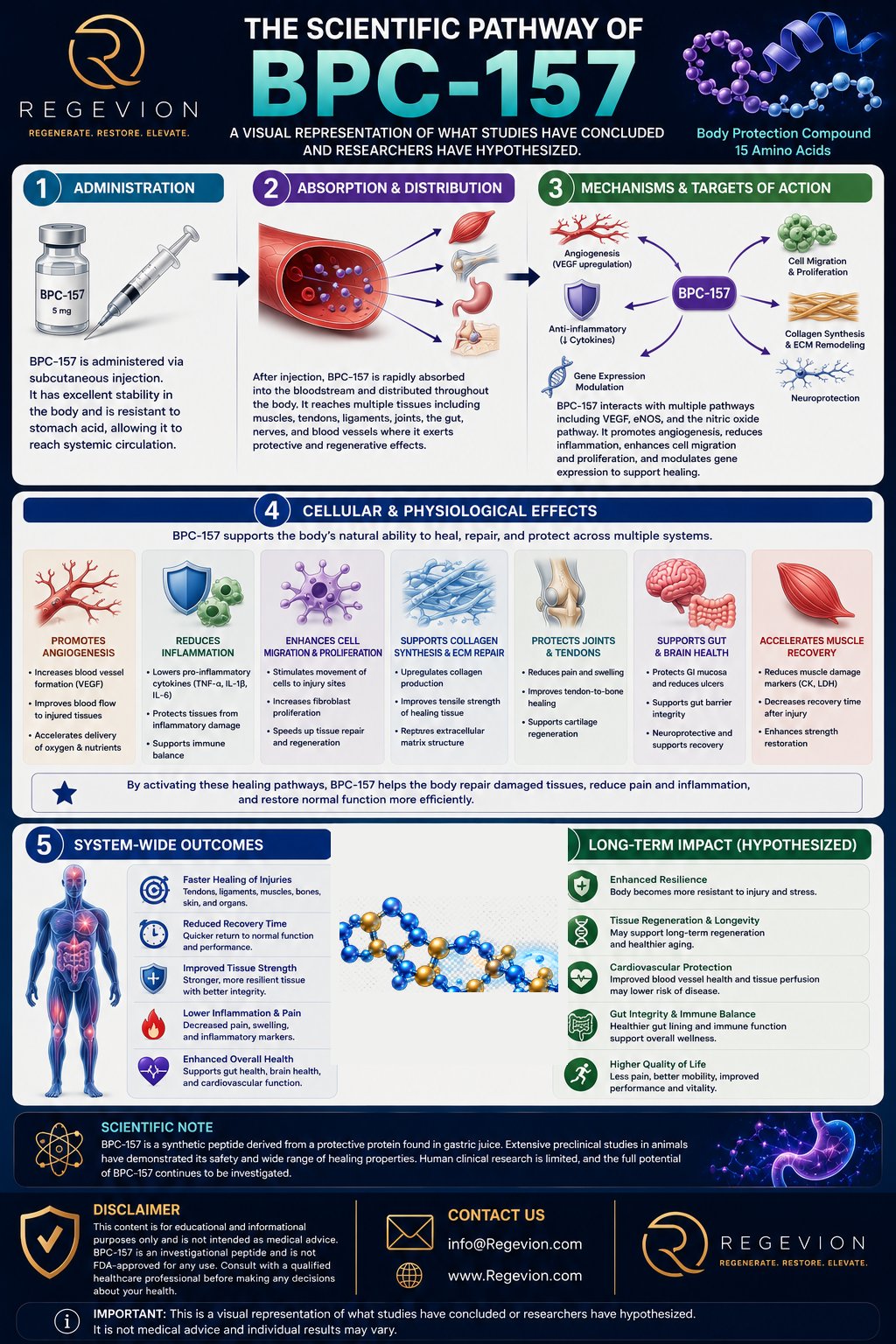
BPC-157 is scientifically unusual: despite decades of research, no single primary receptor or definitive molecular mechanism has been established. Instead, the evidence points to a network of interacting processes — vascular signaling, nitric-oxide biology, cellular migration and survival, inflammatory regulation, and tissue-repair pathways. Most of this mechanistic evidence remains preclinical and should not be presented as equivalent to a proven human mechanism.⁴
1. The Biological Architecture
BPC-157 is a synthetic 15-amino-acid peptide corresponding to a sequence originally identified in human gastric juice. Unlike a conventional hormone with one clearly defined receptor, it appears to influence several biological systems that become particularly relevant when tissue is injured. The most consistently investigated systems include the VEGFR2 (vascular endothelial growth factor receptor 2) pathway, the nitric oxide (NO) system, ERK1/2 signaling, focal-adhesion pathways, and transcriptional regulators such as EGR1/NAB2. Growth-hormone-receptor signaling has also been investigated, but should be regarded as a proposed downstream interaction rather than an established primary receptor mechanism.¹ ³
This can be visualized as: BPC-157 exposure → signaling modulation → endothelial/cellular response → vascular and tissue response → physiological effect. BPC-157 does not appear to function as a replacement for a missing hormone; current evidence instead suggests it may alter signaling conditions surrounding injured or stressed tissue.
2. Molecular Mechanism of Action
The most developed mechanistic evidence concerns the VEGFR2–Akt–eNOS axis. VEGFR2 is a receptor found prominently on vascular endothelial cells; its activation by VEGF normally promotes endothelial-cell survival, migration, proliferation, and new vascular structure formation. In experimental models, BPC-157 has been associated with increased VEGFR2 expression and receptor internalization, followed by Akt activation. Akt can activate endothelial nitric oxide synthase (eNOS), increasing nitric oxide production — a sequence experimentally linked to endothelial-cell migration and tube formation, two behaviors involved in angiogenesis.¹
The proposed chain: BPC-157 → VEGFR2 signaling → Akt activation → eNOS activation → NO production → endothelial response → vascular remodeling. This provides a plausible bridge between molecular signaling and the vascular changes observed in animal models, though the evidence does not establish BPC-157 as a direct VEGFR2 agonist in the pharmacological sense of a conventional receptor-selective drug — the literature more cautiously describes increased VEGFR2 expression, internalization, and signaling following exposure.¹
3. Receptor Biology & Cellular Signaling
VEGFR2 — currently one of the strongest mechanistic targets associated with BPC-157. In endothelial cells, VEGFR2 signaling regulates processes required to establish and remodel blood vessels; experimental exposure has increased VEGFR2 expression and activated downstream Akt–eNOS signaling, which may help explain findings involving vascular repair and angiogenesis in injured tissue.¹
Nitric oxide — a short-lived signaling molecule regulating vascular tone, blood flow, platelet activity, and aspects of inflammatory and cellular signaling. Rather than “more blood flow,” the more useful interpretation is that altered NO signaling can change the local vascular environment surrounding injured tissue. Earlier experimental work also reported interactions between BPC-157 and adrenergic, dopaminergic, and other signaling systems.²
ERK, FAK and paxillin — implicated in cytoskeletal organization, cell adhesion, migration, and proliferation, all biologically relevant to tissue repair: a repairing cell must survive, attach to its surroundings, migrate toward damaged areas, and reorganize its internal structure. BPC-157’s reported influence on these pathways is another possible link between molecular signaling and cellular repair behavior, though the relative importance of each pathway in humans remains uncertain.²
Growth hormone receptor — one study found BPC-157 increased GHR expression in cultured rat tendon fibroblasts in a dose- and time-dependent manner; adding growth hormone afterward increased downstream JAK2 signaling. This is an important mechanistic observation, but doesn’t demonstrate that BPC-157 itself is a growth-hormone-receptor agonist — it suggests instead that BPC-157 may alter tendon fibroblasts’ responsiveness to growth hormone.³
4. Pharmacology
BPC-157’s pharmacology is considerably less characterized than that of approved peptide medicines. Its molecular identity is straightforward — a 15-amino-acid peptide — but its pharmacodynamic target profile, receptor affinity, potency, intrinsic activity, and exposure-response relationships have not been adequately established in humans. A 2026 review identified the absence of a validated dosing regimen and highlighted the gap between extensive preclinical biological observations and limited human pharmacokinetic data.⁴ This means terms like “optimal dose,” “receptor saturation,” or a precise human therapeutic concentration cannot currently carry the same confidence they would for an approved drug.
5. Pharmacokinetics: What Happens to the Peptide?
Animal pharmacokinetic research indicates BPC-157 is metabolized relatively rapidly into smaller peptide fragments and ultimately amino acids that enter normal metabolic and excretion pathways; studies in rats and dogs examining intravenous and intramuscular administration found extensive metabolic breakdown.⁵ This raises an important pharmacological question: how can biological effects persist when the intact peptide may not remain in circulation for long? One possibility is that transient exposure initiates signaling changes that persist beyond the presence of the intact molecule; another is that metabolites contribute to some biological effects. The relative contribution of each has not been adequately resolved.
Human pharmacokinetic characterization remains particularly limited. A registered Phase I study investigated safety and pharmacokinetics in healthy volunteers, but publicly available evidence remains insufficient to establish a validated human PK model.⁶
6. Dose, Exposure & Dose-Response
BPC-157 illustrates why dose cannot automatically be equated with biological benefit. Animal experiments have investigated widely different doses, routes, and treatment schedules, making direct comparisons difficult; findings sometimes show dose- or time-dependent molecular responses, including increased growth-hormone-receptor expression in tendon fibroblasts.³ But there is currently no well-established human exposure-response curve showing that a particular concentration produces a predictable magnitude of tissue repair. Dose → systemic exposure → molecular signaling → biological response is a useful pharmacological framework, but the quantitative relationships between those steps remain incompletely defined for BPC-157 — one of the central translational gaps in the field.
7. Does Body Weight Affect Dose?
There is insufficient human pharmacokinetic evidence to establish a validated weight-based dosing requirement for BPC-157. Animal studies frequently express experimental doses in micrograms or milligrams per kilogram, but an animal mg/kg dose shouldn’t be read as evidence that humans require the same weight-based relationship — nor do BPC-157’s effects on injured tissue establish that heavier individuals require proportionally greater exposure. Without a validated human PK/PD model, body-weight adjustments cannot currently be scientifically justified as a general rule.⁴
8. What Happens at Lower vs. Higher Exposure?
The preclinical literature suggests different biological endpoints may respond differently to exposure — cellular signaling can be concentration- and time-dependent, while tissue-level outcomes depend on the injury model, route of administration, and duration of exposure. There is no scientifically established progression such as low dose = repair, medium dose = greater repair, high dose = maximum repair. The more defensible interpretation is that BPC-157 appears capable of influencing several signaling networks, but the relationship between exposure and the magnitude of each biological response remains incompletely characterized — a gap made more significant by the recent literature’s identification of a substantial pharmacokinetic–pharmacodynamic disconnect: biological effects are extensively reported in animals, while the human exposure required to produce those effects has not been adequately defined.⁴
9. Connecting Molecular Mechanisms to Human Outcomes
The proposed biological sequence is strongest in preclinical tissue-repair models: BPC-157 exposure → VEGFR2/Akt/eNOS and related signaling → endothelial-cell survival, migration and vascular responses → improved local vascular organization and tissue-cell activity → potential improvement in repair processes. This framework helps explain why BPC-157 has produced effects across vascular, gastrointestinal, tendon, muscle, and other experimental models — but the final step, from experimental mechanism to human clinical benefit, remains incompletely demonstrated. Reviews of the field emphasize that human evidence is extremely limited compared with the volume of animal research.⁷
10. Combination & Pathway Interaction
BPC-157’s biology appears inherently networked rather than dependent on a single pathway — experimental literature describes interactions involving the NO system, prostaglandins, dopamine, serotonin, vascular signaling, inflammatory mediators, and growth-related pathways.² That network behavior is scientifically interesting because tissue repair is itself a coordinated process involving blood flow, inflammation, extracellular-matrix remodeling, cell migration, and cellular survival. However, mechanistic interaction shouldn’t be confused with evidence that BPC-157 should be combined with another therapy or peptide — there isn’t sufficient clinical evidence to establish safe or effective combination protocols.
11. What Scientists Still Do Not Fully Understand
The largest unanswered question is fundamental: what is BPC-157’s primary molecular target? VEGFR2 signaling is strongly supported as an important component of its observed activity, but hasn’t been established as the single primary receptor responsible for its effects. Scientists also don’t yet know how much of its activity comes from intact peptide versus metabolites, why effects appear across such diverse tissues, what human exposure is required for meaningful pharmacodynamic activity, or whether the extensive animal findings translate into clinically meaningful human outcomes.⁴ These aren’t minor technical gaps — they’re central questions for converting an intriguing biological signal into a rigorously characterized therapeutic.
Why This Matters
BPC-157 is best understood not as a peptide with one simple receptor, but as an investigational biological signal that appears to influence several interconnected systems involved in vascular function, cellular migration, survival, and tissue response. The most compelling mechanistic pathway currently centers on VEGFR2 → Akt → eNOS → nitric oxide, with additional evidence involving ERK, FAK–paxillin, EGR1/NAB2, and growth-hormone-receptor signaling — together forming a coherent story of molecular signaling → cellular behavior → vascular and tissue response → physiological effect.¹ The scientific significance lies in the possibility that one small peptide can influence several components of the repair environment simultaneously; the scientific limitation is equally important — most of this story remains preclinical, and the human pharmacology has not yet been sufficiently defined.
References
- Therapeutic potential of pro-angiogenic BPC157 is associated with VEGFR2 activation and up-regulation. Journal of Molecular Medicine. 2016. https://pubmed.ncbi.nlm.nih.gov/27847966/
- Pentadecapeptide BPC 157 interactions with adrenergic, dopaminergic, and related signaling systems. Digestive Diseases and Sciences (and related literature). https://pubmed.ncbi.nlm.nih.gov/31158953/
- Pentadecapeptide BPC 157 enhances the growth hormone receptor expression in tendon fibroblasts. Molecules. 2014. https://pubmed.ncbi.nlm.nih.gov/25415472/
- BPC-157 as an Investigational Peptide Therapeutic: Biopharmaceutical Challenges, Formulation Strategies, and Translational Development Barriers. 2026. https://pubmed.ncbi.nlm.nih.gov/42198317/
- Pharmacokinetics, distribution, metabolism, and excretion of body-protective compound 157 in rats and dogs. Frontiers in Pharmacology. 2022. https://pubmed.ncbi.nlm.nih.gov/36588717/
- Registered Phase I safety/pharmacokinetics trial (PCO-02, “Bepecin”). ClinicalTrials.gov NCT02637284. https://clinicaltrials.gov/study/NCT02637284
- Regeneration or Risk? A Narrative Review of BPC-157 for Musculoskeletal Healing. 2026. https://pubmed.ncbi.nlm.nih.gov/40789979/