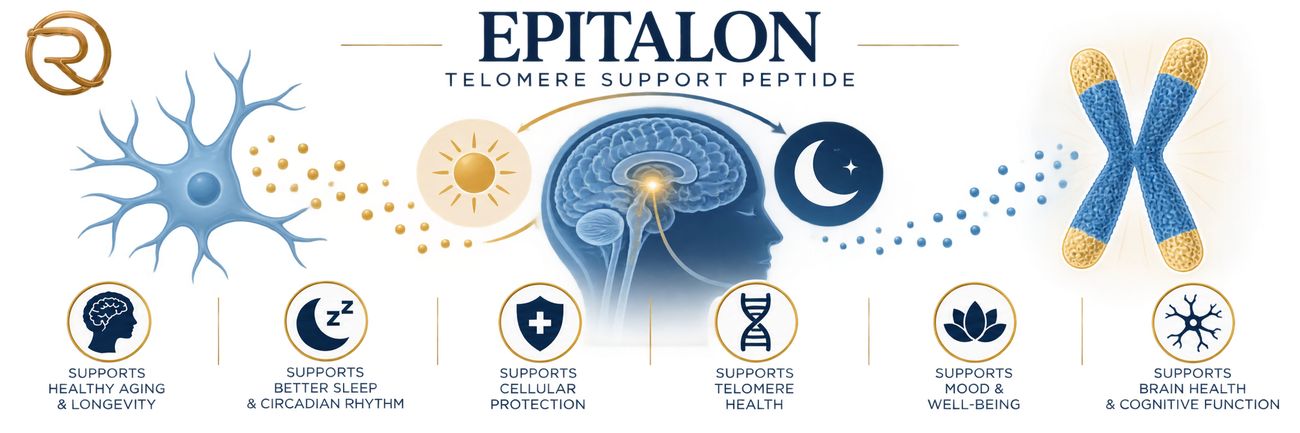
What the studies actually found
In telomerase-negative human fetal fibroblasts, adding Epitalon induced expression of the telomerase catalytic subunit, restored measurable telomerase activity, and elongated the cells' telomeres — the foundational finding behind everything else researchers have investigated since.
READ THE RESEARCH →Human fetal lung fibroblasts normally stop dividing after a fixed number of passages — the "Hayflick limit." Cells treated with Epitalon kept dividing well beyond that point, with telomeres restored to a length comparable to their early, youthful passages.
READ THE RESEARCH →In patients with retinitis pigmentosa — a hereditary, progressive retinal disease — Epitalon treatment produced a positive clinical effect in 90% of cases, with animal data suggesting the peptide helps preserve the retina's structure and electrical activity.
READ THE RESEARCH →Treatment didn't raise the average lifespan across the whole group — an honest result worth stating plainly — but the longest-lived 10% of treated mice lived 13.3% longer, maximum lifespan rose 12.3%, and researchers recorded a marked drop in leukemia incidence.
READ THE RESEARCH →Most peptides work by binding a receptor on the outside of a cell. Epitalon's proposed activity reaches into the nucleus itself — interacting with chromatin and gene expression machinery tied to the telomerase gene.
EXPLORE THE SCIENCE →Epitalon — Overview
What Is Epitalon?
Epitalon is a small synthetic peptide made from four amino acids — alanine, glutamic acid, aspartic acid, and glycine — arranged as Ala-Glu-Asp-Gly (AEDG), classifying it as a tetrapeptide. What makes Epitalon unusual isn’t its size, but the biological question that led scientists to develop it: it emerged from decades of research into the pineal gland, a small brain structure best known for producing melatonin, the hormone helping coordinate sleep-wake and other circadian rhythms. Researchers studying how the pineal gland changes with age became interested in whether small peptide signals produced by the gland might help regulate biological functions that deteriorate over time — so the story of Epitalon begins not with a synthetic molecule, but with an attempt to understand aging itself.
Epitalon was developed as a synthetic representation of a biologically active sequence associated with Epithalamin, a peptide-containing preparation derived from the pineal gland. The distinction matters: Epithalamin was a complex biological extract, while Epitalon is a defined, four-amino-acid molecule that can be produced in a controlled, reproducible form.
That simplicity is part of what makes Epitalon scientifically interesting — a four-amino-acid molecule has been investigated for effects on pineal function, circadian biology, cellular aging, telomere maintenance, gene expression, oxidative stress, and tissue responses. Not all of these findings are equally well demonstrated, and much of the evidence remains preclinical or comes from relatively small human studies, but the breadth raises a larger question: can very small biological signals influence some of the regulatory systems that change as organisms age? That question continues to drive Epitalon research (the full history is on the Research page).
Scientific Discovery & Development
Epitalon’s scientific history is closely connected to Vladimir Khavinson and colleagues in Russia, particularly researchers at the St. Petersburg Institute of Bioregulation and Gerontology. Beginning in the Soviet-era gerontology research tradition, Khavinson and collaborators investigated peptide preparations from animal tissues as potential regulators of age-related biological change, with the pineal gland as an important early focus given its known connection to melatonin production and biological timing.
The research program initially centered on Epithalamin, a complex pineal peptide preparation; over years of investigation, researchers attempted to identify smaller peptide sequences accounting for some of that preparation’s biological activity, eventually leading to the synthetic tetrapeptide now known as Epitalon. This transition mattered scientifically as much as practically — a tissue-derived extract contains many molecular components, making it hard to determine which are responsible for a given effect, while a defined tetrapeptide like AEDG offers a much cleaner experimental system to study, reproduce, and test consistently.
By the 1990s, research on Epithalamin had already accumulated substantial history in experimental gerontology and oncology — a 1994 review by Vladimir Anisimov, Vladimir Khavinson, and V. G. Morozov summarized two decades of work on pineal peptide preparations in aging and cancer research. The next major chapter came in the early 2000s: in 2003, Khavinson, Igor Bondarev, and Alexander Butyugov reported that Epithalon increased expression of telomerase’s catalytic component, increased measurable telomerase activity, and was associated with telomere elongation in cultured human fetal fibroblasts.¹ That finding became one of the central observations behind modern interest in Epitalon and cellular aging. The research trajectory evolved from pineal gland biology → peptide extracts → identification of smaller peptide signals → synthetic Epitalon → cellular aging research, which explains why Epitalon today sits at the intersection of pineal biology and longevity research.
Why Researchers Are Studying Epitalon
Researchers are interested in Epitalon because it potentially connects several biological processes that normally appear as separate areas of aging research: the decline in pineal function and circadian regulation with age, progressive changes in cellular replicative capacity (telomeres and telomerase), and additional effects on oxidative stress, immune signaling, gene expression, and tissue-specific responses. The underlying idea isn’t simply that Epitalon might “slow aging” — it’s more specific: scientists are asking whether a small regulatory peptide can influence biological systems that become less stable or efficient with age.
That makes Epitalon particularly interesting as a gerontology research tool — rather than targeting a single symptom, researchers have explored whether modifying one regulatory system could influence several interconnected processes, including cellular senescence and telomere biology, pineal melatonin production, circadian regulation, oxidative stress, immune function, neuroendocrine signaling, and age-related tissue change. The evidence isn’t uniform: some of the most intriguing findings come from cells and animal models, while human research has generally been smaller and less definitive — an observation in cell culture doesn’t establish the same effect throughout a human body. Epitalon’s scientific interest lies partly in that gap between mechanistic possibility and clinical proof.
Biological Foundation
Deep within the brain, the pineal gland responds indirectly to the light-dark cycle and produces melatonin, whose secretion normally rises during darkness to help coordinate circadian timing. Circadian rhythms extend far beyond sleep — biological clocks influence hormone secretion, metabolism, immune activity, gene expression, body temperature, and more. As organisms age these rhythms can become less robust, and researchers have investigated whether deteriorating pineal signaling contributes to broader age-related change. Epitalon entered this picture because researchers observed effects associated with pineal peptide preparations and asked whether defined peptide signals could reproduce some of them.
A second major area is telomere biology. Telomeres are protective DNA-protein structures at chromosome ends that shorten progressively as many cell types divide; telomerase, an enzyme capable of maintaining or extending telomere DNA, is active in certain cell types but largely suppressed in most ordinary human somatic cells — creating a fundamental tension between the need for cells to divide and their chromosome ends’ limited replicative capacity. The 2003 Epithalon study raised the possibility that this system could be influenced experimentally: in cultured human fibroblasts, Epithalon was associated with increased telomerase activity and telomere elongation. That doesn’t mean Epitalon has been shown to reverse human aging — it means researchers identified a measurable cellular phenomenon giving new reason to investigate the peptide. A 2025 study examining Epitalon in human cell lines added another layer, reporting increased telomere length in both normal and cancer-derived cells, with different cellular systems appearing to involve either telomerase upregulation or alternative lengthening of telomeres (ALT).² (Note: a correction was subsequently published for this 2025 study — see Research for details before citing its specific figures.)
What Researchers Are Investigating
Pineal function and circadian biology — a human study summarized in a 2025 review examined 75 women receiving Epitalon for 20 days and reported changes in urinary 6-sulfatoxymelatonin (a marker used to estimate melatonin production) alongside changes in expression of several circadian-related genes, interpreted as evidence Epitalon could influence pineal and circadian regulation. This matters because circadian regulation isn’t an isolated sleep mechanism — it coordinates timing across multiple biological systems.
Cellular aging and telomere biology — the original 2003 study suggested Epitalon could stimulate telomerase activity and increase telomere length in cultured somatic cells; the 2025 study revisited the question in different human cell lines, finding telomere-length increases and investigating both telomerase-dependent and ALT-associated pathways. This doesn’t establish that Epitalon extends human lifespan — it provides evidence the peptide can alter cellular processes associated with chromosome-end maintenance under experimental conditions.
Neuroendocrine and immune regulation — studies summarized in recent reviews report effects on immune-cell activity, interleukin-related gene expression, enzyme activity, and other cellular-function markers, contributing to the hypothesis that pineal peptides may function as biological regulators rather than through one narrowly defined pathway. Whether these laboratory observations translate into meaningful physiological effects in humans remains an open question.
Aging and longevity — animal and cellular studies report findings on lifespan, tumor development, oxidative stress, cellular proliferation, and age-associated molecular changes, leading researchers to describe Epitalon as a potential “geroprotective” peptide — an intervention being investigated for its ability to protect against or modify aging-associated processes. That term shouldn’t be confused with proof of anti-aging efficacy in humans; the strongest scientific rationale currently comes from Epitalon’s ability to influence measurable processes in experimental systems, and whether those effects produce meaningful improvements in human healthspan or lifespan remains unresolved.
Potential Significance
Epitalon’s potential significance comes from the convergence of several research findings rather than one established clinical effect. If a peptide can influence pineal signaling, circadian regulation, cellular telomere maintenance, and other age-associated pathways, it raises the possibility these systems are more biologically interconnected than conventional research often treats them — improved circadian signaling could influence hormonal and cellular timing, changes in cellular stress responses could affect tissue maintenance, and telomere-biology changes could influence certain cells’ replicative capacity. These relationships remain areas of investigation rather than established therapeutic pathways. A 2025 review concluded that Epitalon has been investigated extensively through in vitro, in vivo, and computational approaches, while emphasizing that important questions remain about its precise molecular mechanisms and structure-function relationships.³ This makes Epitalon scientifically intriguing beyond the peptide itself: it offers a way to examine whether relatively small regulatory signals can influence several interconnected features of biological aging.
Current Research Stage & Future Outlook
Epitalon remains an investigational peptide rather than an FDA-approved therapy in the United States. Its research history is unusual — studied for decades, particularly in Russia and Eastern Europe, but the evidence is uneven and concentrated within a relatively small research tradition; large, modern, independently replicated clinical trials establishing efficacy for longevity or broad anti-aging use are lacking.
In 2026, Epitalon also became part of a US regulatory discussion: the FDA’s Pharmacy Compounding Advisory Committee reviewed Epitalon-related substances for possible inclusion on the 503A Bulks List, in connection with insomnia, at its July 2026 meeting. FDA staff’s briefing materials had proposed against including Epitalon on the list, citing limited safety information for the proposed route and concerns about peptide aggregation and impurities — but the committee’s actual vote went the other way: reporting on the meeting indicates the panel backed Epitalon for inclusion, despite the agency’s own recommendation against it.⁴ (This detail should be verified against the FDA’s own final meeting summary before publishing, since it’s a recent and consequential correction to the “proposed not to include” framing.) Either way, a committee recommendation isn’t FDA approval — advisory committees provide non-binding recommendations, and the FDA retains final regulatory authority. This distinction matters particularly for Epitalon because public interest in the peptide has grown faster than the clinical evidence. The future of Epitalon research depends on answering several fundamental questions: which biological effects are reproducible, which mechanisms are responsible, whether they translate from cells and animals to humans, and whether controlled clinical trials can demonstrate meaningful health outcomes.
Global Research Perspective
Epitalon’s scientific history is strongly rooted in Russia, particularly the research programs associated with Vladimir Khavinson and the St. Petersburg Institute of Bioregulation and Gerontology, with early work on pineal peptide preparations in experimental gerontology, oncology, and aging biology. More recent research has expanded beyond that original tradition — studies published in international journals have revisited Epitalon’s effects on telomere biology, cellular aging, melatonin production, circadian regulation, and other systems, and the 2025 independent cell-study work is particularly notable for examining Epitalon in multiple human cell lines, providing additional data for evaluating the earlier telomere findings. The global research picture is evolving from a historically concentrated body of work toward a broader scientific examination — a transition that matters, since independent replication, standardized methods, and well-controlled human research are what will ultimately determine how much of Epitalon’s promise withstands scientific scrutiny.
Why This Matters
Epitalon is scientifically interesting because it sits at the intersection of several fundamental aging-biology questions: how biological timing changes with age, how cells maintain their chromosomes, and how small regulatory signals may influence complex physiological systems. Its history is an unusual scientific progression — from research into the aging pineal gland, to peptide extracts, to a defined four-amino-acid molecule, to modern investigations of cellular aging and molecular regulation. The evidence is promising in some experimental settings but remains incomplete, particularly moving from laboratory findings to human clinical outcomes — and that gap is precisely what makes Epitalon worth studying. The important question is no longer simply whether a four-amino-acid peptide can produce interesting biological effects; it’s whether those effects reveal something fundamental about how aging is regulated, and whether that knowledge can eventually translate into reproducible, clinically meaningful biology.
References
- Khavinson V, Bondarev I, Butyugov A. Epithalon Peptide Induces Telomerase Activity and Telomere Elongation in Human Somatic Cells. Bulletin of Experimental Biology and Medicine. 2003. https://link.springer.com/article/10.1023/A:1025493705728
- Epitalon increases telomere length in human cell lines through telomerase upregulation or ALT activity. 2025 (see Research page for the subsequently published correction). https://pmc.ncbi.nlm.nih.gov/articles/PMC12411320/
- Overview of Epitalon: Highly Bioactive Pineal Tetrapeptide. 2025. https://pubmed.ncbi.nlm.nih.gov/40141333/
- FDA Pharmacy Compounding Advisory Committee meeting, July 2026 — Epitalon review. https://www.fda.gov/media/193774/download ; reporting on the committee’s vote: https://www.statnews.com/2026/07/24/fda-peptide-compounding-panel-backs-epitalon-rejects-emideltide/
Epitalon — The Research
How Was Epitalon Discovered?
Epitalon’s scientific story begins not with the synthetic tetrapeptide itself, but with a broader question in Soviet-era gerontology: could short peptides derived from specific tissues influence the function of those same tissues as organisms age? During the 1970s and 1980s, researchers in the Soviet Union investigated extracts from the pineal gland, the small endocrine organ involved in circadian regulation. One of the principal researchers in this field was Vladimir Khavinson, working at the St. Petersburg Institute of Bioregulation and Gerontology; his research program explored whether small peptide components of tissue extracts could reproduce some of the biological effects of the original preparations.
This work led to Epithalamin, a complex preparation derived from the pineal gland. Researchers then analyzed its amino-acid composition and used that information to design shorter, chemically defined peptides — one of which was the four-amino-acid Ala-Glu-Asp-Gly (AEDG), subsequently known as Epitalon or Epithalon. An important distinction emerged later: Epitalon was originally designed from Epithalamin’s amino-acid composition, and subsequent work reported identification of AEDG within the pineal polypeptide complex itself — a 2017 study from Khavinson and colleagues described this identification, providing additional support for the relationship between the synthetic peptide and the original biological extract. That created the central research question that has followed Epitalon for decades: could a very small peptide reproduce measurable aspects of the biological effects associated with the aging pineal gland?
From Aging to Cellular Biology
Early research concentrated on whole-organism aging; researchers first observed effects in experimental animals and then began asking whether those effects could be connected to specific biological systems. In the late 1990s and early 2000s, studies of Epithalamin and Epitalon examined lifespan, oxidative stress, circadian hormones, reproductive aging, tumor development, and tissue function, conducted primarily in Russia and other parts of Eastern Europe, with collaborations involving institutions in Ukraine, Georgia, and later Italy.
One early milestone was the demonstration that Epitalon could influence lifespan in Drosophila melanogaster — a 2000 study reported an 11–16% increase in lifespan under the experimental conditions used. The finding mattered not because it established a longevity effect in humans, but because it suggested the peptide could influence biological processes associated with aging at extremely low experimental concentrations. The next question was more demanding: would similar effects occur in mammals?
The Most Important Preclinical Studies
Epitalon and aging in mice (2001–2003). Researchers led by Vladimir Anisimov and Vladimir Khavinson studied Epitalon in several mouse models of aging. In a 2003 Biogerontology study, female Swiss-derived SHR mice received repeated Epitalon treatment throughout life. Epitalon did not increase average lifespan in that experiment — an important result that prevents the animal literature from being interpreted as uniformly positive. However, the longest-lived 10% of treated animals lived 13.3% longer, maximum lifespan increased 12.3%, age-related reproductive decline was delayed, and chromosome abnormalities in bone marrow cells decreased; the study also reported a marked reduction in leukemia incidence.¹ The significance is more nuanced than “Epitalon extends lifespan” — the findings suggested Epitalon could influence specific markers and processes associated with aging, while the effect on overall lifespan depended on the experimental model. Other mouse studies produced similar evidence that Epitalon could influence age-related biological changes and tumor development, but these remain animal findings rather than evidence of human longevity.
Circadian biology in senescent monkeys. In a study of aged female rhesus monkeys, researchers examined melatonin and cortisol secretion before and after Epitalon administration. Epitalon increased evening melatonin production and helped normalize the circadian pattern of cortisol secretion.² This research helped shift the scientific discussion toward biological regulation rather than lifespan alone — if aging alters the timing and coordination of endocrine signals, researchers asked whether a pineal-derived peptide could partially restore those patterns. Studies involving older monkeys also reported changes in glucose regulation alongside alterations in melatonin physiology, although these observations remain preclinical.
Telomerase and telomeres (2003). The most influential cellular discovery came from research on human cells: researchers reported that Epitalon induced expression of the catalytic component of telomerase in telomerase-negative human fetal fibroblasts.¹ Telomerase activity increased, and telomeres became longer in the treated cells. This was a significant shift — instead of simply observing changes in lifespan or hormone patterns, scientists now had a potential cellular explanation for some of Epitalon’s reported effects. But the distinction is critical: a telomere effect in cultured cells doesn’t demonstrate that Epitalon extends human lifespan.
Research Findings by Major Biological Area
Cellular aging and telomere biology. Telomere research remains one of the most scientifically interesting areas surrounding Epitalon. The 2003 human-cell study suggested Epitalon could reactivate telomerase-associated processes and increase telomere length in cultured fibroblasts.¹ More than two decades later, a 2025 study from Brunel University London revisited the question using several human cell types, reporting dose-dependent telomere lengthening in normal epithelial and fibroblast cells alongside increased hTERT expression and telomerase activity; it also observed alternative lengthening of telomeres (ALT) in certain breast-cancer cell lines, demonstrating the biological response wasn’t identical across cell types.³ Important correction: a formal correction has since been published for this 2025 study. Its specific figures should not be treated as final until checked against the corrected version, and any material drawn from it elsewhere in this library should be read with that in mind. This is still a scientifically important modern replication of a central observation from the earlier literature — but it remains cellular research. It doesn’t establish that telomeres are lengthened throughout the human body after treatment, or that doing so produces longer healthy lifespan.
Circadian and pineal function. A second research theme concerns melatonin and circadian rhythm. Studies involving aged monkeys and older humans have reported that Epitalon or related pineal peptide preparations can increase nighttime melatonin secretion and influence circadian hormone patterns.² The scientific interest here is less about melatonin as an isolated hormone and more about whether age-related deterioration in circadian signaling can be modulated by short regulatory peptides.
Nervous-system and gene-expression research. Later work has explored whether Epitalon can influence gene expression and protein synthesis in neural models. A 2020 study involving neurogenesis reported changes in gene expression and protein synthesis after exposure to AEDG and proposed a possible epigenetic mechanism; researchers from the St. Petersburg Institute of Bioregulation and Gerontology and the University of G. d’Annunzio in Italy contributed to the work.⁴ These findings broaden the research beyond aging and telomeres, but they remain mechanistic and experimental — they suggest possible biological activity, not a clinical neurological benefit.
Human Research & Clinical Evidence
Human evidence exists, but it’s considerably less developed than the volume of laboratory and animal literature might suggest.
One of the better-known clinical investigations examined retinitis pigmentosa, a hereditary degenerative retinal disorder. Earlier animal work had suggested Epitalon could preserve retinal structure and function, and a 2002 publication from Khavinson and colleagues reported clinical improvement in patients with retinal degeneration, describing positive effects in 90% of cases. A later review of the work reports that the St. Petersburg study included 162 patients aged 18–72, with Epitalon administered around the eye over 10 consecutive days; investigators reported improvements in retinal electrical activity compared with conventional treatment. These results are scientifically interesting but should be interpreted cautiously — the study is old, relatively localized, and doesn’t resemble the large, independently replicated randomized trials normally required to establish a modern drug indication.
There’s also an important distinction between Epitalon and Epithalamin in the human aging literature: several long-term studies examined Epithalamin, the broader pineal peptide preparation, rather than purified Epitalon alone. For example, a 2006 randomized clinical study involving elderly patients with coronary disease reported improvements in measures of cardiovascular aging and exercise tolerance following long-term Epithalamin treatment, and a later 15-year follow-up similarly reported effects on cardiovascular aging, metabolic measures, circadian melatonin production, and mortality. These studies are relevant to the historical scientific story, but shouldn’t be treated as equivalent to modern randomized trials of purified Epitalon — one of the most important distinctions in evaluating the evidence base.
What the Evidence Shows
Stronger evidence. The strongest evidence for Epitalon currently exists at the cellular and preclinical levels. Multiple experiments have reported biological effects involving telomerase activity, telomere length, circadian signaling, oxidative processes, gene expression, and age-related biological markers. The 2025 human-cell study is particularly notable because it revisited telomere biology using modern laboratory techniques (subject to the correction noted above).³
Emerging evidence. Human research provides intriguing signals, particularly in retinal disease and pineal/circadian physiology, but the clinical literature is comparatively limited and concentrated in older Russian and Eastern European research programs.
Early or experimental evidence. Claims that Epitalon can substantially extend human lifespan, reverse biological aging, or prevent age-related disease remain unproven. Animal lifespan findings can’t be directly translated into human longevity outcomes, and cellular telomere changes aren’t themselves evidence of longer human life. A 2025 scientific review of Epitalon reaches a similar overall conclusion: the peptide has accumulated a substantial body of biological research, but important questions remain about its precise mechanisms, structure, pharmacology, and clinical significance.⁵
Current Research Stage
Epitalon remains investigational and is not FDA approved for any medical indication. The regulatory picture became particularly relevant in 2026: the FDA’s Pharmacy Compounding Advisory Committee reviewed Epitalon and Epitalon acetate in July 2026 in connection with possible inclusion on the federal 503A bulk-drug list, specifically considering insomnia as the proposed use. The FDA staff’s briefing materials proposed against including Epitalon free base or Epitalon acetate on the 503A list, citing a lack of adequate safety information for the proposed route of administration and concerns about peptide aggregation and impurities.⁶
This framing needs an update. The FDA staff’s proposal is not the same as the committee’s outcome, and reporting on the meeting indicates the advisory committee’s actual vote went the other way — the panel reportedly backed Epitalon for inclusion, contrary to the FDA staff’s own recommendation. That reported vote should be confirmed against the FDA’s official post-meeting summary before this page is published, since it materially changes the regulatory narrative from “the FDA proposed leaving Epitalon off the list” to “FDA staff recommended against it, but the advisory committee disagreed.” Either way, this regulatory review is not FDA approval — advisory committee recommendations are non-binding, and FDA states that it retains final regulatory authority. Epitalon is not an FDA-approved longevity, anti-aging, sleep, or other therapeutic drug.
What Researchers Are Studying Now
Modern Epitalon research increasingly focuses on questions testable at the molecular level. One direction is telomere biology — determining whether Epitalon’s effects on hTERT, telomerase, and telomere maintenance can be reproduced consistently across different normal human cell types and experimental conditions. Another is gene regulation: whether the peptide influences transcription, chromatin organization, and cellular protein synthesis in ways that could explain some of its broader biological effects. A third is the relationship between aging, circadian regulation, and pineal biology — the historical animal and human observations provide a foundation, but modern research needs to determine whether these effects are reproducible and clinically meaningful. The central challenge is no longer simply demonstrating that Epitalon can produce a biological effect; it’s determining which effects are reproducible, through which pathways, in which tissues, and whether any translate into meaningful human outcomes.
Future Scientific Potential
Epitalon’s scientific appeal comes from the unusual breadth of its research history — a four-amino-acid peptide investigated in contexts ranging from circadian regulation and retinal biology to telomerase, chromatin, oxidative stress, and experimental longevity. The most compelling future question isn’t whether Epitalon is a universal anti-aging molecule (current evidence doesn’t establish that), but whether specific, reproducible biological effects can be translated into well-controlled human research. The field has already moved from broad observations about aging toward increasingly precise questions about cellular regulation — the 2025 telomere study illustrates that progression particularly well. The next meaningful advance will require larger, independently conducted human studies capable of separating intriguing biological activity from clinically important benefit.
Why This Matters
Epitalon’s research history is unusual because it spans several generations of scientific questions. Early investigators asked whether pineal peptides could influence aging; animal studies then suggested effects on lifespan, circadian biology, tissue function, and age-related changes; cellular research subsequently identified possible effects on telomerase, telomeres, chromatin, and gene expression; and more recent laboratory work has revisited some of these observations with modern molecular techniques. The evidence therefore supports a clear conclusion, but not an exaggerated one: Epitalon is biologically active in experimental systems, and some of its effects have been observed in human research, but its potential for meaningful human longevity or disease modification has not yet been established by the level of large, independent clinical evidence expected for an approved therapy. That gap between intriguing biology and definitive clinical evidence is precisely what makes Epitalon an interesting subject for continued scientific investigation.
References
- Khavinson V, Bondarev I, Butyugov A. Epithalon Peptide Induces Telomerase Activity and Telomere Elongation in Human Somatic Cells. Bulletin of Experimental Biology and Medicine. 2003. https://pubmed.ncbi.nlm.nih.gov/12937682/
- Anisimov VN, Khavinson VK, et al. Effect of Epitalon on nighttime melatonin and glucose/insulin regulation in aged rhesus monkeys. https://pubmed.ncbi.nlm.nih.gov/15664732/
- Epitalon increases telomere length in human cell lines through telomerase upregulation or ALT activity. Brunel University London, 2025 — see correction, PMID 41240216. https://pubmed.ncbi.nlm.nih.gov/40908429/
- AEDG Peptide (Epitalon) Stimulates Gene Expression and Protein Synthesis during Neurogenesis. 2020. https://pubmed.ncbi.nlm.nih.gov/32019204/
- Overview of Epitalon: Highly Bioactive Pineal Tetrapeptide. 2025. https://pubmed.ncbi.nlm.nih.gov/40141333/
- FDA Briefing Document, Pharmacy Compounding Advisory Committee (PCAC) Meeting, July 2026 — Epitalon review. https://www.fda.gov/media/193774/download ; reporting on the committee’s vote: https://www.statnews.com/2026/07/24/fda-peptide-compounding-panel-backs-epitalon-rejects-emideltide/
Epitalon — The Science
Epitalon (also called Epithalon or Epithalone) is a synthetic tetrapeptide composed of four amino acids: Ala-Glu-Asp-Gly (AEDG). Unlike peptides whose mechanism is defined by a single high-affinity receptor, Epitalon presents an unusual pharmacological problem — no definitive classical receptor has been established as its primary target.¹ Current evidence instead points toward a distributed mechanism involving gene regulation, chromatin-associated processes, telomerase activity, pineal endocrine signaling, and cellular redox regulation. Epitalon shouldn’t be described as a conventional receptor agonist or antagonist; its proposed biology is better understood as a short-peptide signal capable of influencing intracellular regulatory machinery, with several downstream effects that may converge on cellular maintenance and age-associated changes in gene expression.
1. The Biological Architecture
The biological system most closely associated with Epitalon is the pineal neuroendocrine system. The pineal gland receives light–dark cycle information through retinal neural pathways and regulates production of melatonin, a hormone that helps coordinate circadian timing and also participates in cellular redox and stress responses. Pineal function changes with age, including alterations in the nighttime melatonin rhythm, and experimental work with Epitalon and related pineal peptides suggests it can influence this system — although the precise molecular route remains unresolved.²
The proposed architecture: Epitalon → cellular regulatory machinery → gene/protein expression and pineal signaling → cellular and tissue responses. This differs fundamentally from peptides such as GLP-1 receptor agonists, where the initiating receptor and intracellular signaling cascade are comparatively well characterized. For Epitalon, the initiating molecular event remains an active area of investigation.
2. Molecular Mechanism of Action
The strongest mechanistic evidence places Epitalon at the intersection of gene regulation and cellular maintenance. An important early observation came from human fetal fibroblasts: Khavinson, Bondarev, and Butyugov reported that Epitalon induced expression of the catalytic component of telomerase, increased telomerase activity, and was associated with telomere elongation.¹ Telomerase is an enzyme complex that maintains chromosome ends (telomeres); its catalytic protein is encoded by TERT (telomerase reverse transcriptase). When telomerase activity increases, the cell gains greater capacity to maintain telomeric DNA during replication.
Proposed sequence: Epitalon exposure → increase in TERT expression/telomerase activity → greater telomere maintenance → changes in cellular replicative capacity and chromosome-end stability. This is not yet a completely mapped receptor-to-gene pathway. A 2025 human-cell study provides newer evidence that Epitalon can produce dose-dependent telomere extension in normal epithelial and fibroblast cells, with increased hTERT expression and telomerase activity.³ Interestingly, the same study observed telomere extension through alternative lengthening of telomeres (ALT) in certain cancer cell lines — reinforcing why Epitalon’s mechanism shouldn’t be reduced to “it activates telomerase,” since different cell types may respond through different telomere-maintenance systems. (A correction has since been published for this study — see the Research page — and its specific figures should be checked against the corrected version before being cited elsewhere.)
3. Receptor Biology & Intracellular Signaling
A conventional receptor hasn’t been definitively identified for Epitalon, so there is currently insufficient evidence to describe it as a selective agonist of a particular GPCR, kinase receptor, nuclear receptor, or ion channel. Instead, one proposed mechanism involves direct interaction with nuclear proteins associated with chromatin — the DNA–protein complex that determines how accessible genes are to transcriptional machinery. In a 2020 study using human gingival mesenchymal stem cells, molecular modeling suggested AEDG could interact with histone H1 variants (specifically H1/3 and H1/6) at regions involved in DNA interaction; Epitalon treatment was associated with increased expression of neurogenic differentiation markers including Nestin, GAP43, β-tubulin III, and Doublecortin.⁴
Proposed sequence: AEDG → interaction with chromatin-associated proteins → altered chromatin accessibility → altered transcription → altered protein production → cellular phenotype. This mechanism is proposed rather than established — molecular docking and gene-expression changes demonstrate plausibility but don’t prove histone binding is the dominant mechanism operating throughout the body. Earlier work in lymphocytes from older individuals also reported changes in heterochromatin organization and activation of previously repressed genes following Epitalon exposure. Together, these findings support a broader model in which Epitalon may influence transcriptional state rather than functioning primarily through a conventional surface receptor.
4. Pineal Signaling, Melatonin & Redox Biology
A second mechanistic axis involves the pineal gland and melatonin. Experimental studies report that Epitalon can increase nighttime melatonin levels and help normalize age-associated alterations in melatonin rhythms. In older rhesus monkeys, Epitalon was associated with increased nighttime melatonin and changes in glucose and insulin dynamics, whereas comparable effects weren’t observed in young animals² — suggesting Epitalon’s effects may be state-dependent, with the biological response differing according to the pre-existing functional condition of the system.
Melatonin itself is both a circadian signal and an important component of cellular antioxidant defense; separate experimental work with Epitalon has reported changes in antioxidant defenses, including activity or expression of enzymes involved in managing reactive oxygen species. A plausible biological chain: Epitalon → altered pineal signaling → altered melatonin production → circadian/redox signaling → downstream cellular effects. Again, the precise initiating molecular interaction remains unresolved.
5. Pharmacology: What Makes Epitalon Different?
Epitalon’s pharmacology is unusual because its molecular target, receptor affinity, potency, and receptor selectivity haven’t been established to the standard expected for an approved receptor-directed drug. There is evidence of activity in biochemical systems — one study found that Epitalon inhibited enkephalin-degrading enzymes in vitro, with an IC50 of approximately 500 μM, and examined interactions with opioid receptors, though this doesn’t establish Epitalon as a clinically relevant opioid-receptor ligand. This distinction matters because an in-vitro concentration producing an enzymatic effect isn’t equivalent to a therapeutic concentration in humans. Current literature also doesn’t provide a validated human pharmacokinetic profile defining Epitalon’s absorption, distribution, metabolic clearance, bioavailability, or plasma half-life — so precise exposure-response relationships can’t currently be established with the confidence possible for approved peptide medicines.
6. Dose, Exposure & Dose-Response
Epitalon research contains experimental concentrations and dosing regimens, but these shouldn’t be converted into an established human dosing protocol. The 2025 cellular evidence is useful mechanistically because it demonstrates a concentration-dependent response: normal human cell models showed increasing telomere length associated with Epitalon exposure, while different cell types displayed different telomere-maintenance behavior.³ That supports the basic pharmacodynamic relationship concentration → molecular response → cellular response, but it can’t yet be translated into human dose → plasma exposure → receptor occupancy → predictable clinical outcome, because the intermediate pharmacokinetic parameters haven’t been adequately characterized. This is one of the most important limitations in understanding Epitalon’s pharmacology.
7. Lower vs. Higher Exposure
The available evidence suggests Epitalon’s response can be concentration-dependent, but there isn’t enough human pharmacology to establish a clinically meaningful “low,” “moderate,” and “high” exposure hierarchy. At the cellular level, increasing concentrations have produced stronger changes in some measured endpoints, including the 2025 study’s dose-dependent telomere effects.³ But biological systems aren’t necessarily linear — gene transcription, enzyme activity, chromatin accessibility, and telomere-maintenance pathways can all become saturable or context-dependent, so higher exposure doesn’t automatically mean greater biological benefit. The appropriate scientific interpretation is that Epitalon demonstrates measurable exposure-dependent biological activity in experimental systems, while the shape and limits of the human dose-response curve remain incompletely defined.
8. Does Body Weight Affect Dose?
There is currently no established evidence that Epitalon requires weight-based dosing in humans or that body weight reliably predicts Epitalon exposure, clearance, distribution volume, or pharmacodynamic response. Without human pharmacokinetic data demonstrating such a relationship, weight-based dosing shouldn’t be presented as scientifically established.
9. Connecting Molecular Mechanisms to Human Physiology
The most useful way to understand Epitalon’s proposed biology is as several interacting layers rather than one pathway:
Molecular level — AEDG may interact with nuclear and chromatin-associated machinery and influence gene expression.⁴ Cellular level — changes in transcription may alter production of proteins involved in differentiation, antioxidant defense, and cellular maintenance. Genome-maintenance level — Epitalon has been associated with increased TERT expression, telomerase activity, and telomere extension in human cell models.¹ Endocrine level — Epitalon may influence pineal function and nighttime melatonin production, particularly in older experimental subjects.² Physiological level — changes in circadian signaling, cellular stress responses, gene expression, and genome maintenance could theoretically contribute to broader changes in tissue function.
The critical scientific point: the final physiological effects can’t yet be attributed to one molecular pathway. Current evidence supports a multi-pathway model.
10. Combination & Pathway Interaction
Epitalon’s proposed mechanisms intersect with several endogenous systems — melatonin signaling, oxidative-stress regulation, transcriptional control, and telomere biology — that are themselves interconnected: circadian signaling influences cellular metabolism and redox state, oxidative stress can affect DNA and cellular senescence, and chromatin state influences which genes are available for transcription. This creates the possibility that a relatively small peptide could produce effects across multiple biological levels without acting through a single dominant receptor. However, evidence is currently insufficient to establish clinically meaningful receptor competition, drug–peptide interactions, or validated “stacking” effects involving Epitalon; such combinations should remain a research question rather than a mechanistic assumption.
11. What Scientists Still Do Not Fully Understand
The largest unanswered question is how Epitalon initiates its biological effects. Researchers have identified downstream phenomena — altered gene expression, telomerase activity, telomere length, chromatin organization, melatonin regulation, and antioxidant responses — but the field hasn’t yet established a single molecular target connecting these observations into one definitive signaling pathway.⁵ Several questions remain particularly important: whether Epitalon’s effects arise primarily from a specific intracellular binding interaction, several molecular targets, or a combination of direct and indirect effects; how Epitalon reaches and behaves within different tissues after systemic administration; whether the 2025 finding that different cell types can use different telomere-maintenance mechanisms means Epitalon produces tissue-specific molecular responses in vivo;³ and, finally, whether extending telomeres, altering gene expression, or changing cellular differentiation is equivalent to producing healthy longevity in humans — a mechanistic bridge that remains incompletely defined.
Why This Matters
Epitalon’s scientific significance lies less in a single receptor and more in the possibility that a very small peptide can influence multiple layers of cellular regulation. The emerging model: Epitalon → intracellular/chromatin-associated regulation → gene-expression changes → altered protein production and cellular behavior → telomerase, telomere, redox and neuroendocrine effects → changes in tissue-level physiology. The strongest mechanistic evidence currently centers on gene regulation, telomerase/telomere biology, and pineal-melatonin signaling, while the precise initiating target remains unresolved. Recent human-cell research strengthens the telomere mechanism but also demonstrates why Epitalon’s biology can’t be reduced to a single pathway.³ Understanding that distinction is essential — Epitalon is scientifically interesting precisely because its biology appears broader, and more complex, than a conventional receptor-targeted peptide.
References
- Khavinson V, Bondarev I, Butyugov A. Epithalon Peptide Induces Telomerase Activity and Telomere Elongation in Human Somatic Cells. Bulletin of Experimental Biology and Medicine. 2003. https://pubmed.ncbi.nlm.nih.gov/12937682/
- Anisimov VN, Khavinson VK, et al. Effect of Epitalon on nighttime melatonin and glucose/insulin regulation in aged rhesus monkeys. https://pubmed.ncbi.nlm.nih.gov/15664732/
- Epitalon increases telomere length in human cell lines through telomerase upregulation or ALT activity. 2025 (see the Research page for the subsequently published correction). https://pubmed.ncbi.nlm.nih.gov/40908429/
- AEDG Peptide (Epitalon) Stimulates Gene Expression and Protein Synthesis during Neurogenesis. 2020. https://pubmed.ncbi.nlm.nih.gov/32019204/
- Overview of Epitalon: Highly Bioactive Pineal Tetrapeptide. 2025. https://pubmed.ncbi.nlm.nih.gov/40141333/