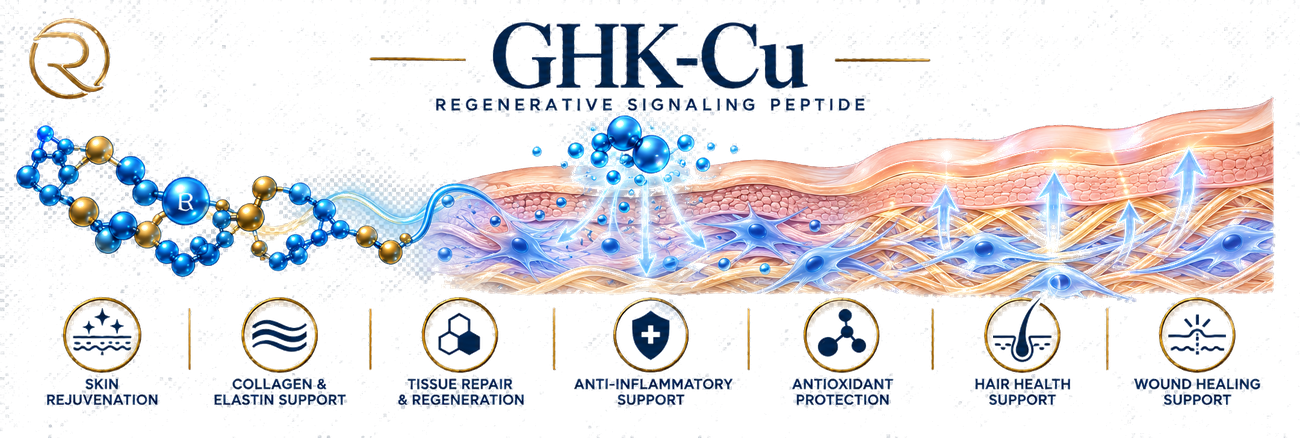
What the studies actually found
In a multicenter, randomized, placebo-controlled study of diabetic patients, topical GHK-Cu gel more than tripled the infection-free rate compared with vehicle gel — infection fell from 34% to just 7%.
READ THE RESEARCH →A landmark 1993 study moved GHK-Cu out of cell culture and into living tissue: injected into experimental wounds, it produced collagen stimulation twice that of every other protein being made in the wound at the same time.
READ THE RESEARCH →A genomic review found GHK-Cu capable of up- and down-regulating at least 4,000 genes — described by the researchers as essentially resetting DNA activity toward a healthier, younger pattern.
READ THE RESEARCH →A Phase 2, randomized, double-blind, vehicle-controlled trial ("CuHeal") is actively recruiting to test whether topical GHK-Cu gel speeds re-epithelialization of standardized skin wounds — exactly the kind of rigorous, modern human data this molecule has been missing.
READ THE RESEARCH →Researchers are investigating how GHK-Cu balances construction and breakdown simultaneously — upregulating the enzymes that clear damaged collagen while also driving new collagen, elastin and glycosaminoglycan synthesis.
EXPLORE THE SCIENCE →GHK-Cu — Overview
What Is GHK-Cu?
GHK-Cu is a naturally occurring copper-binding peptide with an unusually long scientific history. Its name comes from glycyl-L-histidyl-L-lysine (GHK), a three-amino-acid peptide that can bind copper ions, particularly copper(II); when GHK is associated with copper, the resulting complex is commonly called GHK-Cu, or copper tripeptide. In cosmetic ingredient nomenclature it’s also known as Copper Tripeptide-1 or prezatide copper. The FDA’s substance database recognizes prezatide copper as the copper complex of GHK, but inclusion in an FDA chemical database doesn’t mean a substance has been reviewed or approved as a drug.
What makes GHK-Cu distinctive is that it isn’t simply a synthetic molecule designed to imitate something found in the body — GHK itself is an endogenous peptide, occurring naturally in human biological fluids and tissues. Its ability to bind copper adds a second layer of biological importance, since copper is an essential trace element involved in numerous enzymes and cellular processes.
The peptide is exceptionally small, but its biological story is much larger than its size suggests. Over more than five decades of research, scientists have investigated GHK-Cu in connection with extracellular-matrix remodeling, collagen production, wound repair, inflammation, vascular biology, and skin biology. Some of these findings come from cell and animal research, while a smaller body of human research has explored topical and wound-healing applications — the breadth of these observations is one reason GHK-Cu remains scientifically interesting today. It should therefore be understood less as a conventional “anti-aging peptide” and more as a biological signaling and tissue-remodeling molecule whose effects are being studied across several interconnected systems.
Scientific Discovery & Development
GHK-Cu’s story began in the early 1970s with a question about aging biology. Biochemist Loren Pickart was investigating why liver tissue from older individuals behaved differently from younger tissue, and an important observation emerged when older liver cells were exposed to plasma from younger individuals: aspects of their protein-producing behavior shifted toward patterns associated with younger tissue. Researchers began searching the plasma for the small biological factor responsible.
In 1973, Pickart and M. M. Thaler reported a small growth-modulating tripeptide activity in human serum that prolonged survival of normal liver cells and stimulated growth in neoplastic liver — the peptide, glycyl-L-histidyl-L-lysine (GHK), and its strong affinity for copper became the foundation for everything that followed.¹ The copper connection became particularly important: GHK was found to associate readily with copper, and researchers began studying the copper-bound form as a biologically active complex rather than viewing copper as a passive attachment. In 1980, Pickart, Freedman, and Loker proposed that the peptide could facilitate copper uptake into cells, helping connect the peptide’s biological activity with copper biology.²
The scientific story then moved from observation to tissue biology. By the 1980s, researchers were investigating GHK-Cu in relation to wound repair and extracellular-matrix formation. In 1988, a study led by François-Xavier Maquart, with Pickart among the authors, reported that GHK-Cu stimulated collagen synthesis in cultured fibroblasts — the cells responsible for producing much of connective tissue’s structural framework — with the response occurring at very low concentrations, helping establish a scientific rationale for tissue-repair research.³ Research in the 1990s extended these observations into animal models, where GHK-Cu increased connective-tissue accumulation and collagen-related activity in experimental wounds. Human research subsequently explored applications including chronic wound healing and topical skin recovery, while dermatology and cosmetic science began examining its potential role in skin remodeling.
This progression matters because GHK-Cu didn’t become interesting simply because it was marketed as a cosmetic ingredient — its modern popularity grew from a much older scientific question: can a naturally occurring peptide help coordinate the biological processes involved in repairing and remodeling tissue?
Why Researchers Are Studying GHK-Cu
The central scientific interest in GHK-Cu comes from its apparent connection to tissue remodeling — the continual process through which the body breaks down damaged structures, builds new ones, reorganizes extracellular material, and restores tissue function. This is particularly relevant to skin, where structural proteins are constantly produced and reorganized: collagen provides much of the tissue’s mechanical framework, while other extracellular-matrix components influence elasticity, hydration, cell attachment, and cell-to-cell communication.
Researchers became interested in GHK-Cu because experimental studies suggested the peptide could influence several parts of this process rather than acting on only one isolated target — studies have examined collagen synthesis, extracellular-matrix components, wound closure, vascular responses, and inflammatory processes. That broad activity is scientifically intriguing, since tissue repair isn’t controlled by a single pathway; it requires communication between structural cells, immune cells, blood vessels, signaling molecules, and the extracellular environment. GHK-Cu is therefore being investigated as a possible coordinator of several biological processes involved in tissue maintenance and repair, rather than simply as a molecule that “boosts collagen.”
Biological Foundation
To understand why GHK-Cu attracts this attention, it helps to think about copper and peptides as two parts of the same biological system. Copper is an essential micronutrient the body uses as a component of enzymes involved in processes ranging from connective-tissue formation to antioxidant defense and cellular energy metabolism — but free metal ions can also participate in unwanted chemical reactions, so biology relies heavily on proteins and peptides that bind and transport metals in controlled ways. GHK has a particularly strong affinity for copper, and when the two associate, GHK-Cu creates a compact molecular complex capable of participating in biological interactions different from those of the free peptide or free copper alone. Research has consequently examined whether GHK functions partly as a copper-binding or copper-delivery molecule while also exerting signaling effects of its own.
The tissue-repair connection provides another important piece: when tissue is injured, the surrounding environment changes dramatically — proteins are broken down and rebuilt, immune activity increases, blood vessels respond, and fibroblasts begin reorganizing the extracellular matrix. Research has identified GHK-related sequences within larger proteins and explored how GHK-Cu may participate in this changing environment, giving the peptide a particularly interesting biological context: it’s associated with systems that become highly active when tissue needs to be remodeled. The detailed receptors, signaling pathways, gene-expression effects, copper chemistry, and cellular mechanisms behind these observations are explored on the Science page.
What Researchers Are Investigating
Skin and connective-tissue biology — fibroblasts produce collagen and other extracellular-matrix components, and studies have found that GHK-Cu can influence collagen synthesis and the expression of matrix-related molecules, making the peptide relevant to research into skin structure, elasticity, wound repair, and tissue remodeling.
Wound healing — healing requires a carefully timed sequence of inflammation, tissue formation, vascular response, and remodeling. Experimental studies in animals have reported increased connective-tissue accumulation and collagen-related activity following GHK-Cu exposure. Human research has also explored copper-tripeptide preparations in chronic wound settings, including a multicenter study of diabetic neuropathic ulcers that reported greater wound closure with the GHK-Cu preparation than vehicle under a standardized wound-care program.⁴
Skin recovery and dermatology — GHK-Cu has been investigated in topical formulations and in models of damaged or resurfaced skin, with mixed results. One small randomized study following CO₂ laser resurfacing found no significant difference in objective measures of erythema or wrinkle improvement, although participants using the GHK-Cu regimen reported greater satisfaction with overall skin quality.⁵
Inflammation and cellular protection — laboratory and preclinical research suggests GHK-Cu can influence inflammatory and oxidative processes, while its copper-binding properties have prompted investigation into its relationship with copper-dependent cellular functions. These findings are scientifically relevant because inflammation, oxidative stress, extracellular-matrix remodeling, and tissue repair are interconnected rather than independent biological events.
Controlled modern human wound research — a Phase 2 randomized, double-blind, vehicle-controlled clinical trial (NCT07437586) beginning in 2026 is evaluating topical GHK-Cu gel in standardized acute skin wounds in healthy adults, designed to examine re-epithelialization, wound-area reduction, scar quality, and safety — a more rigorous test of whether laboratory and earlier clinical observations translate into measurable human outcomes.⁶
Potential Benefits & Biological Significance
GHK-Cu’s potential significance lies less in any single claimed benefit than in the possibility that one naturally occurring peptide may influence several processes involved in maintaining tissue structure. The strongest scientific rationale centers on tissue remodeling and repair — if GHK-Cu can influence fibroblast activity and extracellular-matrix production, that could help explain why researchers have investigated it in wound healing and skin regeneration. Its potential relevance to skin quality and structural aging follows the same biology, since changes in collagen, extracellular-matrix organization, inflammation, and cellular repair all contribute to how tissue changes over time — which is why GHK-Cu has become a subject of interest in dermatological and cosmetic research, although the strength of evidence varies considerably by application.
The broader scientific possibility is more interesting still: GHK-Cu may represent a link between metal biology, cellular signaling, extracellular-matrix remodeling, and tissue repair, making it relevant not only to cosmetic science but to regenerative biology. However, the evidence should remain in perspective — many of the most detailed biological observations come from laboratory and animal research, while human clinical evidence remains comparatively limited. GHK-Cu is scientifically promising, but promising biology isn’t the same thing as established clinical efficacy.
Current Research Stage & Future Outlook
As of 2026, GHK-Cu is not FDA approved as a drug for any therapeutic indication. Its regulatory position is particularly notable because the molecule has a much longer history of laboratory and topical research than it does of modern, large-scale clinical drug development. The current research landscape is changing: the Phase 2 trial mentioned above is now evaluating topical GHK-Cu for standardized acute skin wounds, with completion anticipated in 2028 — a meaningful transition from predominantly laboratory and earlier clinical evidence toward more controlled human investigation.
At the same time, the U.S. regulatory discussion surrounding GHK-Cu is active. Reporting on FDA’s 503A bulk-drug-substance evaluation process indicates non-injectable GHK-Cu currently sits in Category 1 (evaluation, no significant safety risk identified), while injectable GHK-Cu has been placed in the higher-risk Category 2, reflecting limited human safety data and concerns involving immunogenicity and peptide-related impurities; FDA is reported to be planning to consult its Pharmacy Compounding Advisory Committee on GHK-Cu before the end of February 2027.⁷ (Note: this regulatory detail is sourced from legal/industry analysis of FDA’s public notices rather than a direct FDA.gov statement, and should be confirmed against FDA’s own published materials before publishing.) These developments don’t establish that GHK-Cu is effective as a therapeutic drug — they demonstrate that the scientific and regulatory questions surrounding the molecule are now being examined more formally.
Global Research Perspective
GHK-Cu’s scientific history spans multiple research environments. Its original discovery emerged from U.S. biomedical research, while some of the foundational work on collagen synthesis, extracellular-matrix remodeling, and wound biology was developed by research groups in France. Later dermatological investigations have included work from institutions in the United States and South Korea, among others. This international progression reflects the unusual breadth of GHK-Cu research — what began as an investigation into a small plasma peptide evolved into a field connecting biochemistry, dermatology, wound healing, cell biology, and regenerative research. Today, the most important shift is toward better-controlled human studies that can determine which of the many biological observations surrounding GHK-Cu translate into reproducible clinical outcomes.
Why This Matters
GHK-Cu is scientifically interesting because its story connects a remarkably small molecule with some of biology’s largest questions: how tissues repair themselves, how extracellular structures are rebuilt, how copper participates in cellular function, and how biological systems change with age and injury. More than five decades after its discovery, researchers are still investigating whether the observations that made GHK-Cu intriguing in the laboratory can translate into reliable human applications. That’s what makes GHK-Cu worth studying today — its history is established, its biology is broad, and its clinical potential remains an open scientific question. The next step is to look beyond what GHK-Cu appears to influence and examine what the research has actually demonstrated, how the evidence has developed, and where the strongest unanswered questions remain.
References
- Pickart L, Thaler MM. Tripeptide in human serum which prolongs survival of normal liver cells and stimulates growth in neoplastic liver. Nature New Biology. 1973;243:85-87. https://pubmed.ncbi.nlm.nih.gov/4349963/
- Pickart L, Freedman JH, Loker WJ, et al. Growth-modulating plasma tripeptide may function by facilitating copper uptake into cells. Nature. 1980;288:715-717. https://pubmed.ncbi.nlm.nih.gov/7453802/
- Maquart FX, Pickart L, et al. Stimulation of collagen synthesis in fibroblast cultures by the tripeptide-copper complex glycyl-L-histidyl-L-lysine-Cu2+. FEBS Letters. 1988. https://pubmed.ncbi.nlm.nih.gov/3169264/
- Mulder GD, Patt LM, Sanders L, et al. Enhanced healing of ulcers in patients with diabetes by topical treatment with glycyl-L-histidyl-L-lysine copper. Wound Repair and Regeneration. 1994;2(4):259-269. https://pubmed.ncbi.nlm.nih.gov/17147644/ (the specific 98.5% vs. 60.8% closure figures should be checked against full text before publishing)
- Miller TR, Wagner JD, Baack BR, Eisbach KJ. Effects of Topical Copper Tripeptide Complex on CO2 Laser-Resurfaced Skin. Archives of Facial Plastic Surgery. 2006;8(4):252-259. https://pubmed.ncbi.nlm.nih.gov/16847171/
- ClinicalTrials.gov NCT07437586 — Phase 2 randomized, double-blind, vehicle-controlled, split-wound trial of topical GHK-Cu gel in standardized acute skin wounds.
- FDA 503A Bulk Drug Substances evaluation process for GHK-Cu — reported via legal/industry analysis (e.g., FDA Law Blog, Orrick) of FDA’s public notices; verify against FDA’s own published bulk-substances list before publishing.
GHK-Cu — The Research
How Was GHK-Cu Discovered?
GHK-Cu’s scientific story began not with skincare, but with a surprising observation about aging tissue. In the early 1970s, Loren Pickart, working in the United States, was investigating why liver tissue from older individuals behaved differently from younger tissue. In 1973, Pickart and M. M. Thaler reported a small growth-modulating tripeptide activity in human serum: when older liver tissue was exposed to components of younger human plasma, aspects of its protein-production behavior shifted toward a younger pattern.¹ The active material was small enough to suggest it wasn’t a conventional protein growth factor, but a much smaller biological signal — glycyl-L-histidyl-L-lysine (GHK), a three-amino-acid peptide identified in that same 1973 report.
The next discovery changed the field’s direction again: GHK has a strong affinity for copper, and researchers found it readily forms a copper complex. This copper-bound form, now widely known as GHK-Cu, became the principal subject of subsequent research. In 1980, Pickart, Freedman, and Loker proposed that the peptide could facilitate copper uptake into cells, helping connect the peptide’s biological activity with copper biology.²
The story developed in stages: aging-tissue observation → identification of a plasma-derived peptide → discovery of copper binding → investigation of tissue repair → human wound research → modern skin and regenerative research. That progression matters because GHK-Cu wasn’t originally designed as an anti-aging cosmetic ingredient — its scientific history began as an investigation into biological regulation and tissue behavior.
The Evolution of the Research
During the late 1970s and 1980s, research moved from identifying GHK to understanding what the peptide-copper complex could actually do in biological systems. One of the earliest major findings was that GHK-Cu could stimulate collagen synthesis in fibroblast cultures. In a 1988 study, researchers found collagen production increased at extremely low concentrations of GHK-Cu, with maximal stimulation around 10⁻⁹ M.³ The finding provided an important mechanistic bridge between the original growth-modulating observations and tissue repair: GHK-Cu appeared capable of influencing extracellular-matrix production directly in cells responsible for maintaining connective tissue.
Research then moved into animal models. In 1993, F. X. Maquart and colleagues in Reims, France, studied GHK-Cu in experimental rat wounds and found increased accumulation of connective-tissue components, including collagen and other extracellular-matrix materials — helping establish that effects observed in cell cultures could also appear within living tissue.⁴ This period also changed how scientists thought about wound healing: rather than treating GHK-Cu as simply a “collagen stimulator,” researchers began observing effects involving matrix remodeling, growth-factor signaling, and the organization of newly produced tissue. That distinction became important, since healthy tissue repair requires both construction and remodeling — producing more matrix isn’t enough; the tissue must also reorganize it appropriately.
The Most Important Studies
Collagen production in human fibroblasts (1988). Researchers examined whether GHK-Cu directly influenced collagen production in fibroblasts; the response occurred at very low concentrations and increased toward a maximum near 10⁻⁹ M.³ The significance was larger than the collagen measurement itself — fibroblasts are central producers of the extracellular matrix, so the result provided direct cellular evidence that GHK-Cu could influence one of the fundamental processes involved in connective-tissue maintenance and repair.
Connective-tissue formation in wounds (1993, Reims, France). Researchers introduced GHK-Cu into experimental wound chambers in rats and measured newly produced proteins, collagen, elastin, glycosaminoglycans, DNA, and related markers. GHK-Cu increased the accumulation of newly formed connective tissue and altered the production of several extracellular-matrix components — an important transition from “GHK-Cu changes cultured cells” to “GHK-Cu changes the biological environment of a healing wound.”⁴
Human diabetic ulcer research (1994). This multicenter, randomized, evaluator-blinded, placebo-controlled study moved GHK-Cu beyond laboratory and animal research. Patients with diabetic neuropathic plantar ulcers received standardized wound care with or without topical GHK-Cu treatment, and the GHK-Cu-treated group demonstrated substantially greater wound closure — reported as roughly a threefold faster closure rate, most pronounced in larger ulcers.⁵ (Note: the specific percentages sometimes cited for this study — median closure of 98.5% vs. 60.8% for vehicle — couldn’t be independently confirmed against the full published text during this review and should be checked before being republished as exact figures.) The study doesn’t establish GHK-Cu as an effective treatment for every type of wound; its importance is narrower and more scientifically useful — it provided controlled human evidence that a copper-peptide preparation could influence wound closure under a defined clinical protocol.
Fibroblast and growth-factor research (2005, Stanford University Medical Center). Researchers examined normal and radiation-exposed human dermal fibroblasts; GHK-Cu accelerated fibroblast growth and increased production of basic fibroblast growth factor and vascular endothelial growth factor in irradiated cells.⁶ The finding expanded the scientific picture — GHK-Cu wasn’t simply associated with collagen production, but was also capable of altering cellular growth behavior and signaling molecules involved in tissue repair and vascular responses.
A more complicated picture of skin repair (2006). Not every clinical study produced equally strong results. In this study of patients undergoing CO₂ laser resurfacing, topical GHK-Cu products didn’t significantly accelerate resolution of post-treatment redness or produce objectively superior wrinkle or overall skin-quality results compared with controls; patient satisfaction was higher in the GHK-Cu group, but the objective findings were less convincing.⁷ This study is valuable precisely because it prevents the research story from becoming one-sided — biological activity observed in cells or wounds doesn’t automatically translate into a measurable clinical benefit in every setting.
What Research Has Found Across Major Biological Areas
Tissue repair and extracellular matrix — this is the most established research direction. Across cell and animal studies, GHK-Cu has repeatedly been associated with changes in collagen production, glycosaminoglycan synthesis, extracellular-matrix remodeling, fibroblast activity, and matrix-regulating enzymes; research has also shown effects on matrix metalloproteinases and their inhibitors, suggesting GHK-Cu may influence both construction and remodeling of tissue rather than simply increasing collagen production. The strongest interpretation is that GHK-Cu has demonstrated biological activity relevant to tissue remodeling, while the magnitude of benefit in humans depends on the tissue, formulation, delivery route, and clinical context.
Skin aging and photoaging — one of the most visible areas of GHK-Cu investigation. Laboratory studies support effects on fibroblast activity and extracellular-matrix production, while smaller human cosmetic studies have reported improvements in wrinkles, skin quality, or photoaging-related characteristics; however, these studies vary considerably in formulation, study design, sample size, and whether GHK-Cu was tested alone or as part of a multi-ingredient regimen. The research supports a plausible regenerative and matrix-remodeling effect, but the clinical evidence for cosmetic outcomes is substantially smaller than the underlying laboratory literature.
Inflammation and cellular regulation — researchers have also investigated GHK-Cu as a regulator of broader cellular behavior, including inflammatory signaling, oxidative stress, and gene expression, generating intriguing hypotheses about why a very small peptide can influence multiple biological processes. Much of this work remains mechanistic or preclinical, and the breadth of cellular effects shouldn’t be interpreted as proof that GHK-Cu produces equivalent systemic benefits in humans.
What Human Research Tells Us
Human evidence exists, but it’s considerably smaller than the laboratory literature. The most notable controlled human evidence historically involved topical wound care, including diabetic neuropathic ulcers, along with smaller dermatologic and cosmetic studies examining skin appearance and recovery. The route of administration matters enormously when interpreting this literature — a topical preparation studied in a wound or skin model can’t automatically be used as evidence for an injectable preparation producing the same biological exposure elsewhere in the body. That distinction is especially important today because much public discussion of GHK-Cu involves systemic or injectable administration, while the strongest historical human evidence has generally centered on topical or localized applications.
Preclinical Research: Where the Field Expanded
Animal research broadened the scientific questions considerably. Studies have examined GHK-Cu in wound repair, irradiated tissue, connective-tissue remodeling, and orthopedic healing — for example, a 2015 rat study investigating ACL reconstruction found improvement in graft-related healing measurements at six weeks, but the advantage was no longer statistically significant at twelve weeks.⁸ That pattern is scientifically interesting because it suggests an observed biological effect may be time-dependent rather than permanently altering the final outcome. Other animal studies have investigated irradiated wounds and vascular or tissue responses; these findings help researchers identify mechanisms and potential applications, but remain preclinical evidence and can’t be treated as equivalent to human clinical outcomes.
A Modern Scientific Question: Where Does GHK-Cu Actually Bind Copper?
The chemistry of GHK-Cu has also continued to develop. For decades, researchers understood that GHK binds copper strongly, but the precise relationship between GHK, copper, and human serum albumin remained incompletely characterized. In 2021, Bossak-Ahmad, Bal, Frączyk, and Drew, working with the Polish Academy of Sciences and the University of Melbourne, provided structural evidence for ternary complexes involving copper, GHK, and human serum albumin.⁹ This work matters because it revisits the molecule’s original biological environment with modern analytical techniques, reinforcing that GHK-Cu should be understood not as an isolated synthetic peptide, but as part of a more complicated copper-binding system in human plasma.
Current Research Stage
As of 2026, GHK-Cu is not FDA approved as a drug. The research field is nevertheless becoming more clinically active. The most significant current development is a registered Phase 2 randomized, double-blind, vehicle-controlled clinical trial (NCT07437586) studying topical GHK-Cu for standardized acute skin wounds in healthy adults. The trial began in February 2026 and is designed to enroll approximately 60 participants (ages 18–55, BMI 18–30); each participant receives two standardized punch-biopsy wounds in a split-wound design, allowing GHK-Cu gel to be compared directly with vehicle under controlled conditions. The primary outcome is time to complete re-epithelialization, with additional measures including wound-area reduction, infection, pain, tolerability, and scar quality.¹⁰ This is an important development because it addresses a question older studies couldn’t answer with the same rigor: does GHK-Cu measurably accelerate human wound closure under a modern controlled clinical design?
At the same time, FDA’s current regulatory materials distinguish GHK-Cu by route. Reporting on FDA’s 503A bulk-drug-substance process indicates non-injectable GHK-Cu sits in Category 1 (under evaluation, no significant safety risk currently identified), while injectable GHK-Cu has been placed in the higher-risk Category 2 — a distinct classification reflecting limited human safety data and potential immunogenicity and impurity concerns, rather than merely a “separate note.” FDA is reported to be planning to consult its Pharmacy Compounding Advisory Committee on GHK-Cu before the end of February 2027. (This regulatory detail is drawn from legal/industry analysis of FDA’s public notices rather than confirmed directly against a live FDA.gov listing, and should be verified against FDA’s own published materials before publication.) That regulatory process is not equivalent to FDA drug approval.
What the Evidence Shows
Stronger evidence. The strongest scientific case for GHK-Cu is its biological activity in tissue remodeling and wound-related processes. Multiple generations of laboratory research, animal studies, and historical human wound research point in the same general direction: GHK-Cu can influence extracellular-matrix production and cellular processes associated with repair.
Emerging evidence. The most interesting emerging area is controlled modern human wound research. The current Phase 2 trial could provide a clearer answer about whether the biological activity demonstrated over decades translates into a reproducible clinical effect in standardized human wounds.
Early or experimental evidence. Claims involving systemic regeneration, broad anti-aging effects, neurological protection, muscle or connective-tissue performance, or other whole-body outcomes remain much less established. Much of the rationale in these areas comes from laboratory biology, gene-expression studies, animal models, or theoretical extrapolation rather than large controlled human trials. The research therefore supports scientific potential, but the evidence shouldn’t be presented as if every proposed application has already been demonstrated clinically.
What Researchers Are Studying Now
The central modern question is becoming more precise: can GHK-Cu’s well-established biological activity be translated into reproducible clinical outcomes with controlled delivery? Current research is particularly interested in wound re-epithelialization, extracellular-matrix remodeling, scar quality, skin regeneration, formulation, and delivery. Scientists are also continuing to investigate how GHK interacts with copper and human proteins, since the chemistry of the complex may help explain why its effects vary with biological environment and formulation.
Another important research direction is delivery: GHK-Cu is highly hydrophilic, and formulation studies have shown that its physical and chemical properties create challenges for effective dermal delivery. Understanding how much peptide reaches the relevant tissue is therefore just as important as demonstrating that the peptide can influence cells once it gets there.
Future Scientific Potential
GHK-Cu remains scientifically interesting because its history connects several levels of biology: a naturally occurring human peptide, copper coordination, cellular signaling, extracellular-matrix remodeling, wound repair, and tissue aging. The most credible future path is not to assume that every proposed benefit will materialize, but to determine which biological effects can be translated into reproducible human outcomes, through which routes, at what exposures, and for which applications. That distinction is what separates an interesting biological molecule from an established therapeutic.
Why This Matters
GHK-Cu has one of the longer research histories among modern peptide compounds. Its scientific story began with an unexpected observation about aging human tissue, progressed through identification of a three-amino-acid peptide and its copper complex, and then expanded into decades of research on collagen, extracellular-matrix remodeling, wound repair, and skin biology. The evidence is strongest for biological activity in tissue-repair systems and more limited when moving toward broad systemic claims — human research exists, including historical wound studies, but it remains much smaller than the laboratory literature. The emergence of a modern Phase 2 human wound-healing trial in 2026 is therefore particularly significant: it represents an attempt to test one of GHK-Cu’s oldest scientific hypotheses with contemporary clinical methodology. The scientific story of GHK-Cu is consequently not finished — the important question now is no longer simply whether the peptide can influence cells, but how reliably those effects translate into meaningful outcomes in people.
References
- Pickart L, Thaler MM. Tripeptide in human serum which prolongs survival of normal liver cells and stimulates growth in neoplastic liver. Nature New Biology. 1973;243:85-87. https://pubmed.ncbi.nlm.nih.gov/4349963/
- Pickart L, Freedman JH, Loker WJ, et al. Growth-modulating plasma tripeptide may function by facilitating copper uptake into cells. Nature. 1980;288:715-717. https://pubmed.ncbi.nlm.nih.gov/7453802/
- Maquart FX, Pickart L, et al. Stimulation of collagen synthesis in fibroblast cultures by the tripeptide-copper complex glycyl-L-histidyl-L-lysine-Cu2+. FEBS Letters. 1988. https://pubmed.ncbi.nlm.nih.gov/3169264/
- Maquart FX, et al. In vivo stimulation of connective tissue accumulation by the tripeptide-copper complex glycyl-L-histidyl-L-lysine-Cu2+ in rat experimental wounds. Journal of Clinical Investigation. 1993;91:2368-2376. https://pubmed.ncbi.nlm.nih.gov/8227353/
- Mulder GD, Patt LM, Sanders L, et al. Enhanced healing of ulcers in patients with diabetes by topical treatment with glycyl-L-histidyl-L-lysine copper. Wound Repair and Regeneration. 1994;2(4):259-269. https://pubmed.ncbi.nlm.nih.gov/17147644/
- Pollard JD, Quan S, Kang T, Koch RJ. Effects of copper tripeptide on the growth and expression of growth factors by normal and irradiated fibroblasts. Archives of Facial Plastic Surgery. 2005;7(1):27-31. https://pubmed.ncbi.nlm.nih.gov/15655171/
- Miller TR, Wagner JD, Baack BR, Eisbach KJ. Effects of Topical Copper Tripeptide Complex on CO2 Laser-Resurfaced Skin. Archives of Facial Plastic Surgery. 2006;8(4):252-259. https://pubmed.ncbi.nlm.nih.gov/16847171/
- Fu SC, Cheuk YC, Chiu WYV, Yung SH, Rolf CG, Chan KM. Tripeptide-copper complex GHK-Cu(II) transiently improved healing outcome in a rat model of ACL reconstruction. Journal of Orthopaedic Research. 2015;33(7):1024-1033. https://pubmed.ncbi.nlm.nih.gov/25731775/
- Bossak-Ahmad K, Bal W, Frączyk T, Drew SC. Ternary Cu2+ Complexes of Human Serum Albumin and Glycyl-L-histidyl-L-lysine. Inorganic Chemistry. 2021;60(22):16927-16931. https://pubmed.ncbi.nlm.nih.gov/34730942/
- ClinicalTrials.gov NCT07437586 — Phase 2 randomized, double-blind, vehicle-controlled, split-wound trial of topical GHK-Cu gel in standardized acute skin wounds.
GHK-Cu — The Science
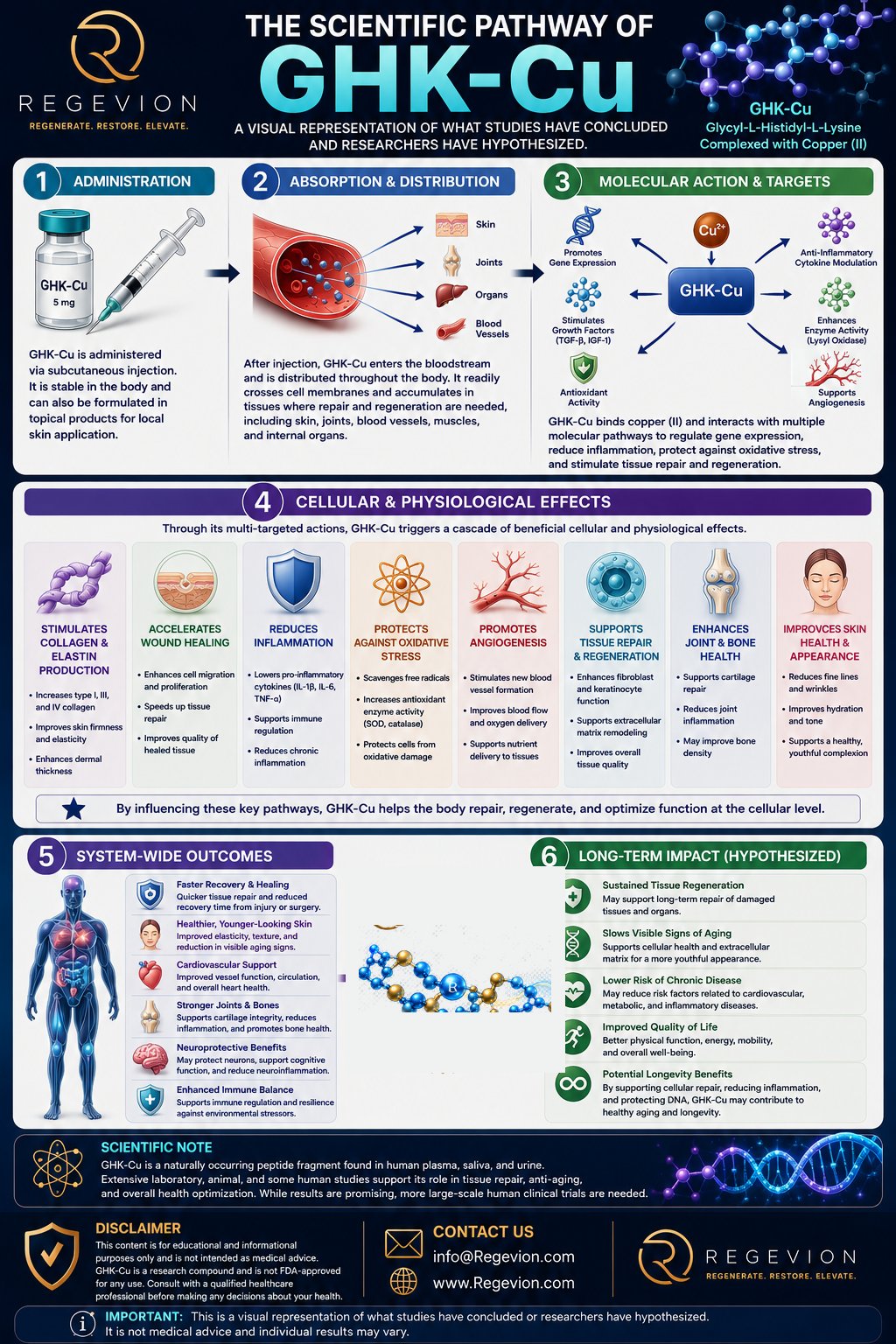
GHK-Cu is the copper(II)-bound form of glycyl-L-histidyl-L-lysine (GHK), a naturally occurring tripeptide found in human biological fluids. Unlike peptides that function primarily through one well-characterized membrane receptor, GHK-Cu appears to operate as a multifunctional signaling and tissue-remodeling molecule. Its biology is therefore better understood as a network of interactions involving copper homeostasis, extracellular-matrix regulation, fibroblast activity, inflammation, angiogenesis, and cellular repair.
GHK has a strong affinity for copper and can form the GHK-Cu complex. One influential early hypothesis proposed that the complex participates in delivering or facilitating copper availability to cells.¹ Copper isn’t simply a structural mineral — it’s a required cofactor for enzymes involved in antioxidant defense, connective-tissue maturation, energy metabolism, and angiogenesis.
The resulting biological sequence: GHK-Cu → copper-associated and cellular signaling effects → altered gene and protein activity → extracellular-matrix remodeling and cellular repair → tissue-level regeneration. This is not equivalent to saying GHK-Cu has one single receptor responsible for all its effects — the available evidence supports a pleiotropic, or multi-target, mode of action.
1. Molecular Mechanism of Action
The best-established biological effects of GHK-Cu are observed in cells involved in tissue repair, particularly fibroblasts, the cells responsible for producing much of the extracellular matrix — the structural environment surrounding cells, containing collagen, elastin, glycosaminoglycans, proteoglycans, and other molecules that determine tissue strength, elasticity, hydration, and organization.
In cultured human fibroblasts, GHK-Cu increases collagen synthesis and stimulates production of glycosaminoglycans.² Interestingly, these effects aren’t simply a matter of increasing cell number — collagen production can increase without a corresponding increase in fibroblast proliferation. This distinction matters: GHK-Cu appears capable of changing what repair cells produce, not merely how many repair cells are present.
GHK-Cu also influences the balance between extracellular-matrix construction and degradation. Studies have reported effects on matrix metalloproteinases (MMPs) and their endogenous inhibitors, allowing the peptide to participate in matrix turnover rather than simply promoting indiscriminate collagen accumulation. In wound models, this translates into increased accumulation of collagen, glycosaminoglycans, and other connective-tissue components, with increased type I and type III collagen expression in experimental wounds.³
2. Receptor Biology & Cellular Signaling
GHK-Cu doesn’t have a single canonical receptor pathway comparable to the receptor systems used by hormones such as insulin or GLP-1 — which makes its pharmacology unusual. Evidence instead points toward several overlapping mechanisms: one proposed mechanism is that GHK-Cu influences cellular copper availability, while other research indicates GHK itself can alter transcriptional programs associated with tissue repair, inflammation, oxidative stress, and cellular maintenance. Gene-expression analyses have identified broad changes involving multiple biological pathways rather than activation of one isolated signaling cascade.
At the cellular level, the consequences include altered expression of proteins involved in collagen and extracellular-matrix synthesis, glycosaminoglycan and proteoglycan production, fibroblast function, angiogenic signaling, inflammatory regulation, and oxidative-stress responses — helping explain why GHK-Cu can affect several stages of tissue repair simultaneously.
A useful way to visualize the mechanism: GHK-Cu encounters repair-associated cells → cellular signaling and copper-dependent processes are influenced → gene expression and protein production change → fibroblasts, endothelial cells, keratinocytes and other repair cells alter their behavior → extracellular matrix, vascularization and tissue organization change → repair and remodeling can be enhanced. The precise molecular receptors and intracellular intermediates responsible for every one of these effects remain incompletely defined — the broad biological effects are better established than any single unified receptor mechanism.
3. Pharmacology
GHK-Cu’s pharmacology differs substantially from that of conventional receptor-selective drugs. Its pharmacodynamic activity appears highly context-dependent: the biological response depends on cell type, extracellular environment, copper availability, concentration, and the state of tissue injury or remodeling.
One particularly important observation is that GHK-Cu can demonstrate a nonlinear, biphasic concentration-response relationship. In human fibroblast experiments, collagen stimulation began around 10⁻¹²–10⁻¹¹ M and reached a maximum around 10⁻⁹ M;³ in glycosaminoglycan experiments, stimulation was greatest around 10⁻⁹–10⁻⁸ M, while higher concentrations progressively moved the response back toward baseline.⁴ This is a reminder that biological systems don’t necessarily respond according to “more peptide → more effect” — instead, the relationship can be bell-shaped or biphasic, with an effective concentration range followed by diminishing biological response. (These are experimental cellular concentrations, not recommended human doses.)
4. Pharmacokinetics: What Happens to GHK-Cu?
This is one of the major limitations of the current evidence base. Although GHK is naturally present in human tissues and fluids, robust modern human pharmacokinetic data describing the absorption, distribution, metabolism, clearance, and half-life of administered GHK-Cu are limited — so it isn’t scientifically justified to assign GHK-Cu a clinically established half-life or claim a validated systemic exposure profile across different routes of administration.
Route of administration is particularly important: topical exposure, local administration, and systemic administration can produce fundamentally different pharmacokinetic environments, and peptides can also undergo enzymatic degradation, meaning the amount administered isn’t necessarily equivalent to the amount of intact peptide reaching a biological target. Consequently, much of the mechanistic literature describes concentration at the cellular or tissue level rather than a complete human plasma concentration-time curve. FDA has specifically noted limited human safety information for injectable compounded GHK-Cu and potential concerns involving immunogenicity, aggregation, and peptide-related impurities.
5. Dose, Exposure & Dose-Response
GHK-Cu provides an unusually clear example of why experimental concentration shouldn’t automatically be translated into a human dosing protocol. Cell and animal experiments demonstrate concentration-dependent biological effects, but these don’t establish an optimal human dose. The available mechanistic evidence suggests GHK-Cu can behave in a saturable or biphasic manner: at relatively low experimental concentrations, collagen and glycosaminoglycan synthesis can increase, but increasing concentration beyond the most responsive range doesn’t necessarily produce a proportionally greater response and, in some experiments, reduces the effect toward baseline.
The biological model is better expressed as dose → systemic or local exposure → tissue concentration → cellular interaction → response rather than “dose → guaranteed proportional effect.” No validated clinical dose-response relationship has been established that would allow the laboratory concentration-response curves to be converted directly into an individualized human dosing schedule.
6. Does Body Weight Affect Dose?
There is currently insufficient evidence to establish a clinically validated weight-based dosing relationship for GHK-Cu. Unlike drugs whose human pharmacokinetics have been systematically characterized across body-weight ranges, GHK-Cu lacks adequate clinical pharmacokinetic data to demonstrate that increasing body mass requires proportionally greater exposure — so body weight shouldn’t be used to infer an evidence-based GHK-Cu dose.
7. What Happens at Different Exposure Levels?
At lower experimental exposure, GHK-Cu can influence fibroblast activity and extracellular-matrix production, with collagen and glycosaminoglycan synthesis among the best-characterized responses. At intermediate exposure within responsive experimental ranges, these remodeling effects may become more pronounced, while broader effects involving matrix organization, cellular migration, inflammatory regulation, and repair-associated signaling can become apparent. At higher concentrations, however, the response doesn’t necessarily continue increasing — the biphasic behavior observed in fibroblast studies demonstrates that cellular signaling has a functional range rather than an unlimited upward trajectory. This is one reason GHK-Cu shouldn’t be interpreted through the simplistic assumption that greater exposure automatically produces greater regeneration.
8. Connecting Molecular Mechanisms to Human Outcomes
The biological significance of GHK-Cu becomes clearer when the molecular events are connected to tissue physiology: GHK-Cu interacts with repair-associated cellular systems → fibroblast activity and extracellular-matrix production change → collagen, glycosaminoglycans and proteoglycans are produced and remodeled → the structural environment surrounding cells becomes more supportive of tissue repair → wound remodeling, tissue organization and regenerative processes can improve. This framework is consistent with experimental findings across skin and other tissues, although the strength of evidence varies substantially by tissue and model — reviews describe effects involving fibroblasts, keratinocytes, endothelial cells, angiogenesis, inflammation, and matrix remodeling.⁵ The important scientific distinction is that these mechanisms provide a biological explanation for observed effects; they don’t prove that every reported systemic or clinical benefit is caused by one particular pathway.
9. Combination & Pathway Interaction
GHK-Cu’s biology is inherently interconnected with the normal tissue-repair environment. Copper participates in enzymatic systems involved in connective-tissue maturation, antioxidant defense, and vascular biology, while GHK can influence the production and organization of extracellular-matrix components — the peptide sits at an intersection between metal-ion biology and tissue-remodeling biology rather than acting as an isolated switch.
The interaction between GHK-Cu and matrix metalloproteinases is particularly relevant: tissue repair requires both construction and controlled degradation of extracellular matrix. Excessive degradation can impair repair, while insufficient remodeling can produce abnormal tissue architecture — GHK-Cu’s reported ability to influence both matrix production and matrix-regulating enzymes is consistent with a remodeling model rather than a simple “collagen booster” model. Recent experimental work is also exploring GHK-Cu in engineered wound-healing systems, including biomaterial formulations; these studies remain experimental and shouldn’t be interpreted as evidence for established clinical combination protocols.
10. What Scientists Still Do Not Fully Understand
The central unanswered question is deceptively simple: what is the primary molecular initiating event that connects GHK-Cu exposure to its broad transcriptional and cellular effects? Researchers have identified numerous downstream changes, but GHK-Cu doesn’t yet fit neatly into a single-receptor pharmacology model. It remains uncertain how much of its activity results directly from GHK signaling, how much depends on copper delivery or redistribution, and how these processes differ between cell types.
Human pharmacokinetics are another major gap — without well-characterized absorption, distribution, metabolism, and exposure-response relationships, it’s difficult to determine how experimental concentrations translate into systemic human biology. Finally, the extent to which mechanisms demonstrated in fibroblast cultures and animal wound models translate into meaningful outcomes across different human tissues remains an active research question. A recent 2021 structural study clarified part of the chemistry underlying these questions: researchers described ternary complexes involving copper, GHK, and human serum albumin, revisiting the molecule’s original biological environment with modern analytical techniques and reinforcing that GHK-Cu should be understood not as an isolated synthetic peptide, but as part of a more complicated copper-binding system in human plasma.⁶
Why This Matters
GHK-Cu is scientifically interesting because its biology isn’t built around one receptor or one isolated pathway. Its effects emerge from an interconnected system involving copper biology, cellular signaling, extracellular-matrix turnover, fibroblast function, inflammation, vascular responses, and tissue remodeling. At the molecular level, GHK-Cu can alter cellular behavior; at the tissue level, those changes can influence how damaged or aging tissue is rebuilt and remodeled. That connection — molecular signaling → cellular behavior → extracellular matrix → tissue architecture — is the central idea behind the science of GHK-Cu, and it also explains why its biology can appear broader than that of a conventional single-target drug, while simultaneously explaining why many mechanistic questions remain unresolved.
References
- Pickart L, Freedman JH, Loker WJ, et al. Growth-modulating plasma tripeptide may function by facilitating copper uptake into cells. Nature. 1980;288:715-717. https://pubmed.ncbi.nlm.nih.gov/7453802/
- Wegrowski Y, Maquart FX, Borel JP. Stimulation of sulfated glycosaminoglycan synthesis by the tripeptide-copper complex glycyl-L-histidyl-L-lysine-Cu2+. Life Sciences. 1992. https://pubmed.ncbi.nlm.nih.gov/1522753/
- Maquart FX, Pickart L, et al. Stimulation of collagen synthesis in fibroblast cultures by the tripeptide-copper complex glycyl-L-histidyl-L-lysine-Cu2+. FEBS Letters. 1988. https://pubmed.ncbi.nlm.nih.gov/3169264/
- Maquart FX, et al. In vivo stimulation of connective tissue accumulation by the tripeptide-copper complex glycyl-L-histidyl-L-lysine-Cu2+ in rat experimental wounds. Journal of Clinical Investigation. 1993;91:2368-2376. https://pubmed.ncbi.nlm.nih.gov/8227353/
- Pickart L, Vasquez-Soltero JM, Margolina A. GHK Peptide as a Natural Modulator of Multiple Cellular Pathways in Skin Regeneration. BioMed Research International. 2015. https://pubmed.ncbi.nlm.nih.gov/26236730/
- Bossak-Ahmad K, Bal W, Frączyk T, Drew SC. Ternary Cu2+ Complexes of Human Serum Albumin and Glycyl-L-histidyl-L-lysine. Inorganic Chemistry. 2021;60(22):16927-16931. https://pubmed.ncbi.nlm.nih.gov/34730942/