What the studies actually found
Danish researchers at Novo Nordisk found ipamorelin stimulated GH release with no meaningful rise in ACTH or cortisol, even at doses more than 200-fold above what it takes to release GH, and no effect on FSH, LH, prolactin or TSH — which is why they called it the first truly selective growth hormone secretagogue.
READ THE RESEARCH →In a rat study, longitudinal bone growth climbed from 42 to 52 micrometers per day at the highest dose (P<0.0001), alongside a pronounced, dose-dependent gain in body weight — the kind of clean dose-response curve researchers look for.
READ THE RESEARCH →In rats after surgery, 78% of a test meal was still sitting in the stomach in untreated animals. With ipamorelin, only 52% remained — close to the 44% seen in animals that never had surgery — and the peptide reversed the loss of stomach-muscle contractions.
READ THE RESEARCH →In a randomized, placebo-controlled Phase 2 trial, median time to a first tolerated meal was 25.3 hours with ipamorelin versus 32.6 hours with placebo, with fewer patients reporting adverse events (87.5% vs 94.8%). The difference didn't reach statistical significance (p=0.15) — a proof-of-concept signal, not a confirmed result.
READ THE RESEARCH →Ipamorelin activates the same receptor as ghrelin, the gut hormone that signals hunger. Its designers made it by removing the central dipeptide from an earlier compound, GHRP-1, producing a five-amino-acid molecule with a far narrower hormonal footprint.
EXPLORE THE SCIENCE →Ipamorelin — Overview
What Is Ipamorelin?
Ipamorelin is a synthetic pentapeptide designed to stimulate the body’s release of growth hormone (GH). Unlike GH itself, Ipamorelin doesn’t supply GH directly — it acts as a growth hormone secretagogue, a compound that signals the body to release its own stored GH. Its molecular structure is unusually small: Ipamorelin consists of only five amino-acid residues, formally identified as Aib-His-D-2-Nal-D-Phe-Lys-NH₂. Several of these building blocks are modified or non-natural amino-acid structures, reflecting that Ipamorelin was deliberately engineered rather than copied from a naturally occurring human peptide.
That distinction matters: Ipamorelin belongs to a scientific family of compounds developed to manipulate the body’s growth-hormone signaling system, but it isn’t simply another form of human growth hormone — its purpose is to influence the body’s own regulatory machinery.
The scientific attraction of Ipamorelin comes largely from its selectivity. Earlier growth-hormone-releasing peptides could stimulate GH while also affecting other hormonal systems, including ACTH and cortisol. Ipamorelin was developed with the goal of producing a strong GH response while minimizing these additional endocrine effects — the original pharmacological work described it as the first growth-hormone secretagogue with a degree of selectivity for GH release comparable to growth hormone-releasing hormone itself.¹ That made Ipamorelin more than another peptide capable of raising GH — it became a tool for asking a broader biological question: can the growth-hormone system be stimulated more selectively, while preserving the body’s natural signaling architecture? That question continues to shape research surrounding the peptide.
Scientific Discovery & Development
The story of Ipamorelin begins before Ipamorelin itself existed. For decades, scientists had known that growth hormone was controlled by a complex signaling system involving the hypothalamus and pituitary gland, and researchers also discovered that certain synthetic peptides could trigger GH release even though they were structurally unrelated to GH itself — these compounds became known as growth hormone-releasing peptides, or GHRPs. Their development opened an important new area of endocrinology: instead of administering the final hormone, researchers could potentially stimulate the body to release its own GH.
During the 1980s and early 1990s, scientists developed increasingly potent members of this class, including GHRP-6 and related compounds, then began modifying their molecular structures in search of greater selectivity. At Novo Nordisk’s research facilities in Denmark, a medicinal-chemistry program explored new compounds derived from the GHRP family, and Ipamorelin emerged from this work as a particularly interesting molecule. According to the original 1998 publication by Karin Raun and colleagues, it was identified within a series of compounds lacking the central Ala-Trp sequence found in GHRP-1.¹ The result was a five-amino-acid peptide that retained powerful GH-releasing activity while demonstrating a strikingly different hormonal profile.
In laboratory studies, Ipamorelin stimulated GH release from rat pituitary cells with potency comparable to GHRP-6, and in animal studies it also produced substantial GH responses. But the most interesting observation was what didn’t happen: at doses that strongly stimulated GH, Ipamorelin didn’t produce the same significant increases in ACTH and cortisol seen with some earlier secretagogues — a major reason researchers became interested in the molecule.
The discovery also occurred during a rapidly expanding understanding of ghrelin biology, a stomach-derived hormone identified in 1999. Ghrelin was subsequently recognized as a natural activator of the growth hormone secretagogue receptor, helping explain why compounds such as GHRPs could stimulate GH through a pathway distinct from traditional growth hormone-releasing hormone signaling.² Ipamorelin therefore sits at the intersection of two scientific discoveries: the earlier development of synthetic GH-releasing peptides, and the emerging understanding of the body’s own ghrelin–growth-hormone signaling system.
Why Researchers Are Studying Ipamorelin
Growth hormone is involved in much more than childhood growth. In adults, the GH system participates in regulating body composition, protein metabolism, tissue growth and repair, bone biology, and production of insulin-like growth factor-1 (IGF-1); GH is released naturally in pulses, with secretion varying according to sleep, age, nutrition, exercise, and metabolic state. That pulsatile pattern matters — the body doesn’t normally maintain one constant GH concentration, but produces carefully timed signals that interact with other endocrine systems.
Researchers became interested in Ipamorelin because it offered a way to stimulate this system indirectly — rather than replacing GH, it could act upstream, encouraging the pituitary to release GH — a fundamentally different research model from simply administering recombinant growth hormone. Scientists have investigated Ipamorelin in areas where manipulation of GH signaling might have biological significance, including growth-hormone physiology, gastrointestinal function, and postoperative recovery. The research is particularly interesting because the same receptor system involved in GH secretion also participates in other physiological processes, meaning a compound acting on this pathway may have effects extending beyond the pituitary — creating both scientific opportunities and important questions about selectivity.
Biological Foundation
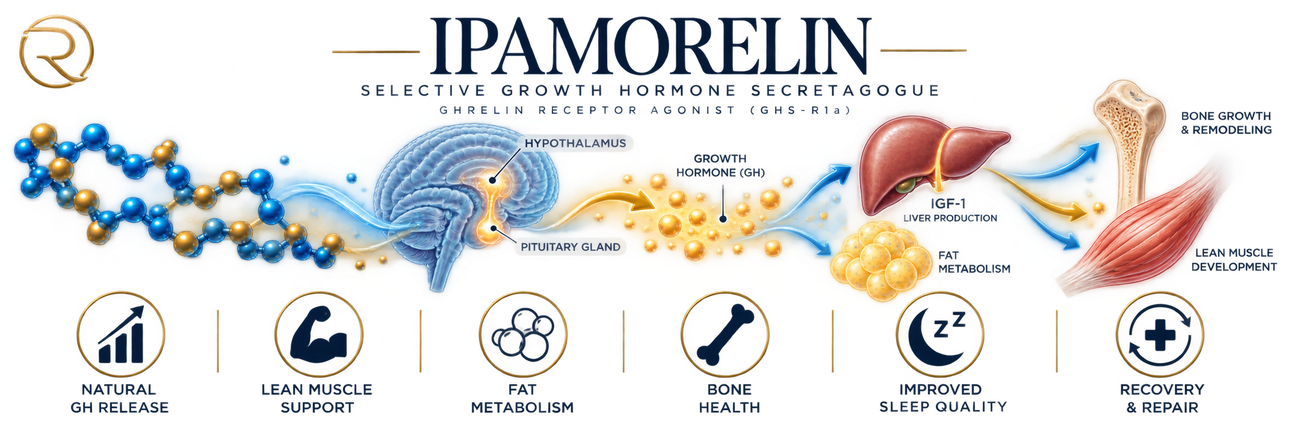
To understand Ipamorelin, it helps to first understand the growth hormone axis. The system begins in the brain: the hypothalamus produces signals that regulate the pituitary gland, including growth hormone-releasing hormone (GHRH), which promotes GH secretion, and somatostatin, which suppresses it. A second signaling route involves the growth hormone secretagogue receptor (GHSR), which became particularly important after the discovery of ghrelin — a naturally occurring peptide produced predominantly in the stomach and one of the body’s endogenous signals capable of activating GHSR. Activation of this receptor can stimulate GH secretion from the pituitary, and Ipamorelin interacts with this same general signaling system.
The result is a biological sequence that can be viewed simply: Ipamorelin → GHSR signaling → pituitary GH release → downstream GH/IGF-1 biology. The important point is that Ipamorelin doesn’t function as GH itself — it acts as a signal that encourages the body to release GH. Once GH enters circulation, it can act directly on tissues and can also stimulate production of IGF-1, particularly in the liver; IGF-1 then participates in a much broader network of cellular and tissue responses. This is why the effects of a GH secretagogue can’t be understood by looking only at the initial receptor interaction — a relatively small signaling event at the pituitary can propagate through an endocrine network involving multiple tissues. The detailed receptor pharmacology, signaling pathways, pharmacokinetics, and GH/IGF-1 relationships are explored more deeply on the Science page.
What Researchers Are Investigating
Growth hormone regulation itself — early human pharmacology studies demonstrated that Ipamorelin can produce measurable GH responses in healthy volunteers. A 1999 pharmacokinetic-pharmacodynamic study by J. V. Gobburu and colleagues examined escalating intravenous infusion rates in healthy men, providing some of the earliest human data describing the relationship between Ipamorelin exposure and GH response.³ This work helped establish that the peptide wasn’t simply an interesting laboratory molecule — it could produce a measurable endocrine response in humans.
Gastrointestinal function — researchers also investigated whether stimulating the ghrelin receptor could influence gastrointestinal function. Ghrelin signaling is involved in gastrointestinal motility, and animal studies suggested Ipamorelin could accelerate intestinal transit in models of postoperative ileus. That observation led to a Phase 2 clinical study examining Ipamorelin in patients recovering from bowel surgery — the study enrolled 117 participants and evaluated intravenous Ipamorelin against placebo for postoperative ileus.⁴ However, this is also an important example of why scientific interest and clinical success aren’t the same thing: FDA’s subsequent review concluded that the available evidence didn’t demonstrate effectiveness for postoperative ileus, noting that the published clinical study didn’t show significant differences between Ipamorelin and placebo on its primary and secondary efficacy analyses.⁵
The research therefore illustrates both sides of Ipamorelin’s scientific story: a compelling biological mechanism can justify clinical investigation, but the mechanism alone doesn’t establish that a treatment will produce a meaningful clinical outcome.
Potential Benefits & Biological Significance
Ipamorelin’s potential significance is primarily connected to its ability to influence the GH signaling network. Because GH contributes to protein metabolism, tissue biology, bone physiology, and body composition, researchers have investigated whether selectively stimulating endogenous GH release could have useful downstream effects — the biological rationale is straightforward: if Ipamorelin can stimulate GH release, and GH subsequently influences downstream pathways including IGF-1 signaling, the peptide becomes a tool for studying how those pathways affect tissues throughout the body.
However, this is where it’s important to separate biological possibility from demonstrated clinical benefit. Ipamorelin has clearly demonstrated GH-secretagogue activity in experimental models and early human pharmacology — that doesn’t establish that using Ipamorelin in otherwise healthy people will reliably produce improvements in muscle mass, fat loss, athletic performance, recovery, longevity, or other outcomes frequently associated with the peptide. Those broader claims require appropriate controlled human studies. The scientific value of Ipamorelin therefore extends beyond whether it eventually becomes a therapeutic product — it provides researchers with a selective pharmacological tool for investigating how the ghrelin receptor and GH axis interact, and how changing one part of that network can influence physiology elsewhere.
Current Research Stage & Future Outlook
Ipamorelin remains investigational and is not FDA approved for a therapeutic indication. Its clinical development hasn’t progressed to an FDA-approved medicine — one of its most notable clinical development programs, the Phase 2 postoperative-ileus study, didn’t demonstrate the expected efficacy, and FDA’s later assessment found insufficient evidence to support effectiveness for that indication.⁵
In the United States, the regulatory story has also become more complicated because Ipamorelin acetate has been evaluated in the context of pharmaceutical compounding. FDA’s Pharmacy Compounding Advisory Committee briefing document (October 2024) identified significant safety concerns associated with compounded Ipamorelin acetate, including potential immunogenicity related to aggregation or peptide impurities and additional characterization challenges associated with its unnatural amino acids, and concluded the evidence weighed against placing either Ipamorelin free base or Ipamorelin acetate on the 503A bulk-substances list for the evaluated uses (growth hormone deficiency and postoperative ileus).⁵ Availability through a compounding or other channel shouldn’t be confused with FDA approval. The future scientific importance of Ipamorelin is therefore less about assuming it will become an approved therapy and more about determining whether selective manipulation of the GH secretagogue pathway can produce clinically meaningful outcomes with an acceptable safety profile — that question remains open.
Global Research Perspective
Ipamorelin’s scientific history reflects an international research effort rather than the work of a single laboratory. Its original development was associated with Novo Nordisk research in Denmark, where researchers including K. Raun, B. S. Hansen, N. L. Johansen, H. Thøgersen, K. Madsen, M. Ankersen, and P. H. Andersen characterized the compound and its pharmacology in the late 1990s. Subsequent pharmacokinetic and clinical research involved investigators in Europe and the United States, including human pharmacology work and clinical investigations conducted across multiple medical centers. The broader scientific story also connects Ipamorelin to discoveries made internationally in endocrinology and peptide biology, particularly the identification and characterization of ghrelin and the growth hormone secretagogue receptor. Together, these discoveries transformed what initially looked like a narrow question about stimulating GH into a much larger investigation of how endocrine signaling can be selectively manipulated.
Why This Matters
Ipamorelin represents an important chapter in the evolution of peptide science: the shift from simply replacing hormones to modulating the body’s own signaling systems. Its development demonstrated that a very small synthetic peptide could selectively influence the growth hormone secretagogue pathway and produce a measurable GH response — making Ipamorelin valuable not only as a potential therapeutic candidate, but also as a scientific tool for understanding the relationship between ghrelin signaling, pituitary function, GH, and downstream physiology. Its story also demonstrates an essential principle of modern biomedical research: a compelling mechanism is the beginning of a scientific question, not the end of it. The continuing significance of Ipamorelin lies in that question — how selectively can the human GH axis be influenced, and what meaningful biological outcomes can follow? Understanding the answer requires moving beyond what Ipamorelin is and into what researchers have actually discovered about it — that’s where the Research page picks up the story.
References
- Raun K, Hansen BS, Johansen NL, et al. Ipamorelin, the first selective growth hormone secretagogue. European Journal of Endocrinology. 1998;139(5):552-561. https://pubmed.ncbi.nlm.nih.gov/9849822/
- Kojima M, Hosoda H, Date Y, Nakazato M, Matsuo H, Kangawa K. Ghrelin is a growth-hormone-releasing acylated peptide from stomach. Nature. 1999. https://pubmed.ncbi.nlm.nih.gov/10604470/
- Gobburu JV, Agersø H, Jusko WJ, Ynddal L. Pharmacokinetic-pharmacodynamic modeling of ipamorelin, a growth hormone releasing peptide, in human volunteers. Pharmaceutical Research. 1999. https://pubmed.ncbi.nlm.nih.gov/10496658/
- Beck DE, Sweeney WB, McCarter MD, et al. Prospective, randomized, controlled, proof-of-concept study of the ghrelin mimetic ipamorelin for the management of postoperative ileus in bowel resection patients. International Journal of Colorectal Disease. 2014. https://pubmed.ncbi.nlm.nih.gov/25331030/ ; ClinicalTrials.gov NCT00672074.
- FDA Briefing Document, Pharmacy Compounding Advisory Committee (PCAC) Meeting, October 2024 — Ipamorelin bulk drug substance review. https://www.fda.gov/media/182088/download
Ipamorelin — The Research
Ipamorelin’s research story begins with a scientific puzzle: how could researchers stimulate growth hormone without activating the broader hormonal effects seen with earlier growth-hormone-releasing peptides? The answer emerged from more than a decade of work on growth-hormone secretagogues, eventually leading to a small peptide notable for its unusually selective stimulation of growth hormone.
How Ipamorelin Was Discovered
The scientific path toward Ipamorelin began before Ipamorelin itself existed. During the 1970s and 1980s, researchers were discovering that certain synthetic peptides could stimulate growth hormone (GH) through a pathway different from the better-known growth hormone–releasing hormone (GHRH) system — these compounds became known as growth hormone secretagogues (GHSs), and their discovery raised an important question: what receptor were these compounds acting through?
In 1996, David Howard and colleagues at Merck Research Laboratories reported the cloning of the growth hormone secretagogue receptor (GHS-R) from human and swine tissues; the receptor was found in the pituitary and hypothalamus and provided molecular evidence for a distinct signaling system controlling pulsatile GH release.¹ That discovery changed the research landscape — if a specific receptor existed, scientists could begin designing molecules that interacted with it more precisely.
Two years later, researchers at Novo Nordisk in Denmark reported the discovery of Ipamorelin. In the 1998 paper “Ipamorelin, the first selective growth hormone secretagogue,” Karin Raun, B. S. Hansen, N. L. Johansen and colleagues described Ipamorelin as the result of a major medicinal-chemistry program derived from the earlier GHRP family.² The important breakthrough wasn’t simply that Ipamorelin could stimulate GH — earlier compounds could already do that. The distinction was selectivity: in laboratory experiments, Ipamorelin stimulated GH release with potency comparable to established GHRPs while producing substantially less stimulation of other pituitary hormones, and the researchers characterized it as the first highly selective GH secretagogue of its type.
Then, in 1999, researchers in Japan led by Masayasu Kojima and Kenji Kangawa identified ghrelin, the natural ligand for the same receptor system. Ghrelin was discovered in stomach tissue and demonstrated to stimulate GH release through GHS-R.³ This discovery placed Ipamorelin within a much larger physiological system — what had initially looked like a synthetic pharmacological pathway was now understood to have an endogenous counterpart: synthetic secretagogue → GHS receptor → discovery of ghrelin → broader understanding of the ghrelin/GH system. That sequence is one of the most important pieces of Ipamorelin’s scientific history.
From Hormone Signal to Human Research
Once Ipamorelin had demonstrated selective GH-releasing activity in experimental models, researchers moved toward understanding how the peptide behaved in humans. A 1999 pharmacokinetic/pharmacodynamic study led by J. V. Gobburu and colleagues examined Ipamorelin in healthy male volunteers using several infusion rates.⁴ Rather than asking whether the peptide could merely stimulate GH, the researchers began defining the relationship between exposure to Ipamorelin and the resulting GH response — establishing that Ipamorelin could produce a measurable, transient GH response in humans and giving researchers a foundation for studying its pharmacology beyond animal models.
The research program then expanded in an unexpected direction. Because the receptor system is also involved in gastrointestinal physiology, scientists investigated whether Ipamorelin could influence gastrointestinal motility, particularly after surgery.
The Research Expands: Gastrointestinal Motility
Preclinical studies provided the first evidence. In rodent models of postoperative ileus — a temporary slowing of intestinal movement after abdominal surgery — Ipamorelin increased gastrointestinal transit; researchers observed increased fecal output and improvements in measures of intestinal recovery compared with untreated animals.⁵ A later study examined gastric emptying more directly: following abdominal surgery, rats retained a large amount of their meal in the stomach, and Ipamorelin significantly reduced the amount remaining (78% vs. 52% meal retention), suggesting faster gastric emptying; experiments with isolated gastric tissue also suggested the peptide could restore contractile responses impaired by surgery.⁶
These findings created a logical human research question: could activation of the ghrelin receptor help restore gastrointestinal function after surgery? That question ultimately led to one of Ipamorelin’s most important human trials.
The Most Important Human Clinical Study
Ipamorelin for postoperative ileus (2014). This Phase 2, multicenter, randomized, double-blind, placebo-controlled trial enrolled 117 adults undergoing small- or large-bowel resection across United States clinical centers, treated with intravenous Ipamorelin (0.03 mg/kg twice daily) or placebo for up to seven days.⁷ Researchers wanted to know whether the biological effects seen in animal models would translate into faster gastrointestinal recovery in humans, with the principal measure being how quickly patients could tolerate a standardized solid meal.
The Ipamorelin group reached that milestone in a median of 25.3 hours, compared with 32.6 hours in the placebo group. Numerically, that favored Ipamorelin, but the difference didn’t reach statistical significance on the primary endpoint (p=0.15), and secondary efficacy measures likewise didn’t demonstrate a significant advantage.⁷ This is an important distinction: the study demonstrated that Ipamorelin could be administered to surgical patients and produced a numerical difference in gastrointestinal recovery, but it didn’t establish a statistically significant clinical benefit for postoperative ileus. The study therefore became less a confirmation of efficacy than a useful demonstration of where the hypothesis stood when tested in humans. (ClinicalTrials.gov NCT00672074.)
What Preclinical Research Has Added
The preclinical literature has explored several consequences of increasing GH signaling through Ipamorelin. One notable area is bone biology: in a study of adult female rats, Johan Svensson and colleagues investigated whether Ipamorelin and GHRP-6 could influence bone mineral content, and found increases in bone mineral content — supporting the idea that GH-secretagogue signaling could influence bone remodeling.⁸ The finding is scientifically interesting because it connects GH-secretagogue research with skeletal biology, but it remains animal evidence and doesn’t establish that Ipamorelin produces the same outcome in humans.
Similarly, the gastrointestinal experiments described above demonstrated effects on gastric emptying and intestinal transit in animals.⁵ ⁶ Together, these studies helped researchers understand that GHS-R activation isn’t restricted to a single endocrine outcome.
What the Evidence Shows
Ipamorelin has a relatively unusual evidence profile.
Stronger evidence. The strongest evidence establishes that Ipamorelin is pharmacologically capable of stimulating GH release in experimental models and humans. Its original characterization also demonstrated unusually selective GH stimulation compared with earlier GHRPs.²
Emerging evidence. Human research has explored whether those hormonal effects can translate into functional outcomes, particularly gastrointestinal recovery. The Phase 2 postoperative-ileus trial provided meaningful human data, but its primary efficacy endpoint wasn’t statistically significant.⁷
Early or experimental evidence. Bone-related effects, broader recovery concepts, body-composition effects, and other applications remain much more dependent on preclinical evidence or extrapolation from GH biology than on large, definitive Ipamorelin trials. That distinction matters — evidence that Ipamorelin changes GH is considerably stronger than evidence that changing GH with Ipamorelin produces a specific clinical outcome.
Where Ipamorelin Stands Today
As of 2026, Ipamorelin is not FDA approved and is not an ingredient in an FDA-approved drug. FDA’s Pharmacy Compounding Advisory Committee briefing document identifies Ipamorelin acetate as a bulk substance associated with potential compounding concerns and notes that neither Ipamorelin free base nor Ipamorelin acetate is a component of an FDA-approved drug.⁹ The regulatory history is important because Ipamorelin’s scientific development didn’t progress to an approved therapeutic indication.
FDA has also specifically reviewed the available Ipamorelin evidence in the context of proposed compounding uses, including growth hormone deficiency and postoperative ileus; its review concluded that the available evidence weighed against placing either substance on the 503A bulk drug substances list for those uses, citing insufficient safety and effectiveness evidence.⁹ This places Ipamorelin firmly in the investigational research category, rather than alongside approved GH-axis medicines.
What Researchers Are Studying Now
The scientific interest surrounding Ipamorelin has increasingly shifted from the simple question of whether it can release GH to the larger question of what selective GHS-R activation can accomplish. Researchers now have a much more sophisticated understanding of the ghrelin system than existed when Ipamorelin was first developed — ghrelin signaling has been linked experimentally with gastrointestinal function, energy regulation, appetite, sleep-related physiology, and other peripheral and central processes.
That creates an interesting scientific distinction: Ipamorelin was designed primarily as a selective GH secretagogue, but the receptor it activates belongs to a much broader biological network. The remaining scientific questions therefore concern translation — whether selective activation of this pathway can produce meaningful clinical outcomes, in which populations, and for which conditions. Those questions remain substantially less developed than the underlying pharmacology.
Future Scientific Potential
Ipamorelin remains scientifically interesting because it represents an important step in the evolution of growth-hormone secretagogue research. The original breakthrough was selectivity: researchers demonstrated it was possible to stimulate GH while minimizing several of the endocrine responses associated with earlier secretagogues. The later discovery of ghrelin revealed that this pharmacological pathway corresponded to a genuine endogenous signaling system. What remains unresolved is whether that pharmacological precision can ultimately translate into meaningful therapeutic applications.
The research therefore continues to raise a valuable scientific question: can selectively modulating the body’s own GH-secretagogue pathway produce useful biological effects without simply reproducing the limitations of direct hormone replacement? That question — not the collection of claims surrounding Ipamorelin online — is where the enduring scientific interest lies.
Why This Matters
Ipamorelin’s research story is ultimately a story about precision in hormone signaling. Scientists moved from discovering synthetic GH-releasing peptides, to identifying their receptor, to discovering the natural hormone that activates that receptor, and then to designing a molecule capable of stimulating the pathway with greater selectivity. The research established that Ipamorelin can stimulate GH in humans and showed how the same signaling system could influence other physiological processes, including gastrointestinal motility. But when those ideas were tested in a controlled Phase 2 clinical trial, the principal clinical outcome didn’t reach statistical significance.
That distinction defines the evidence today: the pharmacology is established; the broader therapeutic applications remain investigational.
References
- Howard AD, Feighner SD, Cully DF, et al. A receptor in pituitary and hypothalamus that functions in growth hormone release. Science. 1996. https://pubmed.ncbi.nlm.nih.gov/8688086/
- Raun K, Hansen BS, Johansen NL, et al. Ipamorelin, the first selective growth hormone secretagogue. European Journal of Endocrinology. 1998;139(5):552-561. https://pubmed.ncbi.nlm.nih.gov/9849822/
- Kojima M, Hosoda H, Date Y, Nakazato M, Matsuo H, Kangawa K. Ghrelin is a growth-hormone-releasing acylated peptide from stomach. Nature. 1999. https://pubmed.ncbi.nlm.nih.gov/10604470/
- Gobburu JV, Agersø H, Jusko WJ, Ynddal L. Pharmacokinetic-pharmacodynamic modeling of ipamorelin, a growth hormone releasing peptide, in human volunteers. Pharmaceutical Research. 1999. https://pubmed.ncbi.nlm.nih.gov/10496658/
- Venkova K, Mann W, Nelson R, Greenwood-Van Meerveld B. Efficacy of ipamorelin, a novel ghrelin mimetic, in a rodent model of postoperative ileus. Journal of Pharmacology and Experimental Therapeutics. 2009;329(3):1110-1116. https://pubmed.ncbi.nlm.nih.gov/19289567/
- Greenwood-Van Meerveld B, Tyler K, Mohammadi E, Peitra C. Efficacy of ipamorelin, a ghrelin mimetic, on gastric dysmotility in a rodent model of postoperative ileus. Journal of Experimental Pharmacology. 2012;4:149-155. https://pubmed.ncbi.nlm.nih.gov/27186127/
- Beck DE, Sweeney WB, McCarter MD, et al. Prospective, randomized, controlled, proof-of-concept study of the ghrelin mimetic ipamorelin for the management of postoperative ileus in bowel resection patients. International Journal of Colorectal Disease. 2014. https://pubmed.ncbi.nlm.nih.gov/25331030/ ; ClinicalTrials.gov NCT00672074.
- Svensson J, Lall S, Dickson SL, et al. The GH secretagogues ipamorelin and GH-releasing peptide-6 increase bone mineral content in adult female rats. Journal of Endocrinology. 2000;165(3):569-577. https://pubmed.ncbi.nlm.nih.gov/10828840/
- FDA Briefing Document, Pharmacy Compounding Advisory Committee (PCAC) Meeting, October 2024 — Ipamorelin bulk drug substance review. https://www.fda.gov/media/182088/download
Ipamorelin — The Science
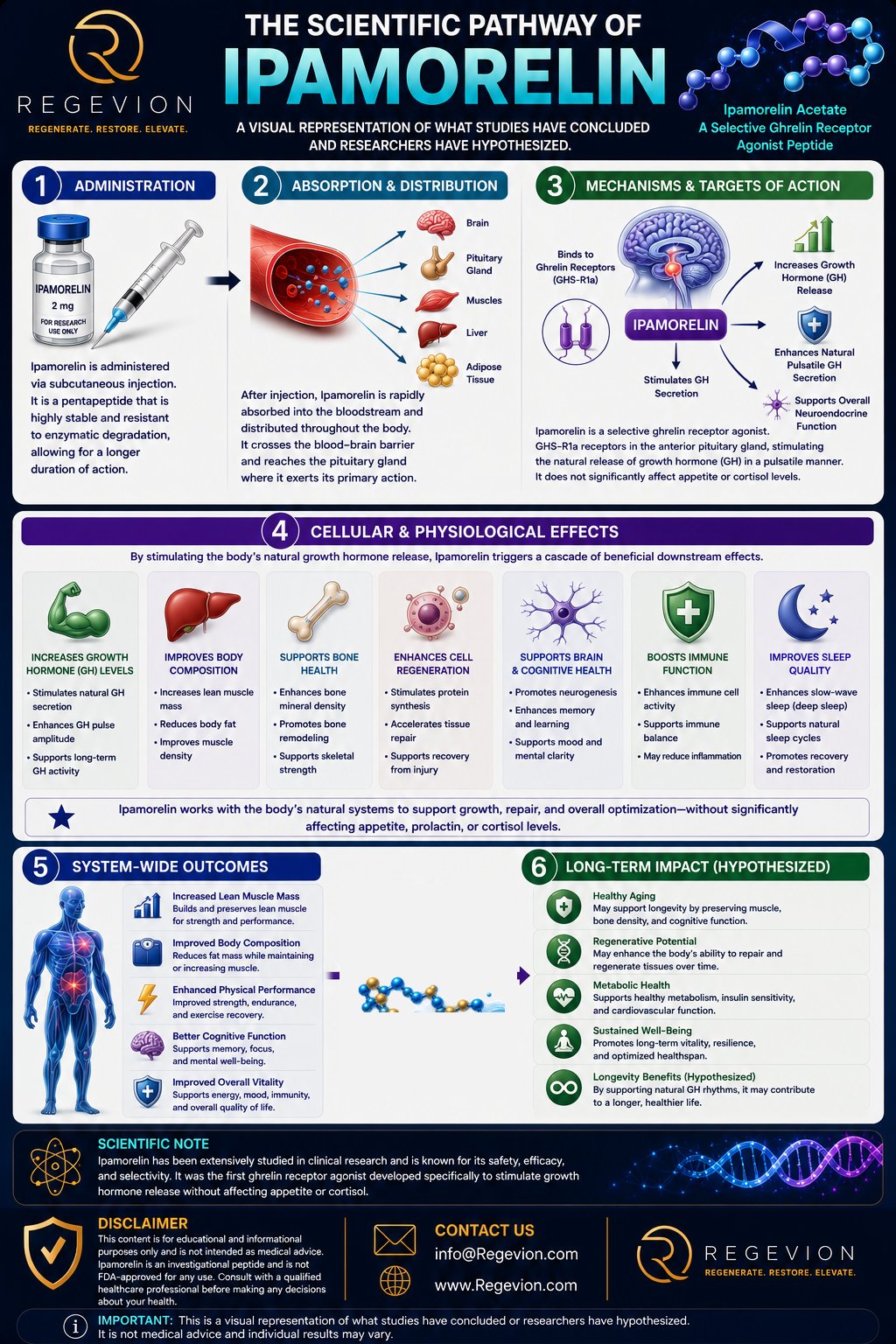
Ipamorelin is a synthetic pentapeptide growth-hormone secretagogue. Its biology is best understood as an upstream signal amplifier: rather than supplying growth hormone (GH) directly, it stimulates the body’s own GH-secretory machinery.
The natural system is the growth hormone axis, a neuroendocrine network connecting the hypothalamus, pituitary gland, liver, and peripheral tissues. Under normal physiology, the hypothalamus releases growth hormone-releasing hormone (GHRH), which stimulates pituitary somatotrophs — the specialized cells that produce GH — while somatostatin provides an opposing signal that suppresses GH release. Ghrelin adds another stimulatory input through the growth hormone secretagogue receptor (GHSR). These signals interact to create the characteristic pulsatile pattern of GH secretion rather than a continuously elevated concentration.
Ipamorelin enters this network primarily through GHSR. The important sequence: Ipamorelin → GHSR activation → intracellular calcium signaling → pituitary GH release → GH receptor signaling → downstream IGF-1 and tissue effects. This distinction is fundamental — Ipamorelin doesn’t behave like recombinant GH; it attempts to stimulate an endogenous endocrine pathway that remains subject to physiological regulation.
1. Molecular Mechanism of Action
Ipamorelin was developed as a highly selective growth-hormone-releasing peptide. Its molecular sequence is Aib-His-D-2-Nal-D-Phe-Lys-NH₂, where Aib is α-aminoisobutyric acid; the unusual amino-acid substitutions contribute to its pharmacological properties. The original characterization demonstrated potent GH release from pituitary cells and showed its activity was mediated through a GHRP-like receptor system.¹
That receptor was subsequently identified as GHSR1a, the principal functional growth-hormone secretagogue receptor and a member of the seven-transmembrane G-protein-coupled receptor (GPCR) family.² Ghrelin is the endogenous ligand most closely associated with this receptor.³ GHSR is expressed in the hypothalamic-pituitary system as well as in other tissues, helping explain why ghrelin signaling can influence functions beyond GH secretion.
When Ipamorelin binds GHSR1a, the receptor changes conformation and activates intracellular signaling. A major pathway involves Gq/11-mediated phospholipase C (PLC) activation; PLC converts membrane phospholipids into signaling molecules including inositol trisphosphate (IP₃) and diacylglycerol (DAG), and IP₃ promotes release of calcium from intracellular stores, increasing cytosolic calcium within the somatotroph. That calcium signal is one of the key molecular events converting receptor activation into secretion — the pituitary cell’s secretory machinery responds to the intracellular calcium rise by releasing stored GH into circulation. The result isn’t simply “more receptor activity”; it’s a coordinated secretory event, and ghrelin/GHSR signaling is well established as a calcium- and phospholipase-linked mechanism for GH secretion.
2. Receptor Selectivity
Ipamorelin’s significance isn’t merely that it activates GHSR, but that it was designed to produce a comparatively selective GH-secretagogue profile. In the original pharmacological studies, Ipamorelin stimulated GH with potency comparable to GHRP-6 (in vitro EC50 1.3 vs. 2.2 nmol/L; in vivo swine ED50 2.3 vs. 3.9 nmol/kg) while producing much less stimulation of other pituitary-adrenal hormones. In swine, ACTH and cortisol responses remained similar to those produced by GHRH even at Ipamorelin exposures roughly 200-fold above those required to stimulate GH.¹ This selectivity was one of the reasons Ipamorelin was distinguished from earlier GHRP compounds.
The important scientific qualification is that this doesn’t mean Ipamorelin has no activity anywhere outside the GH axis — GHSR biology is distributed across multiple tissues, and receptor activation can influence gastrointestinal and other physiological systems. Selectivity should be understood as relative pharmacological selectivity, not absolute tissue exclusivity.
3. From GH Release to the IGF-1 System
Once GH enters the circulation, the mechanism moves to a second layer. GH binds the growth hormone receptor (GHR) on target cells; GHR activation recruits intracellular Janus kinase 2 (JAK2), initiating phosphorylation-dependent signaling that includes STAT proteins and other downstream pathways. In the liver and other tissues, this signaling contributes to production of insulin-like growth factor-1 (IGF-1), which then acts through its own receptor — a receptor tyrosine kinase — producing downstream effects involving cellular growth, protein metabolism, and tissue maintenance.
This creates an important distinction between the immediate and downstream pharmacology of Ipamorelin: Ipamorelin → GHSR → GH pulse is the direct pharmacological event, while GH → GHR → JAK2/STAT and related signaling → IGF-1 represents a downstream endocrine cascade. Therefore, an observed biological effect associated with the GH/IGF-1 axis can’t automatically be attributed to direct action of Ipamorelin on that tissue — it may instead be mediated indirectly through the hormones released after GHSR activation.
4. Pharmacokinetics & Pharmacodynamics
Human PK/PD modeling provides unusually useful information about how Ipamorelin exposure translates into hormonal response. In a dose-escalation study of healthy male volunteers, Ipamorelin was administered by 15-minute intravenous infusions at five dose levels ranging from 4.21 to 140.45 nmol/kg. Plasma pharmacokinetics were approximately dose-proportional; the reported terminal half-life was approximately 2 hours, with a clearance of 0.078 L/h/kg and a steady-state volume of distribution of 0.22 L/kg.⁴
The pharmacodynamic response was faster than the terminal elimination profile might suggest — GH release peaked at approximately 0.67 hours, followed by a decline toward negligible concentrations. Modeling estimated a half-maximal stimulatory concentration (SC50) for GH release of approximately 214 nmol/L. Importantly, variability in the GH response was greater between individuals than variability in Ipamorelin pharmacokinetics.⁴
This is a useful example of why pharmacokinetics and pharmacodynamics aren’t interchangeable: pharmacokinetics asks how much Ipamorelin is present and for how long, while pharmacodynamics asks what biological response that exposure produces. The relationship isn’t simply linear, because GH secretion is itself a regulated, pulsatile biological process.
5. Dose, Exposure & Dose-Response
The human PK/PD study demonstrated a dose-escalation relationship in which Ipamorelin exposure increased proportionally across the studied infusion range, and GH secretion occurred at every dose level. However, the GH response is better understood as a saturable biological system than as an unlimited linear relationship between dose and effect — the SC50 and modeled maximal response illustrate that progressively increasing receptor stimulation eventually approaches the capacity of the secretory system.
This distinction matters: a higher circulating concentration can increase receptor activation when the system is below its effective range, but once substantial receptor occupancy and downstream signaling have been achieved, additional exposure may produce progressively smaller increases in the same physiological output. The body’s own endocrine feedback mechanisms further complicate the relationship — GH secretion is naturally episodic and influenced by GHRH, somatostatin, sleep, metabolic state, age, and other physiological variables, so the same pharmacological exposure doesn’t necessarily produce an identical GH response in every individual.
6. Lower vs. Higher Exposure
At lower effective exposure, the principal measurable pharmacodynamic event is stimulation of the GH secretory pathway. As exposure increases, the magnitude and probability of a GH pulse can increase until the secretory machinery approaches its functional ceiling — at that point, additional peptide doesn’t necessarily translate proportionally into additional GH. This is why the scientific model should be viewed as dose → systemic exposure → GHSR activation → intracellular signaling → GH pulse rather than “dose → proportionally more GH indefinitely.” The available human PK/PD data support this framework, but they don’t establish a clinically optimal exposure for every desired outcome.
7. Does Body Weight Affect Dose?
There is no established evidence permitting a universal conclusion that Ipamorelin should be dosed according to body weight for all potential uses. The principal human PK/PD study expressed experimental infusion doses in nmol/kg, appropriate for a controlled pharmacology experiment, but this shouldn’t be interpreted as proof that clinical dosing must be weight-based. Separately, an investigational postoperative-ileus study used 0.03 mg/kg twice daily, illustrating that weight-based dosing has been studied in a specific clinical setting.⁵ These are research designs, not evidence for a general-purpose dosing rule — differences in body composition, clearance, endocrine status, receptor responsiveness, and underlying disease could all influence exposure or response.
8. Dose Differences Across Conditions
Ipamorelin has been investigated in more than one biological context, but the most informative human dose-response work concerns GH stimulation and gastrointestinal motility. In postoperative ileus, a Phase 2 randomized study administered 0.03 mg/kg intravenously twice daily from postoperative day 1 through day 7 or hospital discharge. Although the treatment was reported as well tolerated, the primary endpoint — time to tolerance of a standardized solid meal — did not differ significantly from placebo (25.3 hours vs. 32.6 hours, p=0.15).⁵
The mechanistic interpretation is important: GHSR activation can influence gastrointestinal motility, and preclinical Ipamorelin studies demonstrated enhanced intestinal transit.⁶ But demonstrating receptor activity and a physiological effect doesn’t guarantee that the same pathway will produce a clinically meaningful outcome in humans.
9. Connecting Molecular Mechanisms to Human Physiology
The complete biological chain: Ipamorelin binds GHSR1a → G-protein signaling activates PLC → IP₃/DAG signaling increases intracellular calcium → pituitary somatotrophs release GH → GH activates GHR/JAK2-dependent signaling → IGF-1 production and other GH-dependent processes are influenced → peripheral tissues respond according to their GH/IGF-1 sensitivity.
The same GHSR pathway also exists outside the pituitary, providing a mechanistic basis for investigating Ipamorelin in gastrointestinal physiology, where ghrelin-receptor stimulation can promote motility. Preclinical experiments demonstrated accelerated gastrointestinal transit,⁶ while human postoperative studies produced a more limited clinical signal.⁵ The molecular pathway therefore explains biological plausibility, but it doesn’t by itself establish therapeutic effectiveness.
10. Combination & Pathway Interaction
Ipamorelin operates within an endocrine network rather than in isolation. Its GH-secretagogue activity intersects with the physiological signals controlling GH secretion, particularly GHRH and somatostatin. GHRH and ghrelin/GHSR signaling can act synergistically at the level of GH secretion, while somatostatin provides inhibitory control — meaning the response to GHSR activation depends partly on the underlying state of the GH axis. This also helps explain why receptor activation doesn’t produce an identical GH response under every physiological condition. No scientifically established general “stacking” protocol should be inferred from these pathway interactions — the mechanistic evidence demonstrates pathway convergence and interaction, not that combining agents is necessarily more effective or appropriate.
11. What Scientists Still Do Not Fully Understand
Several mechanistic questions remain open. First, the relationship between GHSR activation and tissue-specific effects is more complicated than the pituitary GH response alone — GHSR is expressed in multiple physiological systems, and the significance of those receptors for long-term human outcomes remains incompletely defined. Second, the magnitude of a GH response doesn’t automatically predict the magnitude of downstream IGF-1 or tissue effects; endocrine feedback, receptor sensitivity, pulsatility, age, metabolic state, and baseline GH-axis function can all influence the final response. Third, human evidence for long-term exposure to Ipamorelin remains limited compared with established endocrine therapies — the available studies provide valuable pharmacological information, but don’t fully characterize long-term adaptation, tissue-specific signaling, or the clinical consequences of sustained manipulation of the GH axis. These uncertainties matter because a mechanistically selective peptide can still produce complex physiological consequences once its signal enters a multi-organ endocrine network.
Why This Matters
Ipamorelin’s biology is fundamentally a story of signal amplification rather than hormone replacement. The peptide engages GHSR1a, converts receptor activation into intracellular calcium signaling, and prompts the pituitary to release GH; GH then carries the signal outward through its own receptor and downstream endocrine pathways, including the IGF-1 system. Understanding that sequence explains why Ipamorelin can produce a measurable hormonal response while also explaining why the final physiological outcome can’t be predicted from receptor binding alone. The most important scientific insight is the complete chain: molecular interaction → cellular signaling → GH secretion → endocrine signaling → tissue response → whole-body physiology. That chain is what connects Ipamorelin’s pharmacology to the effects researchers have investigated — and it’s also why dose, exposure, biological context, and individual physiology all matter.
References
- Raun K, Hansen BS, Johansen NL, et al. Ipamorelin, the first selective growth hormone secretagogue. European Journal of Endocrinology. 1998;139(5):552-561. https://pubmed.ncbi.nlm.nih.gov/9849822/
- Howard AD, Feighner SD, Cully DF, et al. A receptor in pituitary and hypothalamus that functions in growth hormone release. Science. 1996. https://pubmed.ncbi.nlm.nih.gov/8688086/
- Kojima M, Hosoda H, Date Y, Nakazato M, Matsuo H, Kangawa K. Ghrelin is a growth-hormone-releasing acylated peptide from stomach. Nature. 1999. https://pubmed.ncbi.nlm.nih.gov/10604470/
- Gobburu JV, Agersø H, Jusko WJ, Ynddal L. Pharmacokinetic-pharmacodynamic modeling of ipamorelin, a growth hormone releasing peptide, in human volunteers. Pharmaceutical Research. 1999. https://pubmed.ncbi.nlm.nih.gov/10496658/
- Beck DE, Sweeney WB, McCarter MD, et al. Prospective, randomized, controlled, proof-of-concept study of the ghrelin mimetic ipamorelin for the management of postoperative ileus in bowel resection patients. International Journal of Colorectal Disease. 2014. https://pubmed.ncbi.nlm.nih.gov/25331030/
- Venkova K, Mann W, Nelson R, Greenwood-Van Meerveld B. Efficacy of ipamorelin, a novel ghrelin mimetic, in a rodent model of postoperative ileus. Journal of Pharmacology and Experimental Therapeutics. 2009;329(3):1110-1116. https://pubmed.ncbi.nlm.nih.gov/19289567/