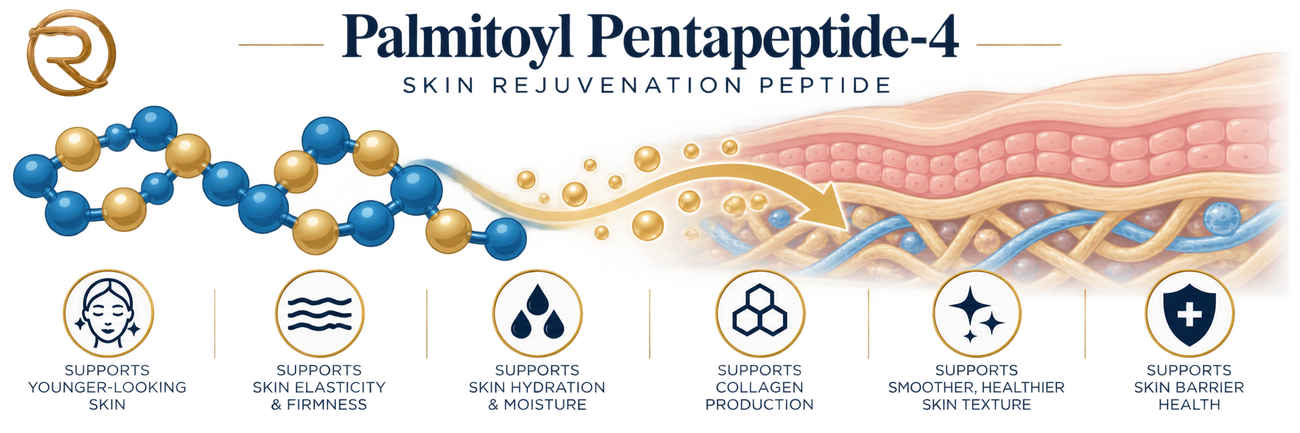
What the studies actually found
In a 12-week, double-blind, placebo-controlled, split-face study, the side treated with pal-KTTKS showed significantly reduced wrinkles and fine lines versus the placebo-moisturizer side — confirmed by both quantitative image analysis and expert visual grading, not just self-report.
READ THE RESEARCH →Pal-KTTKS corresponds to residues 212-216 of human type I procollagen — a piece your body already produces when collagen breaks down. Researchers built a synthetic version, attached a fat molecule so it can cross skin's outer layer, and use it as a "matrikine": a fragment that signals fibroblasts to make more of the real thing.
READ THE RESEARCH →Researchers treating human dermal fibroblasts found pal-KTTKS increased CTGF and α-SMA — markers of the transition to the contractile cells that pull wounds closed — in a dose-dependent way, highlighting a genuine balancing act between healthy wound closure and excess scarring.
READ THE RESEARCH →Pal-KTTKS has been in commercial serums and creams since 2000 and shows up in countless products worldwide, but the controlled human evidence base is mostly a couple of sponsor-conducted studies rather than a large independent trial record — genuinely promising, not yet exhaustively proven.
READ THE RESEARCH →Researchers report pal-KTTKS suppresses matrix metalloproteinases (MMP-1, MMP-3) — the same enzymes that break collagen down over time — while simultaneously signaling fibroblasts to synthesize new collagen, fibronectin, and hyaluronic acid.
EXPLORE THE SCIENCE →Palmitoyl Pentapeptide-4 — Overview
What Is Palmitoyl Pentapeptide-4?
Palmitoyl Pentapeptide-4 is a small synthetic peptide best known for its role in skin biology and cosmetic science. Its scientific shorthand is pal-KTTKS, reflecting the five-amino-acid sequence Lysine–Threonine–Threonine–Lysine–Serine (KTTKS) with a 16-carbon palmitoyl fatty-acid chain attached to its N-terminus.
The KTTKS sequence itself isn’t an arbitrary laboratory design — it comes from type I procollagen, the precursor molecule from which one of the principal structural collagens in human skin is produced. Researchers discovered that a very small fragment of this much larger collagen-associated region could influence extracellular-matrix production in fibroblasts. That observation helped establish an important idea in skin biology: fragments generated from larger structural proteins can sometimes act as biological signals of their own. These signaling fragments are often described as matrikines.
Palmitoyl Pentapeptide-4 is therefore best understood not simply as an “anti-aging peptide,” but as a synthetic, lipid-modified version of a collagen-derived signaling sequence. The palmitoyl group changes the physical properties of the small peptide, making it more lipophilic and better suited to topical formulations and interaction with the skin’s outer environment; research has found the palmitoylated form to be more stable than unmodified KTTKS under certain experimental conditions. The ingredient became commercially associated with the name Matrixyl, and it has since become one of the most recognized peptide ingredients in cosmetic skin-care science.
Its importance comes from the biological question behind it: can a small fragment associated with collagen production act as a signal that encourages the skin’s connective-tissue machinery to produce more of its own structural components? That question has driven more than two decades of research.
Scientific Discovery & Development
The story of Palmitoyl Pentapeptide-4 begins with a much larger molecule: type I collagen. Collagen isn’t produced in its final form — fibroblasts first manufacture procollagen, a precursor containing additional peptide regions at its ends. Scientists investigating these regions began asking whether the fragments released during collagen processing were merely molecular leftovers, or whether they could communicate information back to cells.
In 1991, Katayama, Seyer, Raghow, and Kang examined chemically synthesized fragments from the carboxyl-terminal region of human type I procollagen and found that particular fragments (later designated R9 and R11) could increase production of extracellular-matrix components by fibroblasts sixfold to eightfold, while a different terminal fragment was actually inhibitory.¹ A subsequent 1993 study by Katayama and colleagues — now joined by Armendariz-Borunda — narrowed the active region down much further, reporting that the five-amino-acid sequence Lys-Thr-Thr-Lys-Ser, or KTTKS, represented the minimum sequence required for potent stimulation of collagen and fibronectin production in several mesenchymal cell models.² This was a significant conceptual step — a biologically active signal had been reduced from a large collagen-associated region to just five amino acids.
The next challenge was practical. KTTKS is small and relatively hydrophilic, properties that can limit its ability to move through the skin’s outer barrier, so researchers explored chemical modification, including attachment of a fatty-acid chain. In the late 1990s, Karl Lintner and researchers at the French cosmetic-ingredient company Sederma developed palmitoylated versions of KTTKS, described in their 2000 publication on biologically active peptides moving from laboratory curiosity to functional skin-care product.³ The resulting compound became known commercially as Matrixyl and entered the cosmetic market around 2000; the ingredient was originally referred to as Palmitoyl Pentapeptide-3 before being renamed Palmitoyl Pentapeptide-4 to reflect corrected structural nomenclature.
The scientific journey follows a remarkably clear progression: collagen biology → identification of bioactive fragments → discovery of KTTKS → lipid modification → topical development → clinical investigation.
Why Researchers Are Studying Palmitoyl Pentapeptide-4
The central scientific interest in Palmitoyl Pentapeptide-4 is the extracellular matrix, or ECM — the structural environment surrounding cells. Skin is not simply a collection of skin cells; much of its strength, organization, elasticity, and mechanical behavior comes from the matrix those cells build around themselves. Collagen provides structural framework, while proteins such as fibronectin help organize interactions between cells and matrix components. As skin ages and accumulates environmental damage, its connective-tissue architecture changes — collagen production and organization are affected, and the balance between matrix construction and degradation shifts.
That creates an important research opportunity. Rather than supplying collagen from outside the body, researchers have investigated whether a peptide signal could encourage fibroblasts — the cells responsible for much of the dermal matrix — to increase production of matrix components themselves. Laboratory studies with KTTKS have reported increased synthesis of collagen I, collagen III, and fibronectin, providing the biological foundation for investigating palmitoylated KTTKS as a topical cosmetic ingredient. The broader significance is that Palmitoyl Pentapeptide-4 represents a signal-based approach to skin appearance — instead of acting primarily as a surface moisturizer or physical filler, it’s designed around the possibility of influencing the biological processes that maintain the dermal matrix.
Biological Foundation
To understand the peptide, it helps to picture the dermis as a living construction site. Fibroblasts are among its principal builders — they produce and organize components of the extracellular matrix, including collagen and fibronectin. Collagen provides much of the tissue’s structural strength, while fibronectin participates in the organization and interaction of cells with their surrounding matrix. Collagen production is itself a carefully regulated process — procollagen is synthesized inside fibroblasts, processed, and eventually assembled into the collagen-rich architecture of connective tissue.
During this process, peptide fragments can be generated from larger precursor molecules. The discovery of KTTKS suggested that at least some of these fragments may function as matrikine signals — molecular messages capable of influencing matrix behavior. Palmitoyl Pentapeptide-4 builds on this concept by taking that short collagen-derived sequence and attaching a palmitoyl group. The result isn’t a collagen molecule and doesn’t replace collagen — it’s a much smaller signaling-oriented molecule whose scientific interest comes from how it may interact with the skin’s matrix-producing environment. The detailed molecular events involved in that signaling are explored more deeply on the Science page.
What Researchers Are Investigating
Collagen and extracellular-matrix production — early laboratory research provided the foundation by showing that KTTKS could stimulate production of collagen and fibronectin in fibroblast models; the palmitoylated derivative subsequently became the form most relevant to topical cosmetic development.
Whether topical application produces measurable changes in human skin — a 2005 double-blind, placebo-controlled, split-face study (industry-funded, conducted by Procter & Gamble researchers) evaluated a moisturizer containing 3 ppm pal-KTTKS in 93 women aged 35–55. After 12 weeks, the peptide-containing treatment produced statistically significant improvements in fine lines and wrinkles compared with the control formulation, and the ingredient was reported to be well tolerated.⁴ This study was important because it moved the discussion beyond cultured cells, providing human evidence that a topical formulation containing palmitoyl pentapeptide could be associated with measurable changes in photoaged facial skin. A later, smaller 2023 randomized trial in Indonesian women with crow’s feet also tested Palmitoyl Pentapeptide-4 cream, but with only 7 participants per arm over 8 weeks, the trends favoring the peptide cream didn’t reach statistical significance — a reminder that not every study in this space is adequately powered.⁵
Delivery — small peptides can be vulnerable to enzymatic degradation, and the outermost layer of skin presents a formidable barrier to penetration. Experimental work has found pal-KTTKS more stable than KTTKS in certain skin models, while newer formulation approaches — including lipid-based vesicles — are being explored to improve peptide stability and delivery.⁶ The scientific challenge isn’t simply discovering that a peptide can affect cells in a laboratory; it’s determining whether the molecule can remain sufficiently stable, reach the relevant biological environment, and produce a meaningful effect when incorporated into a real topical formulation.
Potential Benefits & Biological Significance
The principal potential application of Palmitoyl Pentapeptide-4 is improvement in the appearance of photoaged skin, particularly fine lines and wrinkles. The biological rationale is straightforward: if signaling through the peptide influences fibroblast activity and extracellular-matrix production, the resulting changes could contribute to improvements in the structural characteristics and visible appearance of aging skin. Human research has provided evidence of improved wrinkle appearance, while laboratory studies provide a plausible biological foundation involving collagen and fibronectin production.
But the evidence should be interpreted carefully. The strongest human evidence concerns topical cosmetic applications and visible skin outcomes; much of the mechanistic evidence comes from cellular or experimental models. It would therefore be inappropriate to treat Palmitoyl Pentapeptide-4 as a proven systemic regenerative therapy or to extrapolate cosmetic skin findings into unrelated medical applications. What makes the peptide scientifically interesting is precisely the connection between these levels of evidence: a short sequence originating from collagen biology can be chemically modified, incorporated into a topical formulation, and investigated for whether it can influence the appearance of the tissue from which its biological inspiration originated.
Current Research Stage & Future Outlook
Palmitoyl Pentapeptide-4 is not an FDA-approved drug and is not undergoing the conventional Phase 1–3 pharmaceutical development pathway for a therapeutic indication. Its established role is primarily as a cosmetic active ingredient, with scientific research focused on skin biology, topical delivery, extracellular-matrix signaling, and visible skin outcomes. This regulatory distinction matters: in the United States, cosmetic ingredients generally don’t undergo FDA premarket approval the way drugs do (with the exception of color additives), although companies remain responsible for product safety and truthful, non-misleading labeling.⁷
Research continues to explore ways of improving the peptide’s performance, particularly through formulation and delivery technologies — recent experimental work examining liposomal delivery, for example, suggests that packaging pal-KTTKS within phospholipid vesicles may improve stability and skin delivery while enhancing collagen-related activity in fibroblast models. The future of this field is therefore less about proving that one cosmetic peptide is a universal anti-aging solution and more about understanding whether short bioactive peptides can be engineered into increasingly precise signals for tissue biology.
Global Research Perspective
The scientific story behind Palmitoyl Pentapeptide-4 crosses several research environments. The original KTTKS discovery emerged from collagen and connective-tissue research in the United States (University of Tennessee), while its transformation into a commercially useful topical peptide was strongly associated with French peptide and cosmetic-ingredient research led by Karl Lintner at Sederma, based in France. Later research has expanded internationally, including work in South Korea examining the stability and skin permeability of KTTKS and pal-KTTKS, as well as more recent research investigating advanced delivery systems and new peptide derivatives. This progression reflects a broader evolution in peptide science: the field has moved from identifying naturally inspired sequences to engineering their physical properties, optimizing delivery, and testing whether molecular signals can be translated into measurable tissue-level outcomes.
Why This Matters
Palmitoyl Pentapeptide-4 represents a particularly interesting chapter in peptide science because its story begins with one of the body’s fundamental structural proteins: collagen. Scientists discovered that a tiny sequence hidden within the larger collagen system could influence extracellular-matrix biology; that sequence was then chemically modified to make it more suitable for topical use, developed into a commercial peptide, and eventually evaluated in human studies. Its significance extends beyond wrinkles — the larger scientific idea is that small peptides can act as biological signals, potentially allowing researchers to influence complex tissue processes without having to supply the entire structural protein itself. That concept — turning fragments of biology into precise molecular signals — is what makes Palmitoyl Pentapeptide-4 worth studying, and it’s also the question that leads naturally into the next layer of the story: what exactly does pal-KTTKS do when it encounters the cells and molecular machinery of the skin?
References
- Katayama K, Seyer JM, Raghow R, Kang AH. Regulation of extracellular matrix production by chemically synthesized subfragments of type I collagen carboxy propeptide. Biochemistry. 1991;30(29):7097-7104.
- Katayama K, Armendariz-Borunda J, Raghow R, Kang AH, Seyer JM. A pentapeptide from type I procollagen promotes extracellular matrix production. Journal of Biological Chemistry. 1993. https://pubmed.ncbi.nlm.nih.gov/8486721/
- Lintner K, Peschard O. Biologically active peptides: from a laboratory bench curiosity to a functional skin care product. International Journal of Cosmetic Science. 2000;22(3):207-218.
- Robinson LR, Fitzgerald NC, Doughty DG, Dawes NC, Berge CA, Bissett DL. Topical palmitoyl pentapeptide provides improvement in photoaged human facial skin. International Journal of Cosmetic Science. 2005;27(3):155-160. https://pubmed.ncbi.nlm.nih.gov/18492182/ (industry-funded study; all authors were Procter & Gamble employees)
- Aruan RR, Hutabarat H, Widodo AA, et al. Double-blind, Randomized Trial on the Effectiveness of Acetylhexapeptide-3 Cream and Palmitoyl Pentapeptide-4 Cream for Crow’s Feet. Journal of Clinical and Aesthetic Dermatology. 2023;16(2):37-43. https://pubmed.ncbi.nlm.nih.gov/36909866/ (3-arm trial, n=7/arm, differences not statistically significant)
- Choi YL, Park EJ, Kim E, Na DH, Shin YH. Dermal Stability and In Vitro Skin Permeation of Collagen Pentapeptides (KTTKS and palmitoyl-KTTKS). Biomolecules & Therapeutics. 2014;22(4):321-327. https://pubmed.ncbi.nlm.nih.gov/25143811/
- U.S. FDA, “Authority Over Cosmetics: How Cosmetics Are Not FDA-Approved, but Are FDA-Regulated.” https://www.fda.gov/cosmetics
Palmitoyl Pentapeptide-4 — The Research
How Was Palmitoyl Pentapeptide-4 Discovered?
The scientific story of Palmitoyl Pentapeptide-4 didn’t begin with a cosmetic cream — it began with a more fundamental question: can fragments of the extracellular matrix tell skin cells how to rebuild themselves? During the late 1980s and early 1990s, researchers studying collagen biology were discovering that collagen was more than a structural material. When collagen and related precursor proteins are broken down, they can release short peptide fragments called matrikines — rather than being biologically meaningless debris, some of these fragments appeared capable of influencing fibroblasts, the cells responsible for producing much of the skin’s extracellular matrix.
A key step came from work by Katayama, Seyer, Raghow, and Kang, who investigated fragments of the C-terminal region of type I procollagen. In 1991, their experiments identified fragments (designated R9 and R11) capable of stimulating human fibroblasts to produce extracellular-matrix components — including collagen and fibronectin — sixfold to eightfold, while a different terminal fragment was actually inhibitory.¹ Researchers then progressively shortened the active sequence to determine which part was responsible for the biological signal. That work, now with Armendariz-Borunda joining the team, ultimately identified the five-amino-acid sequence Lys-Thr-Thr-Lys-Ser, or KTTKS, as the minimum sequence retaining substantial activity.² KTTKS became an important example of a matrikine: a small peptide derived from a larger structural protein that can act as a biological signal.
The next problem was practical. KTTKS itself is relatively hydrophilic, making movement through the skin’s lipid-rich outer barrier difficult. Researchers therefore attached a palmitoyl lipid chain to the peptide, creating pal-KTTKS, now commonly identified as Palmitoyl Pentapeptide-4 and historically associated with the trade name Matrixyl. The modification increased lipophilicity and was intended to improve the peptide’s stability and ability to reach the skin.³
The progression was unusually direct: collagen research → matrikine discovery → identification of KTTKS → palmitoylation → topical research → human cosmetic studies.
Evolution of the Research
From collagen fragment to biological signal. The earliest research established the central scientific idea: a short sequence originating from collagen could influence fibroblast behavior. In laboratory studies, KTTKS increased extracellular-matrix production and promoted synthesis of type I and type III collagen and fibronectin — important because it suggested fragments generated during matrix turnover might participate in a feedback system influencing tissue remodeling.⁴ The research then moved from identifying biological activity to improving delivery.
From KTTKS to Pal-KTTKS. Palmitoylation changed the physical properties of the molecule, and studies subsequently examined whether pal-KTTKS could remain stable in skin and penetrate beyond the outermost barrier. A 2014 study compared KTTKS with palmitoyl-KTTKS and investigated dermal stability and skin permeation.³ The work helped establish why lipid modification became an important part of the peptide’s development as a topical ingredient. The scientific question had now shifted from “Can this sequence affect fibroblasts?” to “Can a modified version deliver that biological signal through skin?”
From laboratory biology to human research. The next step was testing whether the laboratory findings translated into visible changes in human skin — producing some of the most frequently cited clinical evidence for Palmitoyl Pentapeptide-4.
The Most Important Studies
Identifying the active KTTKS sequence (1991–1993). Researchers began with larger fragments of the C-terminal region of type I procollagen and systematically narrowed them down, discovering that increasingly smaller peptide sequences retained the ability to stimulate extracellular-matrix production; KTTKS emerged as the critical five-amino-acid sequence.¹ ² This work provided the scientific foundation for everything that followed — Palmitoyl Pentapeptide-4 wasn’t developed simply because “peptides are good for skin.” Its research history came from identifying a specific biological sequence within collagen and demonstrating that the sequence itself could influence fibroblast activity.
Topical Palmitoyl Pentapeptide in Photoaged Human Skin (2005). A double-blind, placebo-controlled, randomized split-face human study of 93 women aged 35–55, conducted over 12 weeks — this study asked the question laboratory experiments couldn’t answer: does topical pal-KTTKS produce measurable changes in human photoaged skin?⁵ Participants applied a moisturizer containing 3 ppm pal-KTTKS to one side of the face and a control moisturizer to the other; researchers used quantitative image analysis and expert grading to assess fine lines and wrinkles. The peptide-containing formulation produced statistically significant improvements in wrinkle and fine-line measures compared with the control, participants also reported improvements in their own assessments of skin appearance, and the treatment was well tolerated. (Worth noting: all six authors were Procter & Gamble employees, so this was industry-funded research.) This was an important bridge between mechanism and visible outcome — the research didn’t establish Palmitoyl Pentapeptide-4 as a drug treatment for aging, but it provided controlled human evidence that a topical formulation containing the peptide could improve measured aspects of photoaged skin.
Measuring the peptide in cosmetic formulations (2009). As palmitoylated peptides became increasingly common in cosmetic formulations, researchers faced a different problem: can the actual amount of peptide in a finished product be accurately measured? A French team (Université d’Orléans/CNRS and LVMH Recherche) developed a liquid chromatography–tandem mass spectrometry method capable of specifically detecting pal-KTTKS in cosmetic formulations, and found that palmitoyl-KTTKS stability varied widely by formulation — from near-100% retention in some products to more than 70% degradation in others.⁶ This work may appear less exciting than a clinical trial, but it addressed an important scientific limitation: if an active peptide is being studied in a cream, researchers need reliable analytical methods to determine whether the ingredient is present, how much is present, and how formulation affects its availability.
Research into wound remodeling (2017). Researchers in South Korea explored whether pal-KTTKS could influence fibroblast behavior during tissue contraction and remodeling. In cell and collagen-lattice models, 0.1 μM pal-KTTKS significantly reduced α-smooth muscle actin-positive stress fibers (from 75±7.1% down to 38.6±16.1%, p<0.05) and the proportion of fibroblasts displaying myofibroblast characteristics, though the effect wasn’t statistically significant at a higher concentration of 0.5 μM.⁷ This finding broadened the research question beyond cosmetic wrinkles, suggesting pal-KTTKS can influence cellular behavior involved in matrix remodeling and wound contraction — but it remains preclinical evidence and shouldn’t be interpreted as proof that topical Palmitoyl Pentapeptide-4 treats wounds or scars in humans.
Research Findings by Major Biological Area
Extracellular matrix & collagen — this is the strongest scientific theme surrounding Palmitoyl Pentapeptide-4. Laboratory research consistently connects KTTKS and pal-KTTKS with fibroblast activity and extracellular-matrix production, particularly involving collagen and fibronectin; some studies also report effects involving elastin and hyaluronic-acid-related pathways.⁴ The important point is that these findings began at the cellular level and were later followed by controlled human cosmetic studies showing improvements in visible wrinkles — the evidence forms a chain rather than a single isolated observation: biological activity → modified delivery → human topical testing → measurable skin outcomes.
Skin appearance & photoaging — human evidence is strongest here. Controlled studies have reported improvements in fine lines, wrinkles, surface texture, and related measures of photoaged skin. A 2009 study using three-dimensional imaging also evaluated products containing Pal-KT and Pal-KTTKS (alongside niacinamide and carnosine) in women with periorbital wrinkles, further extending research into objective measurement of wrinkle appearance.⁸ The evidence supports cosmetic improvement in skin appearance, rather than establishing reversal of biological aging.
Skin delivery — delivery remains scientifically important because peptides generally face difficulty crossing the skin barrier. Palmitoylation was specifically introduced to make KTTKS more lipophilic; research examining dermal stability and permeation supports the rationale for this modification, although the degree of penetration and biological activity can depend heavily on the formulation in which the peptide is delivered.³
Human Research & Clinical Evidence
The human evidence base is relatively small compared with pharmaceuticals, but it contains controlled studies rather than relying entirely on laboratory observations. The most notable controlled trial involved 93 women aged 35–55, who used a moisturizer containing 3 ppm pal-KTTKS for 12 weeks in a randomized split-face design; the study found significant improvements in fine lines and wrinkles compared with the control formulation.⁵ Other cosmetic research has evaluated peptide-containing formulations in smaller groups and over shorter periods, including studies of periorbital wrinkles.⁸ A 2023 three-arm randomized trial compared acetylhexapeptide-3 cream, Palmitoyl Pentapeptide-4 cream, and placebo in Indonesian women with crow’s feet; with only 7 participants per arm over 8 weeks, the peptide creams trended favorably on clinical and satisfaction scores, but differences from placebo weren’t statistically significant — a limitation the authors attributed to the small sample size and short duration.⁹
These studies are useful because they examine the ingredient in realistic topical formulations, but they also introduce an important limitation: a finished cosmetic product can contain multiple active ingredients, so not every observed effect can automatically be attributed to Palmitoyl Pentapeptide-4 alone. This is an important distinction when interpreting cosmetic peptide research, and several of the key studies (including the largest and most-cited one) were funded by ingredient or cosmetics manufacturers.
Preclinical Research
Preclinical work continues to explore questions that can’t be answered through appearance-based clinical trials. Cellular studies have examined extracellular-matrix production, collagen biosynthesis, fibroblast behavior, and tissue contraction. More recent research has also explored KTTKS derivatives and delivery systems, including lipid-based and liposomal approaches intended to improve peptide stability or delivery. These studies are scientifically useful because they investigate how and under what conditions the peptide behaves biologically — they don’t, however, establish equivalent effects in living humans.
Current Research Stage
Palmitoyl Pentapeptide-4 occupies a different category from experimental injectable peptides. It’s not an FDA-approved drug and is not being developed through the conventional Phase 1–3 pharmaceutical approval pathway for a therapeutic indication. Instead, Palmitoyl Pentapeptide-4 is principally studied and used as a topical cosmetic ingredient, with research focused on skin appearance, extracellular-matrix biology, formulation, delivery, and related dermatologic applications.
This distinction is important because the FDA does not generally preapprove cosmetic products or their ingredients before they enter the U.S. market, except for color additives — cosmetic companies remain responsible for product safety and compliance with applicable requirements.¹⁰ Therefore, describing Palmitoyl Pentapeptide-4 as an “FDA-approved anti-aging peptide” would be scientifically and regulatorily inaccurate.
What the Evidence Shows
Stronger evidence supports the conclusion that topical formulations containing Palmitoyl Pentapeptide-4 can produce measurable improvements in the appearance of fine lines and wrinkles, particularly in controlled cosmetic studies. Laboratory research also provides a credible biological basis involving extracellular-matrix activity.
Emerging evidence — research continues to investigate skin penetration, formulation, matrix remodeling, and the cellular behavior of fibroblasts. These areas may improve understanding of why some formulations perform differently from others.
Early or experimental evidence — wound remodeling, scar-related biology, antimicrobial peptide derivatives, and advanced delivery systems remain primarily laboratory or preclinical areas. These findings are scientifically interesting but shouldn’t be presented as established clinical applications.
What Researchers Are Studying Now
Current research is increasingly focused on how to make peptide delivery more effective and biologically reproducible. Researchers are investigating modified KTTKS structures, lipid conjugates, peptide amphiphiles, and encapsulation systems that may alter stability, localization, and delivery. A 2022 study, for example, used KTTKS as the foundation for new ionic-liquid peptide conjugates and reported both collagenesis-related and antimicrobial activity in laboratory models.¹¹ These compounds are experimental derivatives — not evidence that Palmitoyl Pentapeptide-4 itself is an antimicrobial treatment. This represents an important evolution in the field: researchers are moving beyond simply asking whether KTTKS has biological activity and toward understanding how peptide structure and delivery can control that activity.
Future Scientific Potential
The continuing interest in Palmitoyl Pentapeptide-4 comes from an unusual combination of factors: a clearly defined sequence, a biological origin in collagen, measurable activity in human fibroblasts, a practical lipid modification, and controlled human cosmetic research. Its future scientific potential is therefore less about becoming a conventional systemic drug and more about refining topical peptide biology — including delivery, formulation, matrix remodeling, and combinations with other skin-active compounds. What research has demonstrated is relatively clear: Palmitoyl Pentapeptide-4 has biological activity relevant to extracellular-matrix regulation, and topical formulations containing it have produced measurable improvements in aspects of photoaged skin. What researchers are still investigating is how much of that activity can be optimized through molecular design and delivery. That distinction — between what has been demonstrated and what remains possible — is central to understanding the peptide’s place in modern skin research.
Why This Matters
Palmitoyl Pentapeptide-4 is a useful example of how modern cosmetic peptide science developed: researchers first identified a biologically active fragment of collagen, narrowed its activity to a five-amino-acid sequence, modified that sequence to improve topical delivery, and eventually tested the resulting peptide-containing formulations in humans. The evidence is strongest for topical cosmetic effects on the appearance of photoaged skin, supported by a plausible extracellular-matrix research foundation. At the same time, much of the broader biology remains laboratory or preclinical. The scientific significance is therefore not that one small peptide has solved skin aging — it’s that Palmitoyl Pentapeptide-4 helped demonstrate a broader concept: small fragments derived from structural proteins can function as biological signals, and those signals can potentially be engineered into practical topical technologies. That concept continues to drive research into peptide-based skin biology today.
References
- Katayama K, Seyer JM, Raghow R, Kang AH. Regulation of extracellular matrix production by chemically synthesized subfragments of type I collagen carboxy propeptide. Biochemistry. 1991;30(29):7097-7104.
- Katayama K, Armendariz-Borunda J, Raghow R, Kang AH, Seyer JM. A pentapeptide from type I procollagen promotes extracellular matrix production. Journal of Biological Chemistry. 1993. https://pubmed.ncbi.nlm.nih.gov/8486721/
- Choi YL, Park EJ, Kim E, Na DH, Shin YH. Dermal Stability and In Vitro Skin Permeation of Collagen Pentapeptides (KTTKS and palmitoyl-KTTKS). Biomolecules & Therapeutics. 2014;22(4):321-327. https://pubmed.ncbi.nlm.nih.gov/25143811/
- Reference review of matrikine/KTTKS biology on ECM production (collagen I/III, fibronectin).
- Robinson LR, Fitzgerald NC, Doughty DG, Dawes NC, Berge CA, Bissett DL. Topical palmitoyl pentapeptide provides improvement in photoaged human facial skin. International Journal of Cosmetic Science. 2005;27(3):155-160. https://pubmed.ncbi.nlm.nih.gov/18492182/
- Chirita RI, Chaimbault P, Archambault JC, Robert I, Elfakir C. Development of a LC-MS/MS method to monitor palmitoyl peptides content in anti-wrinkle cosmetics. Analytica Chimica Acta. 2009. https://pubmed.ncbi.nlm.nih.gov/19393372/
- Park H, An E, Cho Lee AR. Effect of Palmitoyl-Pentapeptide (Pal-KTTKS) on Wound Contractile Process in Relation with Connective Tissue Growth Factor and α-Smooth Muscle Actin Expression. Tissue Engineering and Regenerative Medicine. 2017;14(1):73-80. https://pubmed.ncbi.nlm.nih.gov/30603464/
- Kaczvinsky JR, Griffiths CEM, Schnicker MS, Li J. Efficacy of anti-aging products for periorbital wrinkles as measured by 3-D imaging. Journal of Cosmetic Dermatology. 2009;8(3):228-233. https://pubmed.ncbi.nlm.nih.gov/19735523/
- Aruan RR, Hutabarat H, Widodo AA, et al. Double-blind, Randomized Trial on the Effectiveness of Acetylhexapeptide-3 Cream and Palmitoyl Pentapeptide-4 Cream for Crow’s Feet. Journal of Clinical and Aesthetic Dermatology. 2023;16(2):37-43. https://pubmed.ncbi.nlm.nih.gov/36909866/
- U.S. FDA, “Authority Over Cosmetics: How Cosmetics Are Not FDA-Approved, but Are FDA-Regulated.” https://www.fda.gov/cosmetics
- Boosting Cosmeceutical Peptides: Coupling Imidazolium-Based Ionic Liquids to Pentapeptide-4 Originates New Leads with Antimicrobial and Collagenesis-Inducing Activities. Microbiology Spectrum. 2022. https://pubmed.ncbi.nlm.nih.gov/35950860/
Palmitoyl Pentapeptide-4 — The Science
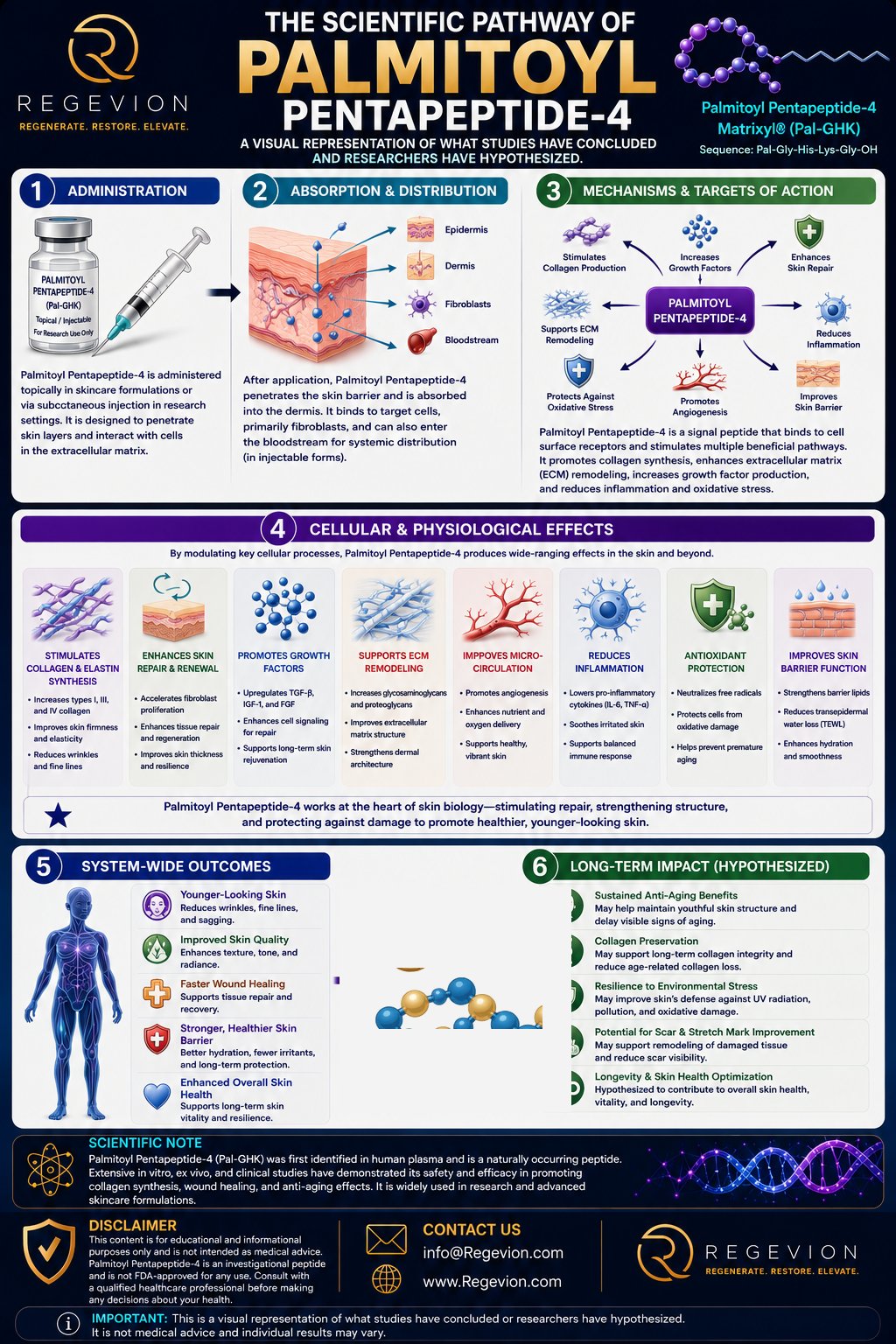
Palmitoyl Pentapeptide-4, commonly written as Pal-KTTKS, is best understood not as a conventional hormone or systemic signaling drug, but as a topically delivered matrikine: a small signaling peptide derived from a sequence within the C-terminal propeptide of type I procollagen.
Its biological context begins in the extracellular matrix (ECM) of the skin. Dermal fibroblasts continuously produce structural components such as collagen, elastin, fibronectin, and glycosaminoglycans. This matrix isn’t simply scaffolding — it’s a dynamic signaling environment in which fragments generated during matrix remodeling can influence fibroblast behavior. The parent sequence, KTTKS — lysine-threonine-threonine-lysine-serine — was identified as a biologically active fragment of type I procollagen. Research by Katayama and colleagues demonstrated that collagen-derived peptide fragments could feed information back to fibroblasts and stimulate extracellular-matrix production.¹
Palmitoyl Pentapeptide-4 adds a palmitoyl group, a 16-carbon fatty-acid chain, to the peptide. This lipid modification increases its lipophilicity and improves its stability and ability to partition into the skin’s outer barrier compared with the unmodified KTTKS peptide — in experimental skin-permeation studies, pal-KTTKS demonstrated greater stability and permeability than KTTKS alone.² The resulting biological concept: Pal-KTTKS → skin penetration → interaction with dermal cells → extracellular-matrix signaling → altered fibroblast activity → changes in matrix production and remodeling. The important point is that Pal-KTTKS doesn’t function primarily by replacing a circulating hormone — its proposed activity is local and matrix-directed.
1. Molecular Mechanism of Action
The central mechanism is often described as signal-peptide or matrikine activity. When extracellular collagen is naturally processed, fragments of the parent protein can appear in the surrounding matrix; some of these fragments act as informational molecules, and KTTKS appears to reproduce part of this signaling behavior.
Once Pal-KTTKS reaches the relevant extracellular environment, the KTTKS sequence can interact with fibroblast signaling machinery. The exact membrane receptor responsible for this activity, however, hasn’t been definitively established — an important distinction: the biological response is reasonably well documented in experimental systems, but the precise receptor-level mechanism remains incompletely resolved.
The downstream effect is more clearly characterized. KTTKS has been shown to stimulate extracellular-matrix production in fibroblasts, including increased production of type I and type III collagen and fibronectin. Experimental work has also associated KTTKS signaling with increased expression of transforming growth factor-β-related pathways and collagen expression.³
The proposed sequence: Pal-KTTKS enters the skin → the KTTKS signaling sequence becomes available to dermal cells → fibroblast signaling is altered → matrix-related gene expression and protein synthesis increase → production of structural ECM components changes → dermal matrix organization and mechanical properties can change over time. This is fundamentally different from a peptide that directly inhibits a single enzyme or activates a well-characterized G-protein-coupled receptor.
2. Receptor Biology & Cellular Signaling
One of the most important scientific qualifications surrounding Palmitoyl Pentapeptide-4 is that there is no universally accepted, molecularly defined receptor equivalent to the receptors characterized for classical peptide hormones — describing Pal-KTTKS as a conventional receptor agonist would overstate the evidence.
The stronger evidence concerns the cellular response. Fibroblasts exposed to KTTKS or Pal-KTTKS can increase extracellular-matrix production, with studies reporting effects involving collagen synthesis, fibronectin, and other matrix components; a review of matrikine biology describes KTTKS as promoting ECM production and increasing expression of collagen types I and III, and Pal-KTTKS has also been reported to increase procollagen secretion and type I collagen-related expression in human fibroblasts.³ TGF-β is particularly interesting because it’s one of the major regulators of fibroblast behavior and matrix synthesis — experimental work has linked KTTKS to increased TGF-β expression and stabilization of messenger RNA associated with that pathway. However, this should be interpreted as support for a downstream signaling association, rather than proof that Pal-KTTKS acts as a direct TGF-β receptor agonist.
This distinction illustrates the current mechanistic hierarchy: established — KTTKS is a collagen-derived bioactive peptide that can stimulate ECM production in experimental fibroblast systems; strongly supported — palmitoylation improves the peptide’s stability and skin permeability, facilitating topical delivery; supported but mechanistically incomplete — KTTKS influences collagen-related and TGF-β-associated cellular signaling; not established — a single definitive cell-surface receptor and complete intracellular signaling cascade responsible for every observed effect.
3. Pharmacology
Palmitoyl Pentapeptide-4 has a pharmacology fundamentally different from that of systemic peptide therapeutics. Its intended application is topical, and its biological activity is primarily investigated at the skin level. The palmitoyl modification is pharmacologically important because it changes the physical behavior of the molecule — KTTKS itself is relatively small and hydrophilic, and attaching palmitic acid increases lipophilicity, improves resistance to degradation, and enhances interaction with the lipid-rich environment of the stratum corneum; experimental work found greater dermal stability and permeability for pal-KTTKS than for the unmodified peptide.² That means the palmitoyl group isn’t simply a chemical decoration — it’s part of the delivery strategy.
There is no established human systemic pharmacokinetic profile comparable to that available for an approved injectable peptide drug. Robust clinical values for systemic bioavailability, plasma half-life, volume of distribution, clearance, or receptor occupancy haven’t been established for Palmitoyl Pentapeptide-4, and these parameters shouldn’t be invented or extrapolated from unrelated peptides.
4. Pharmacokinetics: What Happens to the Peptide?
After topical application, the first pharmacokinetic challenge is the stratum corneum, the skin’s principal permeability barrier. Palmitoylation increases the molecule’s compatibility with this lipid-rich barrier and has been shown experimentally to improve penetration relative to unmodified KTTKS.² From there, the scientifically relevant question isn’t simply how much peptide enters the bloodstream, but how much reaches the biologically relevant skin compartment and remains intact long enough to interact with dermal cells.
Human pharmacokinetic data describing plasma concentrations and systemic half-life aren’t well established. For a topical cosmetic peptide, this is expected — the desired biological activity is local rather than systemic. Formulation therefore becomes part of the pharmacology: vehicle composition, peptide concentration, stability, skin condition, application area, and barrier characteristics can all influence the amount of intact peptide that becomes available to the tissue.
5. Dose, Exposure & Dose-Response
Palmitoyl Pentapeptide-4 doesn’t have a clinically established systemic dose-response curve. One of the best-known human studies evaluated a moisturizer containing 3 ppm Pal-KTTKS, applied topically for 12 weeks in a randomized, double-blind, split-face study involving 93 women aged 35–55 (an industry-funded study conducted by Procter & Gamble researchers). The formulation produced greater improvement in fine lines and wrinkles than the vehicle control.⁴ That concentration shouldn’t be interpreted as an ideal or universally effective dose — it represents the concentration used in a particular formulation and clinical study.
The mechanistic evidence also demonstrates why concentration doesn’t necessarily translate linearly into biological response. In a cultured fibroblast/collagen-lattice wound model, Pal-KTTKS significantly reduced α-smooth-muscle-actin-positive stress fibers at 0.1 μM (75±7.1% down to 38.6±16.1%, p<0.05), but the effect was not statistically significant at the higher concentration of 0.5 μM.⁵ This illustrates a central pharmacological principle: more peptide doesn’t automatically mean more biological benefit. Cellular signaling can become saturable, context-dependent, or even change qualitatively at different exposure levels.
6. Does Body Weight Affect Dose?
There is no established evidence that Palmitoyl Pentapeptide-4 requires weight-based dosing. Because its intended use is topical and local, exposure is more logically influenced by factors such as formulation concentration, amount applied, application area, skin permeability, and frequency of application than by total body mass. Human studies have used fixed topical formulations rather than calculating peptide exposure according to kilograms of body weight⁴ — an important distinction from systemically administered peptides, where body size can sometimes influence distribution and clearance.
7. Lower vs. Higher Exposure
At lower exposure, Pal-KTTKS is expected to produce relatively modest signaling within responsive skin cells. As local exposure increases, more peptide becomes available to interact with the relevant cellular environment, potentially increasing the magnitude of the matrix response. But the relationship is not established as linear — the experimental wound-healing data described above provide an instructive example: 0.1 μM and 0.5 μM didn’t simply produce progressively stronger effects across every measured endpoint.⁵ This may reflect the complexity of fibroblast biology — once a signaling pathway is sufficiently stimulated, additional peptide may provide diminishing returns, and at higher exposure, other cellular pathways may also become more prominent. The evidence therefore supports a concentration-dependent but not necessarily concentration-proportional model.
8. Connecting Molecular Mechanisms to Human Outcomes
The connection between mechanism and visible skin changes can be visualized as a biological chain: Pal-KTTKS reaches the skin → KTTKS acts as a matrikine-like signaling sequence → fibroblast activity changes → collagen and other ECM components are produced or regulated differently → the dermal extracellular matrix is progressively remodeled → skin mechanical and structural properties can change → fine lines and wrinkle appearance may improve.
The human evidence is consistent with the final portion of this pathway. In the 2005 randomized split-face study, topical Pal-KTTKS produced measurable improvements in facial fine lines and wrinkles over 12 weeks.⁴ A later randomized trial in 2023 also tested Palmitoyl Pentapeptide-4 cream in a small group of Indonesian women with crow’s feet; the cream trended favorably compared with placebo, but with only 7 participants per arm over 8 weeks, differences weren’t statistically significant.⁶ These clinical findings establish that a topical formulation can be associated with visible changes, but they don’t prove that collagen stimulation alone accounts for every observed outcome — hydration, vehicle effects, formulation ingredients, and multiple biological processes can contribute to changes in skin appearance.
9. Combination & Pathway Interaction
Palmitoyl Pentapeptide-4 operates within the broader network governing extracellular-matrix synthesis and remodeling — a network that includes fibroblast activity, collagen synthesis, growth-factor signaling, matrix metalloproteinases, inflammatory mediators, and mechanical signaling from the extracellular environment. Matrix metalloproteinases (MMPs), for example, are enzymes responsible for degrading components of the extracellular matrix, including collagen, and are therefore part of the opposing side of the matrix equation: production versus degradation. Pal-KTTKS shouldn’t be described simply as an MMP inhibitor unless a specific formulation or study demonstrates that effect — its better-established role is as a matrix-signaling peptide associated with increased ECM production, making its biology complementary to, rather than identical with, pathways that reduce matrix degradation.
10. What Scientists Still Do Not Fully Understand
The largest mechanistic gap is the identity and complete biology of the primary cellular target for KTTKS/Pal-KTTKS. Scientists have strong evidence that the peptide can alter fibroblast behavior and extracellular-matrix production, but the precise receptor-level sequence connecting peptide recognition to intracellular signaling remains incompletely characterized. Several additional questions remain important: it’s not yet clear how strongly the response varies between different fibroblast populations or between aged and young skin, and the relative contributions of collagen synthesis, matrix remodeling, growth-factor signaling, and changes in other ECM components aren’t completely resolved. Long-term adaptation is another unanswered question — a signaling peptide that repeatedly stimulates a cellular pathway could theoretically produce changes in cellular responsiveness over time, but the long-term molecular consequences of chronic topical exposure aren’t sufficiently characterized to make strong conclusions. These gaps matter because observing a biological response isn’t the same as completely understanding the molecular machinery responsible for it.
Researchers & Scientific Contributors
A foundational contribution came from K. Katayama, R. Raghow, A. H. Kang, and J. M. Seyer, who in 1991 identified collagen-derived fragments capable of stimulating extracellular-matrix production;¹ J. Armendariz-Borunda joined the team for the 1993 paper that narrowed this down to the KTTKS pentapeptide.² The translational development of the palmitoylated form was subsequently explored by Karl Lintner and colleagues at Sederma in France, and L. R. Robinson and colleagues at Procter & Gamble reported the 2005 randomized human study demonstrating improvement in photoaged facial skin with topical Pal-KTTKS.⁴ Later research, including work in South Korea, continued investigating the peptide’s stability, permeability, cellular effects, and relationship to wound and matrix biology.
Why This Matters
Palmitoyl Pentapeptide-4 illustrates an important concept in biological signaling: the extracellular matrix can communicate with the cells that build it. The peptide begins as a short sequence derived from collagen biology; palmitoylation changes how that sequence behaves in the skin, improving its stability and permeability. Once available to responsive cells, the KTTKS sequence can influence fibroblast activity and extracellular-matrix production. The complete scientific chain: collagen-derived signal → cellular communication → fibroblast response → extracellular-matrix remodeling → tissue-level change → visible skin outcome. The significance of Pal-KTTKS isn’t that it acts like a powerful systemic hormone — its interest lies in something subtler: it attempts to reuse one of the skin’s own molecular languages of matrix communication. That distinction is what makes the peptide scientifically interesting. The evidence is much stronger for its matrikine/ECM signaling effects than for a single identified receptor, and that distinction matters for keeping claims about the peptide accurate.
References
- Katayama K, Seyer JM, Raghow R, Kang AH. Regulation of extracellular matrix production by chemically synthesized subfragments of type I collagen carboxy propeptide. Biochemistry. 1991;30(29):7097-7104.
- Choi YL, Park EJ, Kim E, Na DH, Shin YH. Dermal Stability and In Vitro Skin Permeation of Collagen Pentapeptides (KTTKS and palmitoyl-KTTKS). Biomolecules & Therapeutics. 2014;22(4):321-327. https://pubmed.ncbi.nlm.nih.gov/25143811/
- Katayama K, Armendariz-Borunda J, Raghow R, Kang AH, Seyer JM. A pentapeptide from type I procollagen promotes extracellular matrix production. Journal of Biological Chemistry. 1993. https://pubmed.ncbi.nlm.nih.gov/8486721/
- Robinson LR, Fitzgerald NC, Doughty DG, Dawes NC, Berge CA, Bissett DL. Topical palmitoyl pentapeptide provides improvement in photoaged human facial skin. International Journal of Cosmetic Science. 2005;27(3):155-160. https://pubmed.ncbi.nlm.nih.gov/18492182/
- Park H, An E, Cho Lee AR. Effect of Palmitoyl-Pentapeptide (Pal-KTTKS) on Wound Contractile Process in Relation with Connective Tissue Growth Factor and α-Smooth Muscle Actin Expression. Tissue Engineering and Regenerative Medicine. 2017;14(1):73-80. https://pubmed.ncbi.nlm.nih.gov/30603464/
- Aruan RR, Hutabarat H, Widodo AA, et al. Double-blind, Randomized Trial on the Effectiveness of Acetylhexapeptide-3 Cream and Palmitoyl Pentapeptide-4 Cream for Crow’s Feet. Journal of Clinical and Aesthetic Dermatology. 2023;16(2):37-43. https://pubmed.ncbi.nlm.nih.gov/36909866/