What the studies actually found
In the pivotal Phase 2 trial, a quarter of participants on the top dose lost more than 30% of their body weight — "we have not seen results like this before in a trial of less than one year," the lead investigator said at the time.
READ THE RESEARCH →In a substudy of people with MASLD (fatty liver disease), the highest dose produced an average 86% reduction in liver fat — one of the largest liver-fat effects reported for any investigational therapy.
READ THE RESEARCH →At the highest dose, participants saw HbA1c drop by up to 2.02 points and body weight fall by up to 16.9% at 36 weeks — beating the active comparator drug used in the same trial.
READ THE RESEARCH →Topline data from the larger, longer TRIUMPH-1 trial reported 28.3% mean weight reduction at 80 weeks on the highest dose — with the weight-loss curve still not clearly plateaued.
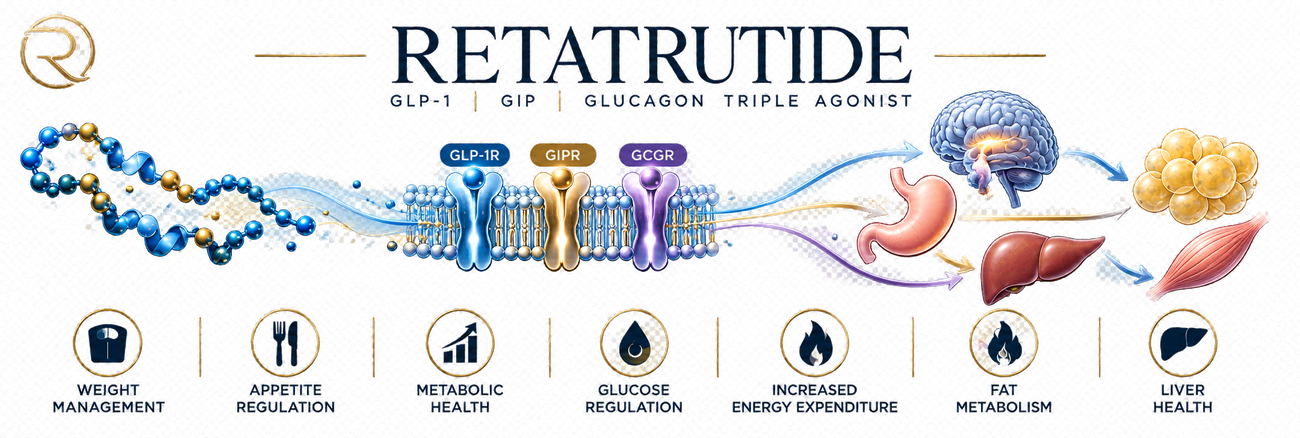
READ THE RESEARCH →Retatrutide is engineered to activate the GLP-1, GIP and glucagon receptors together in a single molecule — a design researchers think may explain why its effects extend beyond weight into liver fat and glucose control.
EXPLORE THE SCIENCE →Retatrutide — Overview
What Is Retatrutide?
Retatrutide is an investigational peptide studied for its role in energy balance, appetite signaling, glucose control, body composition, and metabolic function. It is classified as a triple receptor agonist, engineered to activate three hormone pathways that already exist in human physiology:
- GLP-1 (glucagon-like peptide-1) receptor
- GIP (glucose-dependent insulinotropic polypeptide) receptor
- Glucagon receptor
These receptors sit within the body’s communication network linking the digestive system, pancreas, brain, and liver — coordinating how the body responds to food intake, manages energy, and maintains balance.
Retatrutide’s scientific interest comes from this multi-pathway design. Rather than isolating one signal, researchers are studying whether influencing several interconnected hormone pathways together can deepen understanding of conditions involving excess body fat, insulin resistance, and glucose imbalance. While it has drawn attention for its effects on body weight, its broader significance lies in its studied relationship to glucose regulation, visceral fat, inflammation, and cardiovascular health markers — covered in depth on the Research page.
How Retatrutide Came to Be
Retatrutide grew out of decades of hormone research — first into glucagon, then the incretin hormones GLP-1 and GIP, and eventually the idea that these complementary signals could be engineered into a single molecule. Lilly researchers designed the compound (LY3437943) around that idea, first described in full by Coskun and colleagues in 2022.¹ The full discovery story — from the 1920s isolation of glucagon through today’s Phase 3 trials — is covered on the Research page.
Why Researchers Are Studying It Beyond Weight Loss
Modern research increasingly treats excess body weight as a biological condition involving hormonal signaling, fat-tissue activity, inflammation, and insulin sensitivity — not simply calories in versus calories out. Researchers are examining whether Retatrutide’s multi-pathway activity connects to glucose regulation and prediabetes markers, visceral fat and its inflammatory signaling, cardiovascular risk markers, and joint-related outcomes such as knee osteoarthritis. Each of these areas has its own body of evidence, with citations, on the Research page.
Current Research Stage
Retatrutide has progressed through Phase 1 and Phase 2 trials and is currently in Phase 3 (the TRIUMPH program), the final stage of clinical development before potential regulatory submission.² Any timeline for regulatory review depends on how the remaining trials read out.
Why This Matters
Retatrutide’s significance isn’t just that it activates three receptors — it’s that those receptors sit inside interconnected physiological systems, letting one molecule influence several dimensions of metabolic health at once. That systems-level approach reflects a broader shift in biomedical research: understanding conditions like obesity and insulin resistance as connected biological systems rather than isolated problems. To see the evidence behind these ideas, continue to the Research page.
References
- Coskun T, et al. LY3437943, a novel triple glucagon, GIP, and GLP-1 receptor agonist for glycemic control and weight loss: From discovery to clinical proof of concept. Cell Metabolism. 2022. https://pubmed.ncbi.nlm.nih.gov/35985340/
- Eli Lilly and Company. Investor announcements on Retatrutide Phase 3 (TRIUMPH) program status. https://investor.lilly.com
Retatrutide — The Research
How Was Retatrutide Discovered?
The story predates Retatrutide itself. Glucagon was identified in the early 1920s by American researchers Charles Kimball and John Murlin while studying pancreatic extracts.⁹ In the late 1960s, John Brown and Viktor Mutt, working with Raymond Pederson and others, isolated what became known as glucose-dependent insulinotropic polypeptide (GIP).¹⁰ In the early 1980s, Joel Habener and Graeme Bell used recombinant-DNA techniques to characterize the proglucagon gene, showing the same precursor gives rise to both glucagon and GLP-1.¹¹ Over the following decades, researchers recognized these hormones’ overlapping but distinct roles in glucose regulation, appetite, and energy balance — raising the question of whether several complementary signals could be combined into one molecule.
Lilly scientists designed LY3437943 (Retatrutide) to activate GIP, GLP-1, and glucagon receptors together. Coskun and colleagues published the first full account of its molecular design and preclinical development in Cell Metabolism in 2022.¹
From Discovery to Human Research
First-in-human data (single ascending doses in healthy participants) were presented in 2021, establishing initial safety and supporting once-weekly dosing. Phase 1b research in people with type 2 diabetes followed, published by Urva and colleagues in The Lancet in 2022 — the first randomized human evidence that the three-receptor approach could affect both glucose control and body weight, and the source of the pharmacokinetic data supporting once-weekly dosing.²
The Phase 2 Breakthrough
Jastreboff and colleagues published the pivotal 48-week, randomized, double-blind Phase 2 obesity trial in the New England Journal of Medicine in 2023.³ Comparing several doses against placebo in adults with obesity or overweight with a weight-related condition, the trial found a clear dose-response relationship:
This was the first human evidence that simultaneous GIP/GLP-1/glucagon activation could translate into a substantial metabolic effect, shifting the research question from “does this work” to “how broad are the effects.”
A companion Phase 2 trial in people with type 2 diabetes, led by Rosenstock, Frias, Jastreboff, and colleagues, was published in The Lancet in 2023.⁴ At 40 weeks, once-weekly doses of 4, 9, and 12 mg produced:
Both trials show the same pattern: a positive dose-response that becomes progressively less pronounced at higher doses for some endpoints, alongside dose-related gastrointestinal effects that were reduced with lower starting doses and gradual escalation.
Research Expands Beyond Weight Loss
Subsequent studies have examined liver fat and metabolic dysfunction–associated steatotic liver disease (MASLD) — a Phase 2a trial found substantial reductions in liver fat, published in Nature Medicine in 2024⁵ — along with cardiovascular risk, kidney disease, sleep apnea, and obesity-associated musculoskeletal disease. A body-composition substudy of the Phase 2 diabetes trial, published in The Lancet Diabetes & Endocrinology in 2025, examined how weight reduction was distributed across fat and lean mass.⁶
Landmark Phase 3 Research
The Phase 3 TRIUMPH program began in 2023 and enrolled more than 5,800 participants across four initial global registrational trials, evaluating Retatrutide in obesity and related complications including obstructive sleep apnea and knee osteoarthritis. Topline TRIUMPH-1 results, announced by Lilly in 2026, reported average weight loss of 28.3% at 80 weeks (up to 30.3% at 104 weeks in later reporting), with a substantial share of participants achieving 30% or greater weight loss.⁷ A related Phase 3 trial in type 2 diabetes, TRANSCEND-T2D-1, was published in The Lancet in 2026, examining efficacy and safety in people with inadequate glycemic control on diet and exercise alone.⁸
Research Findings by Major Biological Area
Body weight and composition — the most extensively studied effect, progressing from dose-dependent Phase 2 results to larger, sustained Phase 3 reductions; ongoing work examines how loss is distributed across fat mass, lean mass, and waist circumference.³ ⁷
Glucose regulation — consistent improvements in glycemic control in people with type 2 diabetes and obesity across Phase 2 and Phase 3 trials.⁴ ⁸
Liver metabolism — substantial reductions in liver fat reported in Phase 2a MASLD research; ongoing trials examine whether these translate into longer-term disease improvement.⁵
Cardiovascular and kidney outcomes — large outcome-oriented trials, including at least one designed to follow participants for roughly five years, are testing whether metabolic improvement translates into reduced cardiovascular events or slowed kidney function decline.
Musculoskeletal disease — Phase 3 trials are evaluating Retatrutide in people with obesity and knee osteoarthritis, and separately in chronic low-back pain, testing whether weight reduction affects conditions involving mechanical and inflammatory burden.
What the Evidence Shows
Stronger evidence exists for substantial body-weight reduction and glycemic improvement, now spanning Phase 2 through large Phase 3 trials. Emerging evidence covers sleep apnea, osteoarthritis, liver disease, and cardiovascular/kidney risk — scientifically important, but still developing. Early or exploratory evidence remains concentrated in areas outside the primary clinical program; laboratory and animal findings generate hypotheses but don’t establish equivalent effects in humans.
Why This Matters
Retatrutide’s research arc — from 1920s glucagon discovery through today’s Phase 3 trials — represents more than a century of metabolic science converging on one engineered molecule. The question is no longer whether a triple agonist can work; Phase 2 already answered that. The current research is testing how far that biological strategy extends: whether coordinated activation of three metabolic receptors can meaningfully improve not just body weight, but the diseases that accompany it — and whether those benefits hold up in long-term human outcomes, which is precisely what the ongoing Phase 3 program is designed to determine.
References
- Coskun T, et al. LY3437943, a novel triple glucagon, GIP, and GLP-1 receptor agonist for glycemic control and weight loss: From discovery to clinical proof of concept. Cell Metabolism. 2022. https://pubmed.ncbi.nlm.nih.gov/35985340/
- Urva S, et al. LY3437943, a novel triple GIP, GLP-1, and glucagon receptor agonist in people with type 2 diabetes: a phase 1b, multicentre, double-blind, placebo-controlled, randomised, multiple-ascending dose trial. The Lancet. 2022. https://pubmed.ncbi.nlm.nih.gov/36354040/
- Jastreboff AM, et al. Triple-Hormone-Receptor Agonist Retatrutide for Obesity — A Phase 2 Trial. New England Journal of Medicine. 2023. https://pubmed.ncbi.nlm.nih.gov/37366315/
- Rosenstock J, Frias J, Jastreboff AM, et al. Retatrutide, a GIP, GLP-1 and glucagon receptor agonist, for people with type 2 diabetes: a randomised, double-blind, placebo and active-controlled, parallel-group, phase 2 trial. The Lancet. 2023;402:529–544. https://pubmed.ncbi.nlm.nih.gov/37385280/
- Retatrutide Phase 2a MASLD trial. Nature Medicine. 2024. https://www.nature.com/articles/s41591-024-03018-2
- Body composition substudy of the Phase 2 diabetes trial. The Lancet Diabetes & Endocrinology. 2025. https://www.thelancet.com/journals/landia/article/PIIS2213-8587(25)00092-0/abstract
- Eli Lilly and Company. Phase 3 TRIUMPH-1 topline results announcement, 2026. https://www.prnewswire.com/news-releases/lillys-triple-agonist-retatrutide-delivered-powerful-weight-loss-in-pivotal-phase-3-obesity-trial-302778859.html — treat as a press release citation until the peer-reviewed paper is published, then swap in that link.
- TRANSCEND-T2D-1 Phase 3 trial. The Lancet. 2026. https://www.thelancet.com/journals/lancet/article/PIIS0140-6736(26)00967-0/abstract
- Historical account of glucagon’s discovery (Kimball & Murlin, early 1920s) — standard endocrinology history; confirm names/dates against a review source before publishing, since this wasn’t re-verified against a primary citation.
- Historical account of GIP’s isolation (Brown, Mutt, Pederson, late 1960s) — same verification note as above.
- Historical account of proglucagon gene characterization (Habener, Bell, early 1980s) — same verification note as above.
Retatrutide — The Science
The Biological Architecture
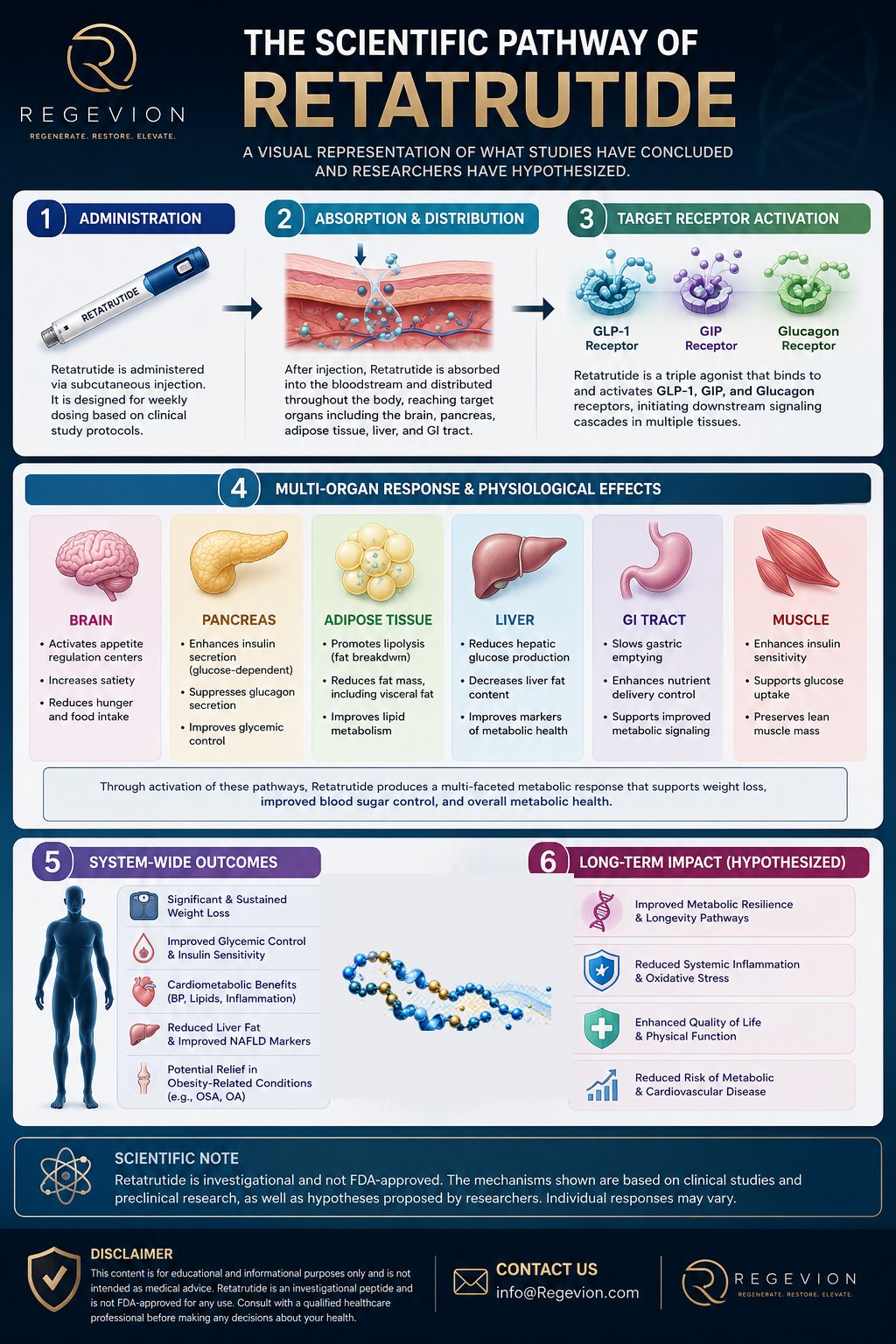
Retatrutide is built around three interconnected hormone systems that regulate energy intake, glucose metabolism, and energy expenditure: GLP-1, GIP, and glucagon. These normally act through G-protein-coupled receptors on different tissues throughout the body. GLP-1 and GIP are incretin hormones — released after nutrient intake to help coordinate insulin secretion — while glucagon mobilizes stored energy and influences hepatic glucose production.
Retatrutide activates all three receptors (GLP-1R, GIPR, GCGR) in a single engineered peptide. Preclinical work suggests the resulting biology functions as a coordinated network rather than three independent effects simply added together:¹
Retatrutide → receptor activation → intracellular signaling → cellular response → tissue response → systemic metabolic change
Molecular Mechanism of Action
All three receptors belong to the class B GPCR family and signal primarily through Gs-protein-mediated stimulation of adenylyl cyclase, raising intracellular cAMP. Retatrutide’s receptor profile is deliberately unbalanced rather than identical across targets: in vitro characterization found relatively balanced activity at GLP-1R and GCGR, with substantially greater potency at GIPR relative to the native hormone.¹ Downstream, cAMP signaling engages protein kinase A and related pathways that alter secretion, metabolism, and cell behavior. Receptor activation is only the first step — the physiological effect emerges from what happens after the signal enters the cell.
Three Receptors, Three Complementary Signals
GLP-1 Receptor — contributes to glucose-dependent insulin secretion, suppressed glucagon secretion, delayed gastric emptying, and central appetite regulation.
GIP Receptor — produced by intestinal K-cells after nutrient exposure; enhances glucose-dependent insulin secretion and interacts with adipose and central metabolic pathways. Within Retatrutide, GIPR adds a second incretin signal alongside GLP-1 — the resulting physiology is a different signaling architecture, not simply stronger GLP-1 activity.
Glucagon Receptor — acts strongly on the liver, promoting glycogen breakdown and hepatic glucose production, and contributes to broader energy-mobilizing responses. Combined with incretin signaling, preclinical research suggests glucagon receptor activation may increase energy expenditure while GLP-1/GIP reduce energy intake — the central hypothesis behind triple agonism.¹ The precise contribution of each receptor to every human outcome is not yet fully defined.
Pharmacokinetics: Why Once-Weekly Dosing
Retatrutide is modified with a fatty diacid moiety, extending systemic exposure. Reported pharmacokinetics have been approximately dose-proportional in early clinical studies, providing the basis for once-weekly administration in trials.² Pharmacokinetics (exposure over time) and pharmacodynamics (what that exposure does biologically) are distinct concepts: dose determines circulating exposure, which determines receptor activation, which determines physiological response — but absorption, distribution, elimination, and receptor activity all shape that relationship too.
Dose-Response: The Pattern, Not the Numbers
Human studies show a broadly dose-responsive pattern across the studied range, but effects don’t scale identically across every endpoint — weight loss and glycemic measures each show their own dose-response curve, and higher doses show diminishing incremental gains alongside more gastrointestinal side effects.³ ⁴ The full trial-by-trial figures are documented on the Research page. Human data support a relationship between increasing exposure and increasing effect, but don’t establish that the highest studied dose is optimal for every outcome or every person.
Fixed-Dose Trial Design
Retatrutide’s clinical program has evaluated fixed once-weekly doses rather than weight-based dosing. This matters pharmacologically: while body size can influence drug distribution and clearance, that alone doesn’t require weight-based dosing. Current trial evidence doesn’t establish Retatrutide as requiring individualized weight-based dosing.
What Happens at Different Exposure Levels
At lower exposure, receptor stimulation produces measurable effects in some individuals; as exposure increases, more sustained receptor activation can produce larger changes in appetite, glucose control, and body weight — until the biological system approaches the limits of a given pathway, shaped by receptor occupancy, downstream signaling capacity, and tolerability. Because Retatrutide engages three receptors with distinct activity levels, increasing concentration changes the overall intensity of signaling across all three systems rather than turning on one pathway in isolation. Exactly how those relative contributions translate into individual outcomes remains an active research question.
Combination & Pathway Interaction
Retatrutide is itself an act of pathway integration — one molecule engineered to engage three targets rather than three separate agents. The rationale is complementary, not simply additive: GLP-1/GIP reduce energy intake and improve insulin secretion, while glucagon receptor activation promotes energy mobilization and, in preclinical models, may increase expenditure.¹ Whether these pathways interact synergistically in every human tissue is less certain — receptor expression differs by tissue, signaling varies by cell type, and chronic stimulation can produce adaptive changes. Triple agonism is best understood as a multi-pathway strategy, not proof that every receptor contributes equally to every clinical effect.
What Scientists Still Don’t Fully Understand
Retatrutide’s receptor targets are well established; the harder question is how much each receptor contributes to each long-term human outcome — appetite reduction, glucose regulation, fat loss, energy expenditure, hepatic metabolism, and body composition. A related open question is adaptation: hormonal signaling systems are dynamic, and receptors, intracellular signaling, and physiological feedback can all shift over sustained use. The long-term consequences of activating three metabolic receptors simultaneously can’t be inferred from short-term receptor pharmacology alone — which is exactly what the ongoing Phase 3 program is designed to test.
References
- Coskun T, et al. LY3437943, a novel triple glucagon, GIP, and GLP-1 receptor agonist for glycemic control and weight loss: From discovery to clinical proof of concept. Cell Metabolism. 2022. https://pubmed.ncbi.nlm.nih.gov/35985340/
- Urva S, et al. LY3437943, a novel triple GIP, GLP-1, and glucagon receptor agonist in people with type 2 diabetes: a phase 1b, multicentre, double-blind, placebo-controlled, randomised, multiple-ascending dose trial. The Lancet. 2022. https://pubmed.ncbi.nlm.nih.gov/36354040/
- Jastreboff AM, et al. Triple-Hormone-Receptor Agonist Retatrutide for Obesity — A Phase 2 Trial. New England Journal of Medicine. 2023. https://pubmed.ncbi.nlm.nih.gov/37366315/
- Rosenstock J, Frias J, Jastreboff AM, et al. Retatrutide, a GIP, GLP-1 and glucagon receptor agonist, for people with type 2 diabetes: a randomised, double-blind, placebo and active-controlled, parallel-group, phase 2 trial. The Lancet. 2023;402:529–544. https://pubmed.ncbi.nlm.nih.gov/37385280/