What the studies actually found
Semax has been on Russia's official list of essential medicines for stroke and cognitive disorders for three decades. It's not FDA-approved and remains investigational in the United States — but it's one of the only peptides in this library with a genuine long-term clinical track record anywhere.
READ THE RESEARCH →In a placebo-controlled trial, healthy volunteers had resting-state fMRI scans before and after a single intranasal dose. The Semax group showed a measurably larger medial-frontal region of the brain's "default mode network" compared to placebo — a fast, visible signal, not just a subjective report.
READ THE RESEARCH →Russian researchers reported improved Barthel index and motor-scale scores in ischemic stroke patients receiving intranasal Semax alongside standard care. Worth knowing: this study wasn't randomized or placebo-controlled, so it's a real signal, not definitive proof.
READ THE RESEARCH →A single dose measurably increased BDNF and its receptor TrkB in the hippocampus of living rats — the same signaling system the brain uses to build new connections and protect neurons under stress.
READ THE RESEARCH →Semax is a fragment of ACTH — the hormone that triggers cortisol release — engineered to keep its effects on the brain while dropping the cortisol-stimulating activity entirely. Researchers still haven't pinned down its primary receptor.
EXPLORE THE SCIENCE →Semax — Overview
What Is Semax?
Semax is a synthetic seven-amino-acid peptide designed from a small portion of adrenocorticotropic hormone, or ACTH. Its sequence is Met-Glu-His-Phe-Pro-Gly-Pro, commonly described as an analog of the ACTH(4–10) fragment. Unlike full ACTH, which is a hormone involved in regulating the adrenal stress response, Semax was developed to explore the biological effects of the ACTH fragment without reproducing the hormone’s broader endocrine activity.
That distinction is important. Semax is not primarily a metabolic peptide, growth-hormone secretagogue, or conventional stimulant. Its scientific identity is much more closely connected to the brain and nervous system. Researchers have investigated it for effects involving cognition, neuronal survival, adaptation to physiological stress, and recovery following neurological injury.
Semax is also unusual because its history began not in today’s peptide-wellness industry, but within Soviet and Russian neuroscience. It was conceived as a way of using a small biological peptide to influence the brain’s ability to function under extreme conditions. The resulting molecule eventually became the subject of decades of research, particularly in Russia, where it developed a clinical history that is much longer than its recognition in Western research communities.
One of the features that makes Semax particularly interesting is the apparent difference between its relatively simple molecular structure and the breadth of biological processes researchers have associated with it. Studies have investigated changes in neurotrophic signaling, including brain-derived neurotrophic factor (BDNF), a protein involved in neuronal survival, synaptic plasticity, learning, and memory.
This does not mean that Semax should be viewed as a universal cognitive enhancer or neuroprotective drug. Rather, it represents a scientific attempt to influence the biological environment in which neurons communicate, adapt, and respond to stress. That idea — supporting the brain’s own adaptive biology — is at the center of the Semax story.
Scientific Discovery & Development
The origins of Semax can be traced to a broader period of Soviet peptide research in which scientists were increasingly interested in whether short chains of amino acids could act as precise biological signals. Scientific teams associated with Moscow State University and the Institute of Molecular Genetics of the Russian Academy of Sciences began investigating peptide-based approaches to helping the brain adapt to demanding physiological conditions during the late 1970s and through the 1980s. The concept was championed by Igor Ashmarin, a prominent Soviet/Russian neuropharmacologist and academician.
The researchers focused on ACTH, a hormone already known to have effects extending beyond the adrenal system. Earlier work had demonstrated that fragments of larger peptide hormones could sometimes retain specific biological activities even after the portions responsible for the hormone’s primary endocrine function were removed. This created an intriguing possibility: perhaps a small section of ACTH could influence neurological function without behaving like the complete hormone.
Research eventually focused on the ACTH(4–10) fragment. Under the direction of Nikolai Myasoedov at the Institute of Molecular Genetics, scientists developed a modified peptide based on this sequence, incorporating a Pro-Gly-Pro sequence into the ACTH-derived structure. This modification became an important part of Semax’s identity, improving its metabolic stability and helping distinguish the molecule from the naturally occurring ACTH fragment. A 1997 review by Ashmarin and colleagues described roughly fifteen years of Semax research and development, consistent with foundational work through the 1980s.
From there, the research progressed from molecular development toward neuroscience. Scientists examined whether Semax could influence learning, memory, neuronal resistance to damaging conditions, and recovery following neurological injury. By the 1990s, human research had begun to appear, including a 1997 clinical study investigating Semax’s use during the acute phase of hemispheric ischemic stroke.
The scientific story therefore followed a distinctive path: ACTH biology → peptide fragments → neurological activity → molecular modification → Semax → experimental neuroscience → clinical investigation.
Why Researchers Are Studying Semax
The central scientific question surrounding Semax is not simply whether it can make someone feel more focused. It is whether a small peptide can influence the biological systems that allow the brain to adapt, protect itself, and reorganize following stress or injury.
This question becomes especially important when the brain is exposed to conditions such as reduced oxygen availability, ischemia, inflammation, or neurological injury. Neurons are highly dependent on tightly controlled energy production and signaling. When that environment is disrupted, cellular stress can trigger a cascade of events that can impair neuronal function or contribute to cell damage.
Researchers have therefore investigated whether Semax can modify some of these responses. Much of the interest has centered on neurotrophic signaling. Neurotrophic factors are proteins that help regulate neuronal survival, development, connectivity, and plasticity. BDNF is one of the best-known members of this family because of its role in maintaining neuronal function and supporting changes in neural connections associated with learning and adaptation.
Experimental studies have found that Semax can alter BDNF expression and signaling in the brain. In one rat study, Semax increased BDNF protein and activation of its receptor TrkB in the hippocampus, a brain region strongly associated with learning and memory. Other work has shown changes in the expression of BDNF and nerve growth factor (NGF) following Semax administration, with effects varying according to brain region and timing.
This has given researchers a broader hypothesis: Semax may not act through a single “focus” pathway. Instead, some of its neurological effects may emerge from changes in the cellular environment that regulates neuronal resilience and plasticity.
Biological Foundation
To understand why Semax attracted attention, it helps to understand the biology behind ACTH fragments.
ACTH is produced in the pituitary gland and is best known for stimulating the adrenal glands. But the biology of ACTH-related peptides is more complicated than that single hormonal function — different fragments of peptide hormones can have biological activities that do not necessarily reproduce the complete effects of the parent hormone.
Semax was developed from this principle. Rather than functioning primarily as a conventional endocrine hormone, Semax has been investigated as a neuropeptide-like signaling molecule capable of influencing processes within the nervous system.
One particularly interesting observation is that Semax appears to affect neurotrophic systems. In laboratory research, Semax has been shown to increase BDNF production in neural support cells and to produce measurable changes in BDNF-related signaling in brain tissue. Researchers have also identified specific, reversible, calcium-dependent binding sites for Semax in rat basal forebrain membranes, suggesting that its biological effects may involve more than nonspecific peptide activity.
The significance of BDNF is relatively straightforward. Think of BDNF as part of the brain’s biological maintenance and adaptation system: it helps neurons survive, communicate, and modify their connections in response to experience. When neural circuits need to adapt — whether during learning or after injury — neurotrophic signaling becomes particularly important.
Semax research therefore raises an intriguing possibility: instead of forcing the nervous system into a stimulated state, the peptide may influence some of the biological machinery that allows neural tissue to adapt. The exact molecular sequence of events remains an area of active investigation and is considerably more complex than any single pathway. That deeper pharmacology belongs in The Science tab.
What Researchers Are Investigating
One major area of investigation is cognitive function. Experimental studies have examined learning, memory formation, attention, and related behavioral measures. The connection to BDNF is particularly relevant because the hippocampus and other neural circuits involved in learning depend heavily on neurotrophic signaling and synaptic plasticity.
A second major area is neuroprotection. Researchers have explored whether Semax can help neurons tolerate conditions associated with metabolic or physiological stress. Experimental work has described antihypoxic and neurotrophic effects, while clinical research has investigated Semax in neurological conditions including ischemic stroke.
Stroke research is particularly significant because ischemia creates a biological environment in which neurons are suddenly deprived of adequate blood flow and oxygen. Recovery does not end when the initial injury occurs — the brain subsequently undergoes a prolonged period of repair and functional reorganization. Russian clinical research has therefore examined whether Semax can influence recovery during and after ischemic stroke. A 1997 clinical study involving 30 patients receiving Semax alongside conventional therapy reported faster regression of neurological deficits compared with a control group of 80 conventionally treated patients, although the study design and scale are very different from the large international randomized trials typically required for modern regulatory approval.
More recent Russian research has continued examining Semax during stroke rehabilitation, reporting increases in circulating BDNF and associations between Semax treatment, BDNF levels, and functional recovery measured during rehabilitation. These findings are scientifically interesting, but they remain part of a geographically concentrated evidence base and should not be interpreted as equivalent to broad international regulatory validation.
Researchers have also explored Semax in other neurological and biological contexts, including cerebrovascular insufficiency, cognitive dysfunction, and experimental tissue-protective processes. The recurring theme, however, is the nervous system’s ability to respond to stress and reorganize.
Potential Benefits & Biological Significance
The potential significance of Semax comes from the intersection of several biological processes rather than from one isolated effect.
If Semax influences neurotrophic signaling, that could theoretically affect the environment in which neurons maintain themselves and form or modify connections. If those changes translate into improved neural plasticity, they could have relevance to learning and memory. If the same biological environment helps neurons tolerate stress, it could also explain why researchers have investigated Semax in ischemia and neurological recovery.
This creates a chain of scientific interest: neurotrophic signaling → neuronal resilience and plasticity → neural adaptation → potential effects on cognition or recovery.
The evidence supporting each part of that chain is not equally strong. Changes in BDNF and related signaling have been demonstrated in experimental research. Human studies have reported neurological and functional outcomes, particularly in Russian clinical research. What remains less established is how consistently these findings translate across different populations, clinical settings, study designs, and research systems.
Semax is scientifically interesting precisely because it sits between established biological observations and questions that remain unresolved. It has a substantial research history, but much of that history has developed within a relatively concentrated Russian scientific and clinical ecosystem. The result is a peptide with meaningful human research experience, but without the breadth of large, internationally replicated clinical evidence that would allow its proposed applications to be considered universally established.
Current Research Stage & Future Outlook
Semax occupies an unusual regulatory position. It has a longstanding clinical history in Russia, where it has been used as a pharmaceutical product, while it is not FDA-approved in the United States. Its Western regulatory and research position is therefore very different from that of an FDA-approved neurological medicine.
That distinction became particularly important in 2026. The FDA’s Pharmacy Compounding Advisory Committee considered Semax-related bulk substances on July 24, 2026, specifically in the context of cerebral ischemia, migraine, and trigeminal neuralgia. The committee voted 8-5, with one abstention, to recommend inclusion — a recommendation that is advisory and non-binding, and does not constitute FDA approval. Notably, the FDA’s own briefing document for that meeting proposed that Semax not be included on the list, so the committee’s vote and the agency staff’s position point in different directions.
The 2026 review is scientifically significant because it represents a new level of formal U.S. regulatory attention to a peptide that historically developed largely outside the Western pharmaceutical system. The future of Semax will depend on whether its existing research can be supported by stronger, independently replicated clinical evidence. Larger controlled trials, standardized manufacturing, clearer pharmacokinetic data, long-term safety assessment, and replication by research groups outside its traditional geographic base would all help determine how much of the molecule’s promise can be translated into broadly accepted medicine.
Global Research Perspective
Semax’s scientific history is strongly rooted in Russia, particularly Moscow-based institutions including the Institute of Molecular Genetics of the Russian Academy of Sciences and major medical research centers. Researchers such as Igor Ashmarin and Nikolai Myasoedov played important roles in the molecule’s development and scientific investigation.
That geographic concentration is both a strength and a limitation. It provides Semax with a long and relatively unusual history of human investigation compared with many experimental peptides. At the same time, relatively limited large-scale independent research outside Russia means that international replication remains an important unanswered question.
This is part of what makes Semax scientifically relevant today. It is not a newly invented molecule waiting for its first human observations. It is a decades-old peptide whose scientific story is now being reconsidered in a much broader international research environment.
Disclaimer
Semax is an investigational peptide in the United States and is not FDA approved. The information presented in the Regevion Educational Library is intended for educational purposes only and is based on current scientific research and publicly available information. This content is not medical advice and should not be interpreted as a recommendation for use or as a substitute for guidance from a qualified healthcare professional.
Why This Matters
Semax matters because it represents a different way of thinking about neurological biology. Rather than approaching the brain solely through conventional neurotransmitter stimulation, its development explored whether a small peptide could influence the biological systems that help neurons adapt, survive, and reorganize.
Decades of research have connected Semax with neurotrophic signaling, cognitive processes, and neurological recovery, while human research has provided observations that continue to attract scientific attention. At the same time, the evidence remains uneven, geographically concentrated, and insufficient to treat every proposed application as established fact.
That combination is exactly what makes Semax worth studying. It sits at the intersection of peptide biology, neuroscience, neuroplasticity, and recovery — raising a larger question that extends beyond one molecule: can precisely designed biological signals help the nervous system become more resilient and adaptable?
References
- Ashmarin IP, Nezavibatko VN, Myasoedov NF, et al. [Fifteen years’ experience of Semax design and study]. Zh Vyssh Nerv Deiat Im I P Pavlova. 1997.
- Dolotov OV, et al. Semax, an analog of ACTH(4-10) with cognitive effects, regulates BDNF and TrkB expression in the rat hippocampus. Brain Res. 2006. PMID 16996037.
- Shadrina MI, Dolotov OV, Grivennikov IA, Myasoedov NF, et al. Rapid induction of neurotrophin mRNAs in rat glial cell cultures by Semax, an adrenocorticotropic hormone analog. Neurosci Lett. 2001. PMID 11457573.
- Dolotov OV, et al. The binding of Semax, ACTH 4-10 heptapeptide, to plasma membranes of the rat forebrain basal nuclei and its biodegradation. Bioorg Khim. 2004. PMID 15344653.
- Gusev EI, Skvortsova VI, Miasoedov NF, Nezavibat’ko VN, Zhuravleva EIu, Vanichkin AV. Effectiveness of semax in acute period of hemispheric ischemic stroke (a clinical and electrophysiological study). Zh Nevrol Psikhiatr Im S S Korsakova. 1997. PMID 11517472.
- The efficacy of Semax in the treatment of patients at different stages of ischemic stroke. 2018. PMID 29798983.
- U.S. Food and Drug Administration. Pharmacy Compounding Advisory Committee meeting materials and briefing document, July 23–24, 2026 (Semax free base and Semax acetate, 503A Bulks List).
Semax — The Research
How Was Semax Discovered?
The story of Semax begins not with Semax itself, but with a much larger scientific question: could fragments of naturally occurring hormones influence the brain without reproducing the hormones’ systemic effects?
That question became particularly interesting around adrenocorticotropic hormone, or ACTH. ACTH is best known for regulating the adrenal response, but earlier neuropeptide research had shown that certain ACTH fragments could influence learning, memory, attention, and adaptation to stress independently of the hormone’s classical adrenal actions. Researchers began asking whether the neurologically active portion could be separated from the endocrine portion.
During the 1980s, scientists in Moscow — including Igor P. Ashmarin, Nikolai F. Myasoedov, and colleagues working at the Institute of Molecular Genetics of the Russian Academy of Sciences and Moscow State University — developed and studied synthetic ACTH-derived peptides. The objective was unusually practical: retain useful neuroactive properties while creating a peptide stable enough to have sustained biological effects.
Semax emerged from this program as a synthetic heptapeptide, Met-Glu-His-Phe-Pro-Gly-Pro. A major part of the development strategy was incorporation of the Pro-Gly-Pro sequence, creating a more stable regulatory peptide than the short ACTH fragments from which the work originated. A 1997 review by Ashmarin, Nezavibatko, and Myasoedov described roughly fifteen years of Semax design and research, placing the foundational work firmly in the 1980s.
This created the first important transition in the scientific story: ACTH biology → identification of neuroactive fragments → peptide engineering → Semax → experimental neuroprotection and cognitive research.
Evolution of the Research
The early research program moved through several interconnected questions.
First, researchers wanted to know whether Semax could influence behavior and cognitive performance. Early experimental work suggested effects on learning, memory, attention, and resistance to hypoxia. By the 1990s, the research had expanded toward cerebral ischemia and neurological recovery, bringing Semax closer to clinical investigation.
The next major shift was mechanistic. Instead of asking only whether Semax changed behavior, scientists began asking what biological processes could explain those effects. Research in the early 2000s identified changes in expression of neurotrophic factors including brain-derived neurotrophic factor (BDNF) and nerve growth factor (NGF). Later work connected Semax with BDNF/TrkB signaling in the hippocampus, providing a biological framework for studying its effects on neuronal plasticity rather than treating cognitive effects as a purely behavioral phenomenon.
Research then broadened into ischemic injury, neurotransmission, neuronal survival, inflammatory and vascular gene expression, and other models of neurological stress. A 2018 review from Myasoedov and Svetlana Koroleva summarized experimental and clinical Semax research published from 1980 through 2016, illustrating how the field had expanded from peptide design into a much broader neurobiological research program.
The modern research question is therefore more sophisticated than the original one. Scientists are no longer asking simply whether Semax has a cognitive or neuroprotective effect. They are investigating which biological pathways are affected, under what conditions, and whether those findings translate reliably into human neurological outcomes.
The Most Important Studies
Semax and Neurotrophin Expression — 2001 Study: Rapid induction of neurotrophin mRNAs in rat glial cell cultures by Semax, an adrenocorticotropic hormone analog Researchers: M. I. Shadrina, O. V. Dolotov, I. A. Grivennikov, N. F. Myasoedov and colleagues Journal: Neuroscience Letters, 2001 Study type: Cellular laboratory research
Researchers exposed rat glial cells to Semax and measured expression of genes encoding BDNF and NGF. The response was rapid, with reported increases in BDNF and NGF messenger RNA relative to controls at their peak.
Why it matters: This study helped move Semax research from the observation that the peptide could influence behavior toward a testable biological explanation. Neurotrophins such as BDNF and NGF are involved in neuronal survival, plasticity, and adaptation. The finding therefore provided a plausible molecular bridge between Semax exposure and changes in neural function. Importantly, this was cellular research, not evidence that the same magnitude of response occurs in humans.
BDNF and TrkB in the Hippocampus — 2006 Study: Semax, an analog of ACTH(4-10) with cognitive effects, regulates BDNF and TrkB expression in the rat hippocampus Researchers: O. V. Dolotov and colleagues Journal: Brain Research, 2006 Study type: Preclinical neurobiology research
Researchers examined what happened inside the brains of living rats. A single Semax administration increased BDNF protein in the hippocampus by approximately 1.4-fold and increased TrkB phosphorylation by approximately 1.6-fold. BDNF and TrkB gene expression also increased.
Why it matters: The importance of this study was not simply that BDNF increased. Researchers observed changes at several levels of the same signaling system — gene expression, BDNF protein, and activation of its receptor pathway — making the neurotrophic hypothesis considerably more biologically coherent. Again, these were animal findings that help explain the research direction but do not establish equivalent effects in humans.
Semax and Cerebral Ischemia — 1999–2001 Study type: Animal ischemia research
Another major research branch developed around cerebral ischemia — restricted blood flow to the brain. Russian investigators studied Semax in experimental ischemia models and reported changes associated with neurological protection. A 2001 study examined nitric oxide production and lipid peroxidation after incomplete global ischemia in rats and found that Semax — unlike glycine, tested as a comparator — prevented the increase in nitric oxide generation observed after ischemic injury.
Other experimental studies examined behavioral and neurological consequences of ischemic injury and reported neuroprotective or anti-amnesic effects.
Why it matters: These studies shifted Semax from being primarily a cognitive peptide of interest toward a potential neuroprotective intervention. The central scientific question became whether modifying the brain’s response to ischemic stress could improve functional recovery.
Human Research in Ischemic Stroke
Human research subsequently became particularly important in Russia. A clinical and electrophysiological study published in 1997 by Gusev, Skvortsova, Myasoedov, and colleagues evaluated Semax in patients with acute hemispheric ischemic stroke. The study compared 30 patients receiving Semax as part of intensive treatment with 80 patients receiving conventional treatment. Investigators reported faster regression of neurological deficits, particularly motor and other focal abnormalities, with the most effective reported daily doses differing according to stroke severity (12 mg/day for moderate stroke, 18 mg/day for severe stroke).
Other Russian clinical research has examined Semax in different stages of ischemic stroke, while ophthalmologic research has investigated its use in diseases affecting the optic nerve.
Why it matters: These studies provide something that animal research cannot: actual human clinical experience. At the same time, the evidence base has an important limitation. Much of the clinical literature originated within the Russian research and medical system, with relatively limited independent replication in large, modern Western randomized controlled trials.
That distinction is important when interpreting the evidence. Human research exists, but the quantity, design, international replication, and reporting standards are not comparable with those supporting widely approved neurological drugs.
Research Findings by Major Biological Area
Neuroplasticity and Cognitive Function
One of the most consistent research themes is the relationship between Semax and neurotrophic signaling. Animal studies have associated Semax with increased BDNF and NGF expression and changes in BDNF/TrkB signaling. These findings have made neuronal plasticity one of the central mechanistic areas of Semax research.
Human neuroimaging research has added another layer. In a small study of 24 healthy volunteers, resting-state fMRI performed before and after intranasal Semax showed changes involving the brain’s default-mode network. A separate functional-connectivity study of 52 healthy participants similarly found changes in resting-state connectivity after Semax administration.
These findings are interesting because they demonstrate measurable changes in human brain-network activity. They do not, however, establish that Semax improves cognition in healthy people or that changes on fMRI translate into clinically meaningful benefits.
Neuroprotection and Ischemia
A second major area is protection of nervous tissue during physiological stress, particularly cerebral ischemia. Animal studies have investigated oxidative stress, nitric oxide signaling, neurotrophin expression, neuronal survival, and behavioral recovery following ischemic injury. The findings have generally supported further investigation, but preclinical consistency should not be confused with proof of clinical efficacy.
Neurotransmission and Neuronal Survival
Research has also examined dopaminergic systems and basal forebrain cholinergic neurons. In an MPTP model of dopaminergic injury, Semax reduced behavioral abnormalities produced by the neurotoxin, with investigators proposing both dopaminergic and neurotrophic mechanisms.
Other laboratory work has examined neuronal survival under toxic or excitatory conditions. These studies are scientifically relevant because they suggest that Semax may influence how neural networks respond to stress rather than functioning simply as a conventional stimulant. The precise human pharmacology, however, remains incompletely established.
Human Evidence: What We Actually Know
The human evidence is strongest in the context of the Russian clinical research tradition, particularly neurological applications such as ischemic stroke.
There are also smaller human studies examining cognitive and brain-network effects, described above. These studies are valuable because they demonstrate that Semax can produce measurable changes in the human brain. They are not, however, equivalent to large randomized clinical trials demonstrating long-term improvements in disease outcomes.
The evidence should therefore be separated into levels:
- Human clinical evidence: Exists, particularly from Russian neurological research, but remains geographically concentrated and less extensively independently replicated than evidence for established Western neurological therapies.
- Preclinical evidence: Substantial and biologically interesting, particularly around neurotrophins, ischemia, neuronal survival, and neural signaling.
- Mechanistic evidence: Strong enough to generate coherent hypotheses, but the complete molecular mechanism in humans remains unresolved.
Current Research Stage
Semax occupies an unusual regulatory position. It has a history of pharmaceutical use in Russia, but it is not FDA approved in the United States. On July 24, 2026, the FDA’s Pharmacy Compounding Advisory Committee reviewed Semax free base and Semax acetate for possible inclusion on the 503A Bulks List for uses including cerebral ischemia, migraine, and trigeminal neuralgia.
The committee subsequently recommended inclusion in a reported 8–5 vote, with one abstention. That recommendation is advisory and does not constitute FDA approval. More importantly, the FDA’s own July 2026 briefing document proposed that both Semax free base and Semax acetate not be included on the 503A Bulks List. The agency stated that it had not yet made a final determination pending the advisory process and further review.
This distinction matters: Semax has clinical history outside the United States, but it remains an unapproved drug in the U.S., and its committee recommendation and the FDA staff’s own position point in different directions.
What the Evidence Shows
Stronger Evidence: The most established research signal is the existence of reproducible biological effects in experimental neuroscience, particularly involving neurotrophic signaling, neuronal stress responses, and ischemic models. There is also human clinical experience, especially in Russian neurological medicine.
Emerging Evidence: Human neuroimaging and contemporary molecular research are beginning to connect Semax exposure with measurable changes in brain-network activity and neurotrophic biology. These findings are scientifically interesting but remain relatively small-scale.
Early or Experimental Evidence: Claims involving broad cognitive enhancement, healthy aging, psychiatric disorders, neurodegenerative disease, or other applications beyond the better-studied neurological indications remain considerably less established.
The overall picture is therefore neither “unproven” nor “clinically proven everywhere.” Semax has a substantial research history, but the evidence is uneven: preclinical biology is broader than the human evidence, and human evidence is broader than the high-quality international clinical-trial literature.
What Researchers Are Studying Now
Current scientific interest is increasingly focused on connecting the different pieces of the Semax story. Researchers are investigating how changes in neurotrophin expression translate into neuronal resilience, whether ischemia-related gene-expression changes can be reproduced across models, how Semax influences functional brain networks, and which molecular pathways are responsible for its effects.
The field is also moving toward transcriptomic and systems-level research, where scientists can examine hundreds or thousands of genes simultaneously rather than studying one pathway at a time. This approach may help determine whether Semax acts through a single dominant pathway or through coordinated changes across several neural and vascular systems.
The most important unanswered question remains translational: can the biological effects repeatedly observed in experimental models produce meaningful, reproducible clinical outcomes in larger and independently conducted human trials?
Future Scientific Potential
Semax remains scientifically interesting because its research history connects several areas of neuroscience that are usually studied separately: neurotrophic signaling, neuronal survival, ischemic injury, cognitive function, and brain-network activity.
What research has demonstrated is that Semax can produce measurable biological effects in experimental systems and that it has a history of human clinical investigation. What researchers are still determining is how consistently those effects translate into clinically meaningful outcomes, which patients might benefit, and which biological mechanisms are most important.
That distinction is central to understanding Semax. Its scientific story is not simply about a “nootropic peptide.” It is the story of an early Russian peptide-development program that progressed from hormone-fragment research into decades of experimental neuroscience and clinical investigation — and that is now receiving renewed international attention.
Why This Matters
Semax is unusual because its evidence base spans several decades and multiple levels of investigation. Researchers moved from the discovery that ACTH fragments could influence neural function, to the engineering of a more stable peptide, to animal studies of neuroprotection and neurotrophic signaling, and eventually to human neurological research.
The research has produced a credible scientific rationale and a substantial body of experimental evidence. At the same time, the strongest questions remain unanswered by modern international clinical standards: how large and reproducible are the clinical effects, in which conditions do they matter most, and how well do the experimental mechanisms predict human outcomes?
That is precisely what makes Semax scientifically interesting today. The foundational research has created the hypothesis. The next stage of science is determining how far that hypothesis survives rigorous clinical testing.
Disclaimer
Semax is an investigational peptide in the United States and is not currently FDA approved. The information presented in the Regevion Educational Library is intended for educational purposes only and is based on current scientific research and publicly available information. This content is not medical advice and should not be interpreted as a recommendation for use or as a substitute for guidance from a qualified healthcare professional.
References
- Ashmarin IP, Nezavibatko VN, Myasoedov NF, et al. [Fifteen years’ experience of Semax design and study]. Zh Vyssh Nerv Deiat Im I P Pavlova. 1997.
- Koroleva SV, Myasoedov NF. Semax as a universal drug for therapy and research. Biology Bulletin. 2018;45(6):589-598.
- Shadrina MI, Dolotov OV, Grivennikov IA, Myasoedov NF, et al. Rapid induction of neurotrophin mRNAs in rat glial cell cultures by Semax, an adrenocorticotropic hormone analog. Neurosci Lett. 2001. PMID 11457573.
- Dolotov OV, et al. Semax, an analog of ACTH(4-10) with cognitive effects, regulates BDNF and TrkB expression in the rat hippocampus. Brain Res. 2006. PMID 16996037.
- Novel synthetic analogue of ACTH 4-10 (Semax) but not glycine prevents the enhanced nitric oxide generation in cerebral cortex of rats with incomplete global ischemia. Brain Res. 2001. PMID 11245825.
- Gusev EI, Skvortsova VI, Miasoedov NF, Nezavibat’ko VN, Zhuravleva EIu, Vanichkin AV. Effectiveness of semax in acute period of hemispheric ischemic stroke (a clinical and electrophysiological study). Zh Nevrol Psikhiatr Im S S Korsakova. 1997. PMID 11517472.
- Lebedeva IS, et al. Effects of Semax on the default mode network of the brain. Bull Exp Biol Med. 2018. PMID 30225715.
- Functional connectomic approach to studying Selank and Semax effects. Dokl Biol Sci. 2020. PMID 32342318.
- The neuroprotective effects of Semax in conditions of MPTP-induced lesions of the brain dopaminergic system. Neurosci Behav Physiol.
- The efficacy of Semax in the treatment of patients at different stages of ischemic stroke. 2018. PMID 29798983.
- U.S. Food and Drug Administration. Pharmacy Compounding Advisory Committee meeting materials and briefing document, July 23–24, 2026 (Semax free base and Semax acetate, 503A Bulks List).
Semax — The Science
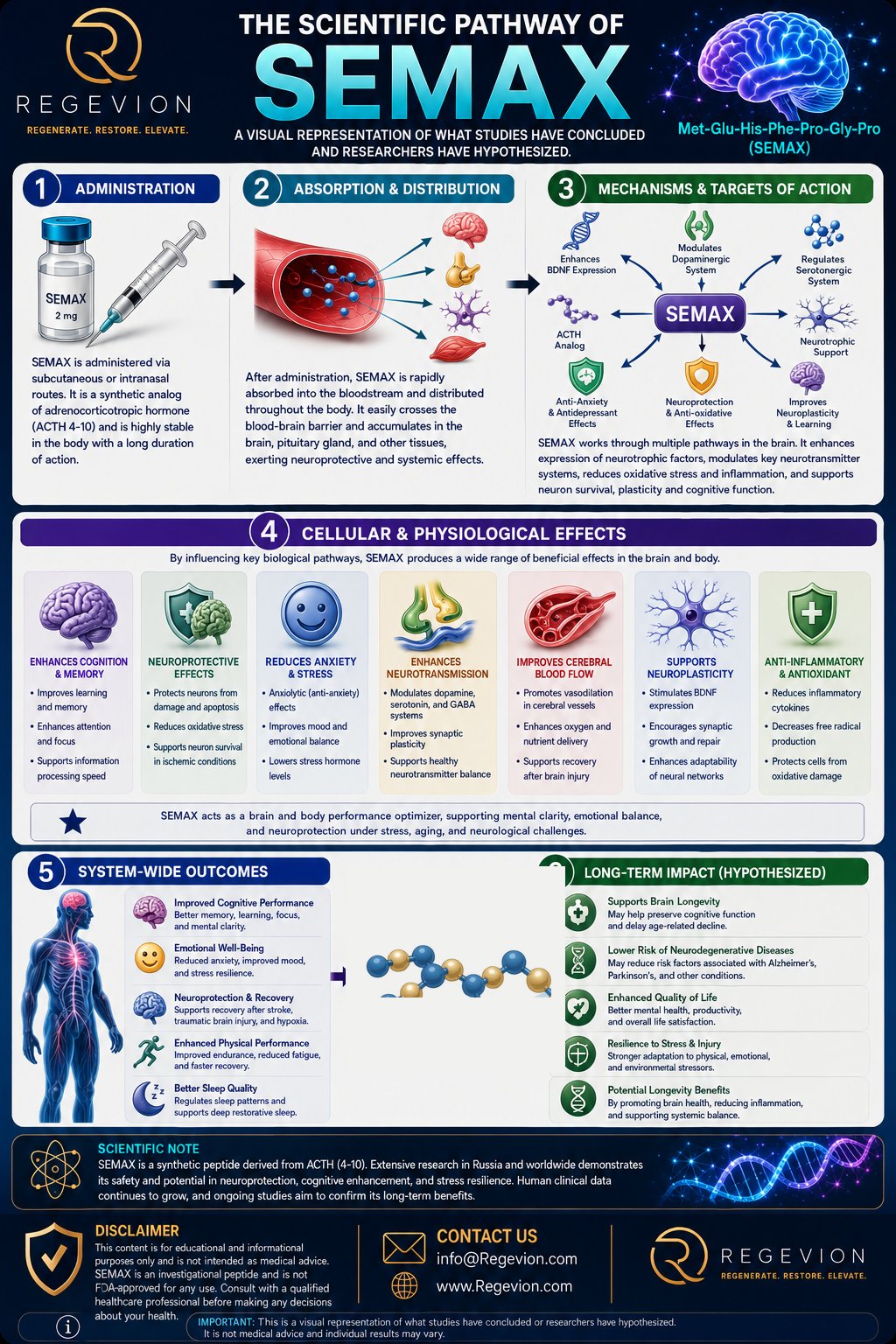
Semax is unusual among peptide therapeutics because its biology does not fit neatly into the conventional model of a peptide drug acting through one well-defined receptor and one dominant signaling pathway. It is a synthetic heptapeptide, Met-Glu-His-Phe-Pro-Gly-Pro (MEHFPGP), derived from the ACTH(4–10) region but modified with a C-terminal Pro-Gly-Pro sequence. Its molecular weight is approximately 814 Da.
The central scientific question is therefore not simply “which receptor does Semax activate?” Instead, the evidence points toward a multilayered neuromodulatory mechanism involving direct peptide binding in brain tissue, regulation of neurotrophin expression, modulation of neurotransmission, and changes in inflammatory and stress-response signaling. Some parts of this model are well supported experimentally; others remain proposed mechanisms.
1. The Biological Architecture
The starting point is the ACTH/melanocortin system. Adrenocorticotropic hormone (ACTH) is produced by pituitary corticotroph cells and normally participates in communication between the hypothalamus, pituitary gland, and adrenal cortex. Full-length ACTH acts primarily through melanocortin receptors, particularly MC2R in the adrenal cortex, to stimulate glucocorticoid production.
Semax is structurally related to an N-terminal ACTH fragment, but it should not be treated as simply a miniature version of ACTH — its biological behavior is substantially different, and the available literature does not establish a canonical melanocortin receptor as the primary mediator of Semax’s central effects.
Instead, experimental studies have identified specific, calcium-dependent binding sites for Semax in rat forebrain membranes, with a reported dissociation constant of approximately 2.4 nM. The existence of these binding sites provides evidence that Semax interacts with molecular targets in neural tissue, although the identity and physiological function of the principal binding protein remain incompletely defined.
This distinction is important: Semax → neural molecular interaction → intracellular signaling → altered gene expression → neurotrophin and neurotransmitter changes → tissue-level neural effects, rather than Semax → one known receptor → one pathway. That broader model is the foundation for understanding its pharmacology.
2. Molecular Mechanism of Action
One of the strongest mechanistic findings concerns the BDNF/TrkB system. BDNF, or brain-derived neurotrophic factor, is a neurotrophin involved in neuronal survival, synaptic plasticity, learning, and adaptive remodeling. Its principal high-affinity receptor is TrkB, a receptor tyrosine kinase. When BDNF activates TrkB, intracellular phosphorylation cascades can engage pathways including PI3K-Akt, Ras-MAPK/ERK, and PLC-γ, ultimately altering neuronal survival, excitability, protein synthesis, and gene transcription.
Semax does not appear simply to function as BDNF itself. Rather, experimental work suggests that Semax can increase the expression of BDNF and TrkB, potentially increasing the capacity of neural tissue to respond to endogenous neurotrophic signaling. In rats, a single intranasal administration produced increases in hippocampal BDNF protein (approximately 1.4-fold), BDNF mRNA, and TrkB phosphorylation (approximately 1.6-fold). The investigators therefore proposed that Semax influences cognition through modulation of the BDNF/TrkB signaling system.
A related study found that Semax rapidly altered Bdnf and Ngf gene expression in the hippocampus and frontal cortex, demonstrating that its effects can occur at the level of transcription rather than merely changing neurotransmitter concentrations.
The biological sequence can therefore be visualized as: Semax exposure → neural molecular interaction → altered transcriptional signaling → increased BDNF/NGF and their receptor systems → enhanced neurotrophic signaling → changes in neuronal plasticity, survival, and network function. This is currently one of the most compelling mechanistic explanations for Semax’s neurotrophic effects.
3. Receptor Biology & Cellular Signaling
Semax presents an important pharmacological caveat: its definitive primary receptor has not been established. Specific, reversible binding has been demonstrated in rat forebrain membranes, and the binding depends partly on calcium ions. However, identifying a binding site is not equivalent to identifying a validated physiological receptor. Consequently, describing Semax as a confirmed agonist of a particular melanocortin, dopamine, serotonin, or opioid receptor would overstate the evidence.
The downstream biology is better characterized. Experimental ischemia studies demonstrate changes in neurotrophin and neurotrophin-receptor transcription, including BDNF, NGF, TrkA, TrkB, and TrkC. Other experiments suggest modulation of genes involved in neurotransmission and inflammatory responses — in a rat cerebral ischemia-reperfusion model, Semax altered hundreds of genes and suppressed expression associated with inflammatory processes while increasing expression associated with neurotransmission.
At the protein level, Semax exposure in the same general experimental model was associated with increased active CREB, alongside reduced active JNK, MMP-9, and c-Fos in selected brain regions. CREB is a transcription factor strongly associated with activity-dependent neuronal adaptation and memory-related plasticity, whereas JNK and MMP-9 participate in cellular stress and tissue-injury responses.
These findings support a network-level signaling model, but they do not establish that Semax directly binds every molecule within that network.
4. Pharmacology
Semax has characteristics of a centrally acting peptide with multistep pharmacodynamics. Its pharmacodynamic effect appears to involve relatively rapid molecular and transcriptional responses followed by downstream changes in proteins and neural signaling. In animal experiments, changes in neurotrophin gene expression were detectable within minutes and evolved over several hours.
That timing is important because it suggests that some effects cannot be explained simply by transient receptor occupancy. A short-lived molecular interaction may initiate a longer biological sequence involving transcription, protein synthesis, and altered neuronal signaling.
Semax is also more resistant to enzymatic degradation than ACTH(4–10) in rat blood and serum. Experimental degradation studies found that aminopeptidases participate in breakdown of both peptides, while Semax demonstrated greater stability against other enzymatic pathways.
5. Pharmacokinetics: What Happens to Semax?
The pharmacokinetic literature is considerably less complete than the mechanistic literature. Intranasal administration is particularly important because experimental studies demonstrate that labeled Semax can reach the brain and ocular tissues in animals after nasal administration, providing biological plausibility for central activity without requiring conventional systemic concentrations to fully explain the effect.
However, precise human pharmacokinetic parameters — including a rigorously established human plasma half-life, absolute bioavailability, volume of distribution, and clearance — are not well characterized in modern clinical pharmacology literature. An older membrane study found a degradation half-life exceeding one hour in the presence of rat brain membranes, but that is not equivalent to a human plasma elimination half-life and should not be presented as one.
The evidence therefore supports: intranasal administration → nasal absorption and/or neural access → brain exposure → molecular signaling, but does not yet provide the kind of detailed human PK model available for extensively characterized pharmaceutical drugs.
6. Dose, Exposure & Dose-Response
Human studies have examined Semax primarily through intranasal administration, including neurological research using daily doses in the milligram range. One clinical stroke study investigated 12 mg/day and 18 mg/day, with treatment courses of five to ten days depending on stroke severity.
Animal mechanistic experiments have used substantially different doses. For example, a rat hippocampal study used 50 µg/kg intranasally and demonstrated measurable changes in BDNF and TrkB signaling. These numbers should not be directly translated between species or treated as an optimal human dose.
The biological relationship is more useful: dose → exposure → molecular interaction → signaling intensity/duration → biological response. Semax does not have enough high-quality dose-ranging pharmacology to establish a universal linear dose-response curve. Higher exposure therefore should not automatically be interpreted as producing proportionally greater neurotrophic or cognitive effects.
7. Does Body Weight Affect Dose?
Available evidence does not establish a validated requirement for weight-based Semax dosing in humans. Some animal experiments normalize exposure to body weight, such as the 50 µg/kg dose used in the BDNF/TrkB experiment. Human clinical studies, however, have also used fixed daily amounts rather than a simple mg/kg framework.
There is insufficient pharmacokinetic evidence to conclude that increasing body weight predictably requires proportionally greater Semax exposure.
8. What Happens at Lower vs. Higher Exposure?
The evidence is not strong enough to divide Semax pharmacology into clinically validated “low,” “medium,” and “high” exposure zones. At experimental exposures, measurable molecular effects include changes in neurotrophin expression and signaling. At higher or more prolonged exposures in some experimental and clinical settings, broader changes in neurotransmission, inflammatory signaling, and neural recovery pathways have been observed.
But this should not be interpreted as proof that increasing the dose progressively activates additional beneficial pathways. The more scientifically defensible interpretation is that Semax may have multiple downstream effects with different exposure-response relationships, and these relationships have not been sufficiently mapped in humans.
9. Connecting Molecular Mechanisms to Human Outcomes
The mechanistic chain becomes most interesting when viewed from molecule to physiology: Semax interacts with neural molecular targets → neurotrophin-related transcription changes → BDNF/TrkB and NGF signaling are enhanced → neuronal plasticity and cellular resilience can be supported → neural networks may become better able to adapt to physiological stress → changes in learning, attention, or neurological recovery may emerge.
The ischemia literature provides another pathway. Experimental Semax treatment has been associated with suppression of inflammatory gene programs, modulation of neurotransmission, increased CREB activity, and reduced activity of proteins associated with tissue injury. This offers a plausible biological bridge between molecular signaling and observed neuroprotective effects.
It remains important, however, to distinguish mechanistic plausibility from proof of clinical causation.
10. Combination & Pathway Interaction
Semax appears capable of influencing several interconnected neural systems rather than operating in isolation. Experimental research has reported interactions with neurotrophin signaling, neurotransmission, stress-response pathways, and immune-related gene expression. One study also found that Semax can inhibit human serum enkephalin-degrading enzymes in vitro, suggesting another possible route through which peptide signaling could be modified.
These findings illustrate why Semax should not be reduced to a single “BDNF peptide” description. At the same time, evidence for specific peptide-stacking strategies, receptor competition, or pharmaceutical compatibility is insufficient to support generalized combination protocols — these remain pharmacological questions rather than established treatment recommendations.
11. What Scientists Still Do Not Fully Understand
The largest unanswered question is deceptively simple: what is Semax’s primary molecular receptor or binding protein? Specific binding has been demonstrated, but the biological identity and signaling role of the principal target remain unresolved.
Scientists also do not yet fully understand how a relatively brief peptide exposure produces transcriptional effects that can persist for hours, how much of the response is mediated directly by Semax versus its metabolites or fragments, and how strongly the mechanisms identified in rodents translate to humans.
The neuroimmune component is another developing area. Semax alters immune-response genes after cerebral ischemia, suggesting that communication between neural and immune systems may contribute to neuroprotection — but the exact causal sequence remains under investigation.
These uncertainties matter because identifying the primary target would allow researchers to connect Semax’s molecular pharmacology to its downstream effects with far greater precision.
Why This Matters
Semax is scientifically interesting because its biology appears to operate less like a conventional single-target drug and more like a neuromodulatory signal that can reshape several interconnected biological programs.
The emerging model is: Semax exposure → neural molecular signaling → neurotrophin and transcriptional regulation → altered cellular resilience and plasticity → tissue-level neural adaptation → physiological effects.
The strongest mechanistic evidence currently centers on BDNF/TrkB and related neurotrophin systems, while changes in inflammatory, neurotransmitter, stress-response, and recovery pathways broaden the picture. Understanding this architecture is important because it explains both the scientific promise and the remaining uncertainty. Semax’s effects cannot yet be reduced to a single receptor or pathway — and discovering exactly how its initial molecular signal becomes a coordinated change in neural physiology remains one of the most important questions in its pharmacology.
Disclaimer
Semax is an investigational peptide and is not currently FDA approved. The information presented in the Regevion Educational Library is intended for educational purposes only and is based on current scientific research and publicly available information. This content is not medical advice and should not be interpreted as a recommendation for use or as a substitute for guidance from a qualified healthcare professional.
References
- Dolotov OV, et al. Semax, an analog of ACTH(4-10) with cognitive effects, regulates BDNF and TrkB expression in the rat hippocampus. Brain Res. 2006. PMID 16996037.
- Effect of Semax on the temporal dynamics of brain-derived neurotrophic factor and nerve growth factor gene expression in the rat hippocampus and frontal cortex. Mol Genet Microbiol Virol. 2008. PMID 18756821.
- Dolotov OV, et al. The binding of Semax, ACTH 4-10 heptapeptide, to plasma membranes of the rat forebrain basal nuclei and its biodegradation. Bioorg Khim. 2004. PMID 15344653.
- Dmitrieva V, Povarova O, Skvortsova V, Limborska S, Myasoedov N, Dergunova L. Semax and Pro-Gly-Pro activate the transcription of neurotrophins and their receptor genes after cerebral ischemia. Cell Mol Neurobiol. 2009. PMID 19633950.
- Filippenkov IB, et al. Novel insights into the protective properties of ACTH(4-7)PGP (Semax) peptide at the transcriptome level following cerebral ischaemia-reperfusion in rats. Genes (Basel). 2020. PMID 32580520.
- Brain protein expression profile confirms the protective effect of the ACTH(4–7)PGP peptide (Semax) in a rat model of cerebral ischemia-reperfusion. 2021. PMID 34201112.
- Potaman VN, Alfeeva LY, Kamensky AA, Levitzkaya NG, Nezavibatko VN. N-terminal degradation of ACTH(4-10) and its synthetic analog Semax by the rat blood enzymes. Biochem Biophys Res Commun. 1991. PMID 1851003.
- Sheremet NL, et al. An experimental substantiation for using the “Semax” neuroprotector in the treatment of optic-nerve diseases. Vestn Oftalmol. 2004. PMID 15678666.
- Gusev EI, Skvortsova VI, Miasoedov NF, Nezavibat’ko VN, Zhuravleva EIu, Vanichkin AV. Effectiveness of semax in acute period of hemispheric ischemic stroke. Zh Nevrol Psikhiatr Im S S Korsakova. 1997. PMID 11517472.
- Kost NV, Sokolov OIu, Gabaeva MV, et al. Semax and selank inhibit the enkephalin-degrading enzymes from human serum. Bioorg Khim. 2001. PMID 11443939.
- Semax, an analog of ACTH(4-7), regulates expression of immune response genes during ischemic brain injury in rats. Mol Genet Genomics. 2017. PMID 28255762.