What the studies actually found
In September 2025, the FDA granted accelerated approval to elamipretide — under the brand name Forzinity — for improving muscle strength in Barth syndrome patients. It's important to be precise: that approval covers one specific branded drug for one rare genetic disease, not SS-31 as a general research compound, and a confirmatory trial is still required.
READ THE RESEARCH →Because the original placebo-controlled trial was too small to reach statistical significance on its own, researchers compared long-term treated patients against a matched natural-history control group — and found a 79.7m difference at 64 weeks and 91.0m at 76 weeks, both highly significant.
READ THE RESEARCH →Average cardiac stroke volume rose from 40.8 mL to 51.8 mL by 36 weeks of continuous treatment — notable because heart failure is the leading cause of early death in Barth syndrome.
READ THE RESEARCH →Aging mitochondria become less responsive to the body's energy-demand signal. Researchers found SS-31 restores that sensitivity by improving how a specific transporter (ANT) moves fuel into the mitochondria — and rescued muscle force and heart function in old mice as a result.
READ THE RESEARCH →SS-31 skips the usual cell-surface receptor entirely and travels straight into the mitochondria, where it binds cardiolipin — a fat molecule that holds the cell's energy-making machinery in shape. It's less a messenger and more a structural repair tool.
EXPLORE THE SCIENCE →SS-31 — Overview
What Is SS-31?
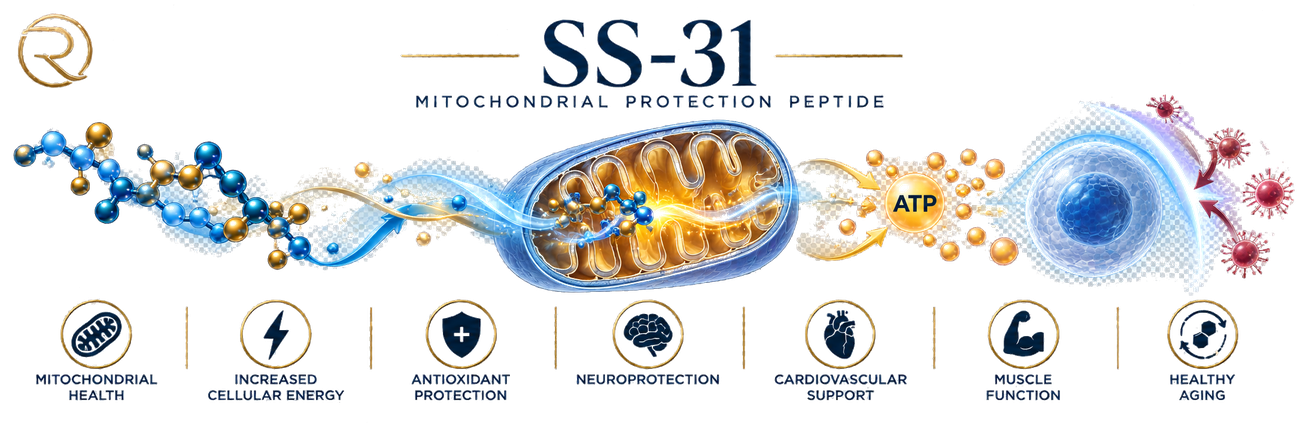
SS-31 is a small synthetic peptide designed to do something unusual: reach the mitochondria inside cells and interact with one of the structures that helps those mitochondria produce energy.
Also known as elamipretide, MTP-131, and formerly Bendavia, SS-31 belongs to the Szeto–Schiller family of mitochondria-targeted peptides. It is a four-amino-acid peptide with the sequence D-Arg-Dmt-Lys-Phe-NH₂, where Dmt is 2’,6’-dimethyltyrosine. Unlike conventional peptides that primarily act by binding to a protein receptor on the outside of a cell, SS-31 was designed around a different idea: target the mitochondrion itself.
That distinction is important. Mitochondria are often described as the “powerhouses” of the cell, but their role is much broader. They regulate energy production, calcium handling, cellular signaling, oxidative stress, and pathways involved in cell survival and death. When mitochondrial structure or function deteriorates, the consequences can extend far beyond energy production.
SS-31 is particularly interesting because it concentrates in the inner mitochondrial membrane, where the machinery responsible for oxidative phosphorylation is located. It does so without depending on the mitochondrial membrane potential in the way many other mitochondria-targeted compounds do. Research has shown that SS-31 can accumulate in mitochondria at concentrations far higher than those found elsewhere in the cell.
Its principal biological target is cardiolipin, a specialized phospholipid concentrated in the inner mitochondrial membrane. Cardiolipin helps organize the membrane and supports the architecture and operation of the respiratory machinery. SS-31’s ability to associate with cardiolipin gives researchers a way to influence mitochondrial structure and function without having to directly inhibit or stimulate a conventional protein receptor.
This makes SS-31 less like a traditional signaling peptide and more like a mitochondria-directed molecular tool.
Scientific Discovery & Development
The story of SS-31 began somewhat unexpectedly. Researchers Hazel H. Szeto and Peter W. Schiller were originally working in peptide chemistry and opioid receptor research. While developing small peptide compounds intended to interact with opioid receptors, they encountered a surprising property: some of these peptides readily entered cells and accumulated inside mitochondria. What began as an investigation into peptide-receptor interactions eventually opened a completely different field of research.
The key observation came when fluorescently labeled peptide analogs were examined using microscopy. Rather than remaining distributed throughout the cell, the compounds showed striking mitochondrial localization. Follow-up experiments demonstrated that the peptides preferentially accumulated in the inner mitochondrial membrane.
That discovery changed the question. Instead of asking whether these peptides could activate an opioid receptor, researchers began asking whether their unusual ability to reach mitochondria could be used therapeutically.
In 2004, Zhao, Szeto, Schiller, and colleagues reported that these cell-permeable peptides could protect mitochondria against swelling, oxidative cell death, and reperfusion injury. SS-31 emerged as one of the most promising members of the family because it combined mitochondrial targeting with strong biological activity.
The next major advance was understanding why the peptide went to the mitochondria. Researchers discovered that SS-31 selectively interacts with cardiolipin. Because cardiolipin is highly concentrated in the inner mitochondrial membrane, it effectively provides a molecular address for the peptide. This helped explain how SS-31 could selectively accumulate at the precise membrane where mitochondrial energy production occurs.
The scientific story therefore progressed from: unexpected mitochondrial localization → deliberate peptide design → mitochondrial protection → cardiolipin targeting → clinical development.
What began as an accidental observation in peptide research eventually became the foundation for a new class of mitochondria-targeted therapeutics.
Why Researchers Are Studying SS-31
The central scientific problem behind SS-31 is mitochondrial dysfunction.
Mitochondria constantly produce energy through oxidative phosphorylation. This process depends on an extraordinarily organized inner membrane containing respiratory-chain proteins, ATP synthase, lipids, and highly structured folds called cristae.
When mitochondria become damaged or inefficient, several problems can develop simultaneously. Energy production can decline, reactive oxygen species can increase, membrane integrity can deteriorate, and signaling pathways associated with inflammation or cell death can become activated.
This creates a difficult biological cycle: mitochondrial damage can impair energy production, while impaired energy production and oxidative stress can produce additional mitochondrial damage.
Researchers are therefore interested in whether protecting mitochondrial architecture could have effects beyond simply increasing ATP.
SS-31 has been studied in conditions where mitochondrial dysfunction is believed to contribute to disease, including Barth syndrome, primary mitochondrial myopathy, cardiovascular disease, skeletal muscle dysfunction, ischemia-reperfusion injury, and certain retinal and neurodegenerative disorders. Preclinical research has also examined its potential in aging-related loss of mitochondrial function and other conditions involving cellular bioenergetic stress.
The attraction is not that SS-31 treats one particular pathway. It is that mitochondrial dysfunction appears across many different biological conditions. If mitochondrial structure can be preserved, researchers ask whether downstream cellular function can also be preserved.
Biological Foundation
To understand SS-31, it helps to look inside the mitochondrion.
The inner mitochondrial membrane contains the electron transport system that converts nutrients into a usable cellular energy currency called ATP. It is not a flat membrane — it is folded into highly organized structures called cristae, which create the architecture needed for efficient energy production.
Cardiolipin is a specialized lipid embedded within this membrane. It helps maintain membrane curvature, supports respiratory-chain complexes, and contributes to the organization of larger protein assemblies involved in oxidative phosphorylation.
When cardiolipin becomes damaged or its organization changes, the architecture of the mitochondrial membrane can become less stable. This can affect how efficiently the respiratory machinery operates.
SS-31 is attracted to this environment through a combination of electrical and hydrophobic interactions. Its positively charged amino acids interact with the negatively charged regions of cardiolipin, while its aromatic residues interact with the membrane environment. The result is selective localization to the cardiolipin-rich inner mitochondrial membrane.
This is one of the most important ideas behind SS-31: the peptide is not simply trying to remove oxidative stress after damage occurs. It is being investigated as a way to influence the mitochondrial environment in which that damage develops.
The precise molecular consequences of cardiolipin binding are an active area of research and are explored more deeply in The Science tab.
What Researchers Are Investigating
One major area of interest is cellular energy production. Preclinical studies have reported improvements in mitochondrial bioenergetics and ATP production following SS-31 treatment in several models. Researchers are examining whether stabilizing the inner membrane allows respiratory machinery to operate more efficiently and with less damaging oxidative stress.
A second area is oxidative stress. Early descriptions of SS-31 emphasized its antioxidant properties, particularly the contribution of its dimethyltyrosine residue. More recent research has refined that picture. Rather than viewing SS-31 simply as a conventional free-radical scavenger, scientists increasingly investigate how its interaction with cardiolipin and mitochondrial membranes may alter the conditions that generate excessive reactive oxygen species in the first place.
A third area is mitochondrial structure. Research suggests that SS-31 can influence cristae organization and preserve aspects of mitochondrial architecture under conditions of stress. This is significant because mitochondrial structure and energy production are closely connected: the physical organization of the membrane helps determine how efficiently its protein machinery functions.
Researchers have consequently investigated SS-31 across tissues with particularly high energy demands, including the heart, skeletal muscle, nervous system, and retina. Preclinical findings have generated interest in whether mitochondrial protection could translate into improved tissue function in diseases where mitochondrial failure is an important component of pathology.
Potential Benefits & Biological Significance
The potential significance of SS-31 comes from the possibility of influencing several consequences of mitochondrial dysfunction at once.
In experimental models, mitochondrial targeting has been associated with preservation of membrane integrity, improved bioenergetics, reduced oxidative stress, and protection against cellular injury. These findings have encouraged investigation into cardiovascular injury, muscle weakness, neurodegeneration, retinal disease, and inherited mitochondrial disorders.
The most important distinction is between preclinical promise and demonstrated human benefit. Animal and cellular studies have produced a broad body of encouraging findings, but clinical research has been more mixed. Trials in primary mitochondrial myopathy and other diseases have not uniformly reproduced the magnitude of effects observed in laboratory models. That tension is scientifically valuable: it is forcing researchers to determine which mitochondrial abnormalities are most responsive to cardiolipin targeting, which patients are most likely to benefit, and which biological measurements best predict meaningful clinical outcomes.
One particularly important human application has been Barth syndrome, a rare inherited mitochondrial disorder characterized by abnormalities in cardiolipin metabolism and associated cardiac and skeletal-muscle dysfunction.
In 2025, the U.S. FDA granted accelerated approval to elamipretide under the brand name Forzinity for improving muscle strength in adults and pediatric patients with Barth syndrome who weigh at least 30 kg. The approved regimen is a once-daily subcutaneous injection.
This represents a major transition in the history of SS-31: a molecule that began as an experimental mitochondria-targeting peptide became an approved therapy for a specific mitochondrial disease.
Current Research Stage & Future Outlook
SS-31 is therefore in a unique position.
It is no longer purely investigational. Elamipretide is FDA approved as Forzinity for improving muscle strength in patients with Barth syndrome weighing at least 30 kg. The approval was granted through the accelerated approval pathway, with a required post-approval study intended to verify clinical benefit.
At the same time, SS-31 remains an investigational therapy for other diseases and applications. Clinical programs have examined conditions including primary mitochondrial myopathy, heart failure, and age-related macular degeneration. For example, the ReCLAIM-2 Phase 2 study investigated daily 40 mg subcutaneous elamipretide for 48 weeks in patients with dry age-related macular degeneration and geographic atrophy.
This distinction matters. Approval for one mitochondrial disorder does not establish effectiveness across every disease associated with mitochondrial dysfunction.
The future of SS-31 will depend on whether the biological principle demonstrated in Barth syndrome can translate into meaningful outcomes across other conditions — and whether researchers can identify the patients, tissues, disease stages, and mitochondrial defects in which cardiolipin targeting provides the greatest advantage.
Global Research Perspective
The scientific development of SS-31 has crossed multiple research environments.
Its origins are associated with the peptide research of Hazel H. Szeto and Peter W. Schiller, while subsequent work has involved investigators studying mitochondrial biology, cardiovascular disease, neurology, ophthalmology, aging, and inherited mitochondrial disorders. Research has appeared across institutions and scientific groups in North America, Europe, Asia, and Australia, reflecting the broader international interest in mitochondria as therapeutic targets.
The field itself has also evolved. Early research largely framed SS-31 as a mitochondria-targeted antioxidant. Contemporary work increasingly focuses on cardiolipin, membrane organization, cristae architecture, respiratory-chain organization, and mitochondrial bioenergetics. This shift illustrates how scientific understanding can mature after a molecule has already entered development.
SS-31 is therefore important not only because of the molecule itself, but because it has helped establish a broader scientific concept: mitochondrial membranes and their specialized lipids may be therapeutically addressable targets.
Disclaimer
SS-31 (elamipretide) is FDA approved under the brand name Forzinity for improving muscle strength in adult and pediatric patients with Barth syndrome weighing at least 30 kg. Its use for other diseases and applications remains investigational.
The information presented in the Regevion Educational Library is intended for educational purposes only and is based on current scientific research and publicly available information. This content is not medical advice and should not be interpreted as a recommendation for use or as a substitute for guidance from a qualified healthcare professional.
Why This Matters
SS-31 represents an important shift in how scientists think about therapeutic peptides.
Rather than targeting a conventional receptor on the surface of a cell, it was developed to reach one of the cell’s most fundamental structures and interact with the specialized membrane that powers it. Its story connects peptide chemistry, mitochondrial biology, cardiolipin, cellular energy production, oxidative stress, and human disease.
The 2025 FDA approval of elamipretide for Barth syndrome demonstrates that this concept has moved beyond laboratory theory. At the same time, the mixed results across other clinical programs show that the science is far from finished.
The larger question is compelling: can protecting the architecture of mitochondria translate into better function at the level of cells, tissues, and ultimately human health? That question is what makes SS-31 worth studying — and it is the question the research and science that follow are designed to explore.
References
- Zhao K, Zhao GM, Wu D, Soong Y, Birk AV, Schiller PW, Szeto HH, et al. Cell-permeable peptide antioxidants targeted to inner mitochondrial membrane inhibit mitochondrial swelling, oxidative cell death, and reperfusion injury. J Biol Chem. 2004. PMID 15178689.
- Szeto HH, Birk AV. First-in-class cardiolipin-protective compound as a therapeutic agent to restore mitochondrial bioenergetics. Br J Pharmacol. 2014. PMID 24117165.
- Karaa A, et al. Efficacy and safety of elamipretide in individuals with primary mitochondrial myopathy: the MMPOWER-3 randomized clinical trial. Neurology. 2022.
- Thompson WR, et al. TAZPOWER open-label extension. Genet Med. 2024. PMID 38602181.
- U.S. Food and Drug Administration. FDA grants accelerated approval to Forzinity (elamipretide), first treatment for Barth syndrome. Press announcement, September 19, 2025; FDA approval letter, NDA 215244.
- ReCLAIM-2: a randomized phase 2 clinical trial evaluating elamipretide in age-related macular degeneration, geographic atrophy growth, visual function, and ellipsoid zone preservation. Ophthalmol Sci. 2024. PMID 39605874.
SS-31 — The Research
How SS-31 Was Discovered
The scientific story behind SS-31 began not with mitochondria, but with an unexpected observation during research into peptide-based opioid molecules.
Around 2000, Peter W. Schiller at the Institut de recherches cliniques de Montréal (IRCM) and Hazel H. Szeto at Cornell University were developing small synthetic peptides related to opioid peptides. The researchers were interested in designing molecules that could cross cell membranes and reach intracellular targets. Instead, some of the resulting peptides displayed an unusual property: they accumulated selectively inside mitochondria.
That observation created a new question: could a small peptide be deliberately engineered to reach mitochondria and protect them from damage?
The answer led to the Szeto–Schiller, or SS, peptide family. Researchers discovered that these tetrapeptides contained an alternating pattern of positively charged and aromatic amino acids that allowed them to cross cell membranes and concentrate at the inner mitochondrial membrane. SS-31 emerged as the lead compound, with the sequence D-Arg-Dmt-Lys-Phe-NH₂, where Dmt is 2’,6’-dimethyltyrosine.
Early work initially emphasized SS-31’s antioxidant properties. In 2004, Zhao, Zhao, Wu, Soong, Birk, Schiller, Szeto and colleagues reported that these cell-permeable peptides targeted to the inner mitochondrial membrane could inhibit mitochondrial swelling, oxidative cell death, and reperfusion injury. The dimethyltyrosine component could interact with reactive oxygen species, while the peptide’s unusual structure allowed it to reach the mitochondrial environment where oxidative damage occurs. This was important because it represented a different strategy from conventional antioxidants: rather than distributing an antioxidant throughout the body, researchers were attempting to concentrate protective activity at the mitochondrion itself.
The research then moved toward an even more important discovery: SS-31 was not simply an antioxidant. It interacted directly with cardiolipin, a distinctive lipid of the inner mitochondrial membrane. That finding shifted the scientific model from simply “scavenging free radicals” toward protecting mitochondrial membrane structure and bioenergetic function.
From Experimental Peptide to Mitochondrial Drug Candidate
During the 2000s and early 2010s, research expanded rapidly beyond isolated biochemical experiments.
Cellular and animal studies repeatedly investigated whether SS-31 could preserve mitochondrial function during conditions associated with oxidative stress, ischemia, aging, metabolic dysfunction and tissue injury. Across these models, researchers reported improvements in mitochondrial respiration, ATP production, oxidative balance and cellular survival.
One of the important conceptual advances was recognizing that mitochondrial dysfunction is not necessarily an irreversible failure of the organelle. Under some conditions, mitochondrial performance could be pharmacologically modified. SS-31 therefore became interesting not simply as a protective antioxidant, but as a potential mitochondrial-targeted therapeutic capable of changing how damaged or stressed mitochondria function.
By the early 2010s, the evidence was strong enough to support systematic clinical development. SS-31 acquired several development names, including MTP-131, Bendavia and eventually elamipretide, and moved into human studies targeting diseases in which mitochondrial dysfunction was thought to be central.
The Most Important Research Milestones
Cardiolipin and Mitochondrial Protection Study: First-in-class cardiolipin-protective compound as a therapeutic agent to restore mitochondrial bioenergetics Researchers: Szeto HH, Birk AV Journal: British Journal of Pharmacology, 2014
Researchers proposed that cardiolipin was a central biological target of SS-31. Rather than merely neutralizing reactive molecules, SS-31 could interact with cardiolipin and reduce its conversion into a highly reactive state associated with mitochondrial oxidative damage.
Why it matters: This helped establish the modern scientific rationale for SS-31. The peptide was increasingly understood as a cardiolipin-protective mitochondrial agent, not simply another antioxidant.
Defining How SS-31 Interacts With Membranes Study: The mitochondria-targeted peptide SS-31 binds lipid bilayers and modulates surface electrostatics as a key component of its mechanism of action Journal: Journal of Biological Chemistry, 2020
Researchers examined how SS-31 physically interacts with mitochondrial-like membranes. The peptide preferentially partitioned into anionic membrane interfaces according to membrane surface charge, modestly increased lipid headgroup packing, and did so without destabilizing the bilayer’s overall structure.
Why it matters: The study provided direct physical evidence supporting the idea that SS-31’s mitochondrial activity begins with its interaction with the membrane itself, particularly its negatively charged lipid environment.
Human Research: Where the Story Became More Complicated
The transition from promising laboratory biology to human medicine produced a more nuanced picture.
Primary Mitochondrial Myopathy
Early clinical work generated encouraging signals. In MMPOWER-2, a randomized, double-blind, placebo-controlled crossover study involving 30 adults with genetically confirmed primary mitochondrial myopathy, participants received 40 mg/day of subcutaneous elamipretide for four weeks (with a four-week washout and crossover to placebo). The study found significant improvements in patient-reported fatigue and muscle symptoms, although the difference in the primary 6-minute walk outcome (19.8 meters favoring elamipretide) did not reach conventional statistical significance (p=0.083).
Researchers then conducted the larger MMPOWER-3 Phase 3 trial, involving 218 participants over 24 weeks. This time, the primary outcomes were not improved: elamipretide did not significantly improve either 6-minute walking distance or total fatigue compared with placebo.
That result is scientifically important because it demonstrates the difference between a compelling mitochondrial mechanism and a reproducible clinical benefit. The trial provided high-quality evidence that the biological rationale alone could not guarantee improvement in functional outcomes for a broad population with primary mitochondrial myopathy.
Barth Syndrome
The most important clinical breakthrough occurred in Barth syndrome, a rare genetic disorder involving abnormal cardiolipin metabolism.
Here, the biological rationale was unusually direct: the disease itself involves disruption of the mitochondrial cardiolipin system that SS-31 is designed to interact with.
The randomized Phase 2/3 crossover study, TAZPOWER, enrolled 12 patients. Its primary endpoints — 6-minute walk distance and symptom scores — were not met during the randomized portion. However, longer-term open-label follow-up (168 weeks) showed a sustained or improved trend in walking distance, improved fatigue and “most bothersome symptom” scores, and improved cardiac stroke volume, helping establish a clinically meaningful signal that supported continued development.
The Barth syndrome program ultimately produced the most significant regulatory milestone in SS-31’s history.
On September 19, 2025, the U.S. FDA granted accelerated approval to Forzinity (elamipretide) for improving muscle strength in adults and children with Barth syndrome weighing at least 30 kg. It became the first FDA-approved treatment specifically for Barth syndrome, and the first approved mitochondria-targeted therapeutic.
The approval is important, but its scope should be understood precisely: elamipretide is FDA approved for muscle-strength improvement in qualifying patients with Barth syndrome — based on improvement in knee-extensor muscle strength, an intermediate endpoint under the accelerated-approval pathway — not as a general mitochondrial therapy, anti-aging treatment, or treatment for primary mitochondrial myopathy. The pivotal TAZPOWER trial itself did not demonstrate superiority to placebo on its primary six-minute-walk and fatigue endpoints.
Because the approval was accelerated, the FDA requires a confirmatory randomized trial intended to verify and further characterize clinical benefit. FDA’s approval letter lists study completion in September 2029, with a final report due March 2030.
What Researchers Have Learned Across Biological Areas
Mitochondrial Bioenergetics
The strongest recurring scientific theme is that SS-31 can influence mitochondrial performance under stress. Experimental studies have reported improved electron-transfer efficiency, ATP generation and preservation of mitochondrial structure. More recent research has also suggested that elamipretide can improve ADP sensitivity in aged mitochondria by increasing ADP uptake through the adenine nucleotide translocator (ANT), connecting mitochondrial energy transport with improvements in muscle and cardiac function in experimental models.
Cardiovascular Research
Preclinical research has investigated SS-31 in ischemia-reperfusion injury, heart failure and age-related cardiac dysfunction. The results helped establish mitochondrial bioenergetics as a potential therapeutic target in cardiovascular disease, although clinical translation has been less consistent than the laboratory findings.
Muscle and Aging
A major research direction has been whether impaired mitochondrial energy production contributes directly to age-related loss of muscle performance. Animal and mechanistic studies have provided evidence that SS-31 can improve mitochondrial function under aging-related stress. Human trials, however, have produced mixed functional results, making this an active research question rather than an established clinical application.
Neurological and Tissue Injury Research
Researchers continue to investigate SS-31 in neurological disease and tissue injury because mitochondria are particularly vulnerable in cells with high energy demands. Studies have explored conditions ranging from neurodegeneration to glaucoma and spinal cord injury. A 2026 study reported that SS-31 promoted recovery after spinal cord injury in an experimental model by preserving mitochondrial bioenergetics and supporting neural remodeling. Separate 2026 research examined SS-31’s relationship with α-synuclein, finding that it modulates α-synuclein membrane binding and aggregation while restoring impaired mitochondrial function in experimental systems. These findings remain preclinical and should not be interpreted as evidence of an established human treatment.
Current Research Stage
SS-31 has moved beyond the purely investigational stage.
As of 2026, its active pharmaceutical form, elamipretide (Forzinity), is FDA approved for improving muscle strength in adults and pediatric patients with Barth syndrome who weigh at least 30 kg.
At the same time, SS-31 remains investigational for the many other conditions in which it has been studied. The negative Phase 3 primary mitochondrial myopathy result is particularly important when interpreting claims about broader mitochondrial disease. The evidence supports genuine biological activity, but it does not establish effectiveness across every disease associated with mitochondrial dysfunction.
This distinction is central to understanding where the science stands today.
What the Evidence Shows
Stronger evidence now exists for a specific clinical application: improving muscle strength in qualifying patients with Barth syndrome, the indication for which elamipretide received FDA accelerated approval in 2025.
Emerging evidence supports continued investigation of mitochondrial bioenergetics, cardiolipin biology, aging-related mitochondrial dysfunction and selected tissue-specific disorders.
Early or experimental evidence includes many neurological, metabolic, inflammatory and injury-related applications. These areas remain largely dependent on cellular or animal research and should not be treated as established clinical benefits.
The overall research picture is therefore unusually interesting: the mitochondrial target is biologically well characterized, the drug has demonstrated clinical relevance in a rare genetic disease, but broader applications have not yet produced uniformly positive human outcomes.
What Researchers Are Studying Now
Current research is increasingly focused on understanding which mitochondrial diseases and patient populations are most likely to benefit from cardiolipin-targeted therapy.
Researchers are also investigating whether mitochondrial dysfunction can be modified in aging-related muscle decline, neurological injury and other disorders where impaired bioenergetics may contribute to disease progression.
The newest mechanistic work is broadening the picture beyond cardiolipin alone. Studies are examining interactions with mitochondrial proteins involved in ATP transport and oxidative phosphorylation, while 2026 research is also exploring SS-31’s relationship with α-synuclein and mitochondrial dysfunction.
These studies reflect an important evolution in the field: researchers are no longer asking only “Can SS-31 protect mitochondria?” They are increasingly asking “Which mitochondrial defects can actually be reversed, in which diseases, and in which patients?”
Future Scientific Potential
SS-31 remains scientifically interesting because it represents a different therapeutic strategy: instead of targeting a single disease-specific receptor, it attempts to influence a fundamental component of mitochondrial function.
The strongest evidence now demonstrates that this strategy can translate into a human therapy in a specific mitochondrial disease. The broader research program is still being defined.
The future question is therefore not whether SS-31 has biological activity — it clearly does — but how broadly that activity can be translated into meaningful clinical outcomes.
That distinction between mechanism, biological effect and proven clinical benefit is what makes the continuing research particularly important.
Why This Matters
SS-31’s research history illustrates how an unexpected observation can develop into an entirely new therapeutic field.
What began with synthetic peptide research led to the discovery of mitochondria-targeting peptides, then to the identification of cardiolipin as an important pharmacological target, and ultimately to the first FDA-approved therapy for Barth syndrome.
At the same time, clinical trials have shown that promising mitochondrial biology does not automatically translate into benefit across every disease. That combination — a validated biological concept, one important clinical success, and significant unanswered questions elsewhere — is what makes SS-31 one of the more scientifically interesting mitochondrial peptides under study today.
Disclaimer
Elamipretide (SS-31) is FDA approved under the brand name Forzinity for improving muscle strength in adults and pediatric patients with Barth syndrome who weigh at least 30 kg. Its use for other conditions remains investigational.
The information presented in the Regevion Educational Library is intended for educational purposes only and is based on current scientific research and publicly available information. This content is not medical advice and should not be interpreted as a recommendation for use or as a substitute for guidance from a qualified healthcare professional.
References
- Zhao K, Zhao GM, Wu D, Soong Y, Birk AV, Schiller PW, Szeto HH, et al. Cell-permeable peptide antioxidants targeted to inner mitochondrial membrane inhibit mitochondrial swelling, oxidative cell death, and reperfusion injury. J Biol Chem. 2004. PMID 15178689.
- Szeto HH, Birk AV. First-in-class cardiolipin-protective compound as a therapeutic agent to restore mitochondrial bioenergetics. Br J Pharmacol. 2014. PMID 24117165.
- The mitochondria-targeted peptide SS-31 binds lipid bilayers and modulates surface electrostatics as a key component of its mechanism of action. J Biol Chem. 2020. PMID 32273339.
- Karaa A, et al. Efficacy and safety of elamipretide (MMPOWER-2). J Cachexia Sarcopenia Muscle. 2020. PMID 32096613.
- Karaa A, et al. Efficacy and safety of elamipretide in individuals with primary mitochondrial myopathy: the MMPOWER-3 randomized clinical trial. Neurology. 2022.
- Thompson WR, et al. TAZPOWER open-label extension. Genet Med. 2024. PMID 38602181.
- U.S. Food and Drug Administration. FDA grants accelerated approval to Forzinity (elamipretide), first treatment for Barth syndrome. Press announcement, September 19, 2025; FDA approval letter, NDA 215244.
- Pharaoh G, et al. The mitochondrially targeted peptide elamipretide (SS-31) improves ADP sensitivity in aged mitochondria by increasing uptake through the adenine nucleotide translocator (ANT). GeroScience. 2023. PMID 36778398.
- Elamipretide (SS-31) promotes recovery by preserving mitochondrial bioenergetics and neural remodeling after spinal cord injury. 2026. PMID 42082001.
- Stefaniak E, et al. Therapeutic peptide SS-31 modulates membrane binding and aggregation of α-synuclein and restores impaired mitochondrial function. Chem Biol Drug Des. 2026. PMID 42219795.
SS-31 — The Science
The Biological Architecture
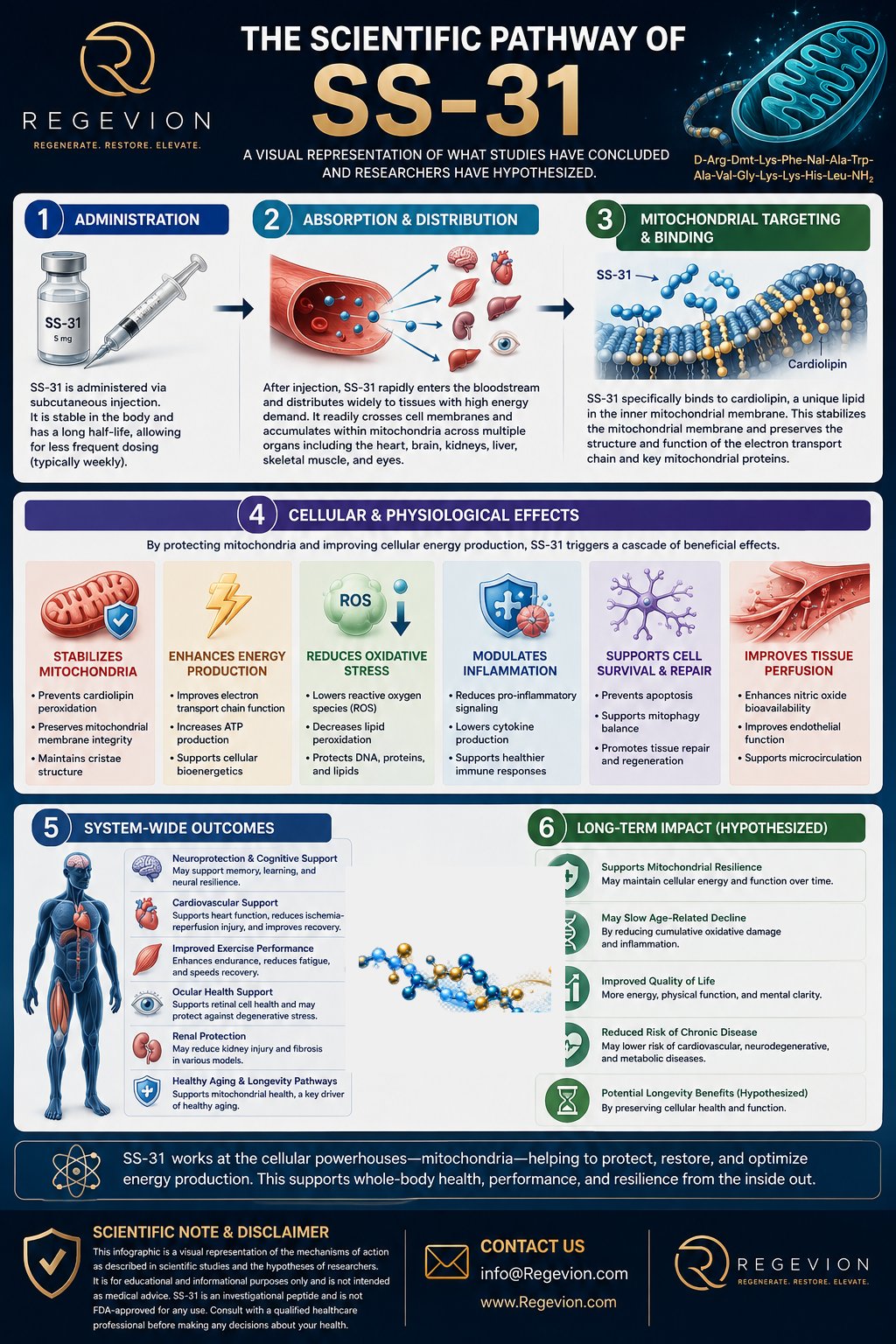
SS-31, now known by its generic name elamipretide, is fundamentally different from peptides that work by activating a conventional cell-surface hormone receptor. Its primary biological target is located inside the cell, at the inner mitochondrial membrane.
Mitochondria are the organelles responsible for most cellular ATP production through oxidative phosphorylation. They are particularly important in tissues with high and continuous energy requirements, including skeletal muscle, cardiac muscle, brain, and the retina. Within the inner mitochondrial membrane is a specialized phospholipid called cardiolipin.
Cardiolipin is unusual because it contains four fatty-acid chains rather than the two found in most membrane phospholipids. It helps organize the inner mitochondrial membrane, supports the architecture of mitochondrial cristae — the folded structures where respiratory machinery is concentrated — and stabilizes proteins involved in the electron transport chain.
This creates the central biological sequence for elamipretide: elamipretide → mitochondrial inner membrane → cardiolipin → membrane/protein organization → mitochondrial bioenergetics → cellular energy and stress responses.
Unlike a classical receptor agonist, therefore, SS-31 does not primarily instruct a cell through a receptor-mediated hormonal signal. It interacts directly with a structural component of the mitochondrial membrane and modifies the environment in which mitochondrial energy production occurs.
Molecular Mechanism of Action
Elamipretide is a small, aromatic-cationic tetrapeptide with the sequence D-Arg-2’,6’-dimethyl-Tyr-Lys-Phe-NH₂. Its positively charged residues and amphipathic structure facilitate cellular penetration and preferential accumulation at the negatively charged inner mitochondrial membrane, where cardiolipin is highly concentrated.
The important interaction is cardiolipin binding. Cardiolipin normally helps maintain the organization of respiratory-chain proteins and the physical structure of the inner membrane. Under conditions of mitochondrial stress, cardiolipin can become oxidized and its membrane environment can become disordered. These changes can destabilize respiratory machinery, impair electron transfer, increase oxidative stress, and ultimately compromise ATP production.
Elamipretide associates with cardiolipin and appears to normalize some of these abnormal membrane properties. Modern mechanistic research has moved beyond the earlier description of SS-31 as simply a mitochondrial antioxidant. Evidence increasingly indicates that its principal effect is modulation and stabilization of the cardiolipin-rich mitochondrial membrane environment, with secondary consequences for respiratory-chain organization and mitochondrial bioenergetics.
That distinction matters. SS-31 is not best understood as a molecule that simply sweeps up free radicals. Experimental work suggests that it can reduce mitochondrial reactive oxygen species partly by improving the function and organization of the respiratory system that generates those reactive species in the first place.
From Cardiolipin to Cellular Energy
The inner mitochondrial membrane contains the electron transport chain, in which electrons move through respiratory complexes while protons are pumped across the membrane. This creates an electrochemical gradient known as the mitochondrial membrane potential. ATP synthase then uses that gradient to generate ATP.
Cardiolipin contributes to the structural organization of this system. It supports the assembly and stability of respiratory-chain complexes and larger supercomplexes, allowing electron transport and oxidative phosphorylation to operate efficiently.
When cardiolipin and the surrounding membrane architecture are destabilized, electron transport can become less efficient. Electron leakage can increase, reactive oxygen species can rise, and the proton gradient can become less effectively coupled to ATP production.
Elamipretide’s cardiolipin interaction appears to support the membrane environment required for efficient respiration. Experimental studies have associated treatment with preservation of mitochondrial membrane potential, improved respiratory-chain function, better bioenergetic efficiency, and lower mitochondrial ROS emission.
The resulting chain is: cardiolipin interaction → improved inner-membrane organization → better respiratory-chain organization and function → more efficient oxidative phosphorylation → improved mitochondrial bioenergetics → greater capacity for cellular energy production and stress resilience.
The exact contribution of each step varies by tissue and disease state, and not every downstream effect has been established equally in humans.
Oxidative Stress, Cytochrome c & Cell Survival
Cardiolipin also participates in mitochondrial signaling during cellular injury.
One important interaction involves cytochrome c, a protein normally associated with electron transfer within the respiratory chain. When cardiolipin becomes oxidized, its interaction with cytochrome c can acquire peroxidase-like activity, contributing to further lipid oxidation. This creates a potentially damaging feedback loop.
Elamipretide can alter this cardiolipin–cytochrome c environment, reducing conditions associated with cardiolipin peroxidation while helping preserve cytochrome c’s normal role in electron transport.
Mitochondrial damage can also promote opening of the mitochondrial permeability transition pore, loss of membrane potential, mitochondrial swelling, and release of pro-apoptotic signals. Preclinical research indicates that elamipretide can reduce these pathological changes, although the precise molecular composition and regulation of the permeability transition pore remain active areas of mitochondrial research.
This means that the peptide’s effects extend beyond ATP production. By preserving mitochondrial structure and reducing the conditions that promote oxidative injury, SS-31 may alter whether stressed cells remain functional or progress toward irreversible damage.
Pharmacology & Pharmacokinetics
Elamipretide is now an FDA-approved drug for a specific indication, but its pharmacology has also been investigated extensively across earlier experimental programs.
Under the current FDA-approved formulation, elamipretide is administered subcutaneously. After subcutaneous administration, peak plasma concentrations occur approximately 0.5–1 hour after dosing, and absolute bioavailability is approximately 92%. Its apparent volume of distribution is approximately 0.5 L/kg, with relatively low plasma-protein binding (approximately 39%).
The peptide is metabolized primarily through sequential C-terminal degradation, producing M1 and M2 peptide metabolites that do not retain pharmacological activity. Elamipretide and these metabolites are eliminated predominantly through the urine. In subjects with normal renal function, approximately 100% of the administered dose was recovered in urine within 48 hours as parent drug or metabolites.
Renal function therefore matters to exposure. FDA pharmacokinetic analyses found progressively greater elamipretide exposure as renal function declined — approximately 39% greater in mild impairment, 75% greater in moderate impairment, and 125% greater in severe impairment — with the largest increase occurring in severe renal impairment. This is reflected in the approved dosing modification (a reduced 20 mg daily dose) for adults with severe renal impairment.
The important pharmacological point is that plasma exposure and mitochondrial biology are related but not identical measurements. A short-lived circulating peptide can still produce biologically meaningful effects because it rapidly distributes into tissues and interacts with a persistent cellular structure rather than requiring continuous receptor occupancy at the plasma membrane.
Dose, Exposure & Dose-Response
Elamipretide has been studied through multiple routes and dose ranges during its development.
Earlier mitochondrial-myopathy studies examined intravenous exposure ranging from 0.01 to 0.25 mg/kg/hour during two-hour infusions, while later clinical studies evaluated subcutaneous administration, including 40 mg once daily.
The current FDA-approved regimen for patients weighing at least 30 kg is 40 mg subcutaneously once daily for Barth syndrome. FDA pharmacokinetic data show approximately proportional increases in exposure across a 2–80 mg daily subcutaneous dose range, with minimal accumulation during repeated daily dosing.
This is an important distinction between dose-response and dose escalation. More peptide produces greater systemic exposure, but greater exposure does not automatically mean proportionally greater biological benefit. Mitochondrial membranes contain a finite population of cardiolipin-rich binding environments, and downstream mitochondrial processes can become limited by factors other than peptide concentration.
Consequently, the scientifically meaningful relationship is: dose → systemic exposure → mitochondrial localization → cardiolipin interaction → mitochondrial response. The strength of each link can vary according to tissue, disease state, mitochondrial damage, renal clearance, and the amount of functional mitochondrial machinery remaining.
Does Body Weight Affect Dose?
Elamipretide provides an interesting example of why fixed-dose and weight-based pharmacology should not be conflated.
The current approved regimen is a fixed 40 mg once-daily subcutaneous dose for patients weighing at least 30 kg, rather than a dose calculated continuously from body weight. The indication itself uses a weight threshold, but that does not mean the medication is prescribed as mg/kg.
Earlier research did use weight-based intravenous dosing, particularly during experimental dose-escalation studies. Those research designs were intended to characterize exposure and pharmacology and should not be interpreted as evidence that a weight-based regimen is inherently superior.
The current prescribing information instead emphasizes renal function as an important determinant of exposure, because reduced renal clearance increases systemic exposure.
Lower vs. Higher Exposure
At lower exposure, elamipretide can interact with cardiolipin-enriched mitochondrial membranes without necessarily producing a generalized cellular signaling response. As exposure increases, greater mitochondrial engagement can influence membrane organization, respiratory-chain performance, membrane potential, and oxidative stress.
At still higher exposure, however, the biological relationship should not be interpreted as unlimited. Once the relevant mitochondrial membrane environments are sufficiently occupied or stabilized, additional circulating peptide may produce diminishing incremental effects.
This is why mitochondrial-targeted pharmacology is better represented as an exposure-response curve than as a simple rule that higher concentration equals greater benefit. Importantly, different biological outcomes can have different response curves — mitochondrial respiration, oxidative stress markers, muscle performance, and clinical outcomes do not necessarily reach their maximal response at the same exposure.
Connecting the Mechanism to Physiology
The significance of SS-31 becomes clearer when the mechanism is followed all the way from the membrane to the organism.
Cardiolipin binding → preservation of mitochondrial membrane architecture → improved organization and efficiency of respiratory machinery → more effective oxidative phosphorylation and maintenance of membrane potential → improved cellular bioenergetic capacity → greater ability of energy-demanding tissues to maintain function under metabolic stress.
This mechanism is particularly relevant to tissues in which mitochondrial energy production is continuously challenged. In skeletal muscle, improved mitochondrial bioenergetics could influence the ability of muscle fibers to sustain contraction. In cardiac muscle, where ATP demand is continuous, preservation of mitochondrial respiratory function may influence myocardial energetic reserve. In mitochondrial disorders such as Barth syndrome, where cardiolipin remodeling and mitochondrial function are intrinsically abnormal, targeting the cardiolipin-rich membrane provides a mechanistically direct therapeutic strategy.
Human outcomes, however, remain the final test of this biological model. The FDA’s approval of Forzinity for Barth syndrome was based on improvement in knee-extensor muscle strength, an intermediate endpoint, under the accelerated-approval pathway; the pivotal randomized crossover trial (TAZPOWER) did not demonstrate superiority to placebo on its primary six-minute-walk and fatigue endpoints.
That distinction is scientifically important: a plausible mitochondrial mechanism does not automatically establish clinical efficacy for every disease in which mitochondrial dysfunction occurs.
Combination & Pathway Interaction
Elamipretide is best viewed as a mitochondrial membrane-directed intervention, rather than as a replacement for an endogenous hormone.
Its activity therefore intersects with many downstream systems that depend on mitochondrial performance, including oxidative phosphorylation, cellular redox balance, apoptosis signaling, calcium handling, and energy metabolism.
The strongest mechanistic rationale for interaction is with processes that alter cardiolipin integrity or mitochondrial respiratory function. However, evidence that combining elamipretide with other experimental peptides produces superior clinical outcomes remains limited, and molecular compatibility should not be confused with demonstrated therapeutic synergy.
What Scientists Still Do Not Fully Understand
One of the most important unanswered questions is how much of elamipretide’s biological effect comes from direct cardiolipin stabilization versus secondary changes in membrane electrostatics, respiratory-chain organization, protein assembly, and mitochondrial dynamics.
Recent research has also challenged the older idea that SS-31 acts primarily as a conventional free-radical scavenger. The newer model places mitochondrial membrane organization and cardiolipin-dependent protein function much closer to the center of its mechanism.
Another unresolved question is why improvement in mitochondrial biomarkers or tissue-level function does not always translate into consistent improvement in clinical endpoints. Mitochondrial disease is heterogeneous, and damaged mitochondria may differ substantially in their capacity to recover function.
Understanding which patients retain enough recoverable mitochondrial machinery to benefit — and which biological markers best predict that response — remains an important area of research.
Why This Matters
SS-31 is scientifically interesting because it approaches mitochondrial dysfunction at its membrane architecture, rather than attempting to stimulate a conventional surface receptor.
Its central mechanism can be understood as a chain: elamipretide → cardiolipin → mitochondrial membrane organization → respiratory-chain function → bioenergetics → cellular and tissue function.
That framework explains why a four-amino-acid peptide can influence processes as fundamental as ATP production, oxidative stress, and cellular resilience.
The larger scientific significance is the idea that mitochondria may be therapeutically influenced not only by changing metabolic substrates or blocking individual enzymes, but by stabilizing the physical environment in which mitochondrial machinery operates. Elamipretide has helped make that concept testable in humans.
Disclaimer
Elamipretide (SS-31) is FDA approved in the United States under the brand name Forzinity for improving muscle strength in adult and pediatric patients with Barth syndrome weighing at least 30 kg. Its approval was granted under the accelerated-approval pathway. Other uses of elamipretide remain investigational.
The information presented in the Regevion Educational Library is intended for educational purposes only and is based on current scientific research and publicly available information. This content is not medical advice and should not be interpreted as a recommendation for use or as a substitute for guidance from a qualified healthcare professional.
References
- Zhao K, Zhao GM, Wu D, Soong Y, Birk AV, Schiller PW, Szeto HH, et al. Cell-permeable peptide antioxidants targeted to inner mitochondrial membrane inhibit mitochondrial swelling, oxidative cell death, and reperfusion injury. J Biol Chem. 2004. PMID 15178689.
- Szeto HH, Birk AV. First-in-class cardiolipin-protective compound as a therapeutic agent to restore mitochondrial bioenergetics. Br J Pharmacol. 2014. PMID 24117165.
- The mitochondria-targeted peptide SS-31 binds lipid bilayers and modulates surface electrostatics as a key component of its mechanism of action. J Biol Chem. 2020. PMID 32273339.
- Pharaoh G, et al. The mitochondrially targeted peptide elamipretide (SS-31) improves ADP sensitivity in aged mitochondria by increasing uptake through the adenine nucleotide translocator (ANT). GeroScience. 2023. PMID 36778398.
- U.S. Food and Drug Administration. Forzinity (elamipretide) prescribing information and approval letter. NDA 215244. Approved September 19, 2025.