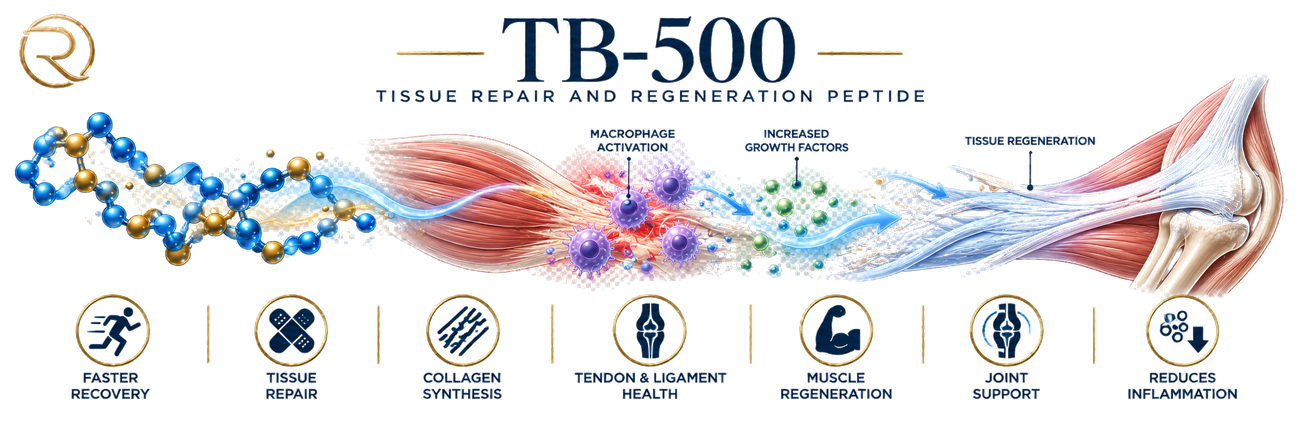
What the studies actually found
Important distinction: this trial used the full-length parent protein, Thymosin Beta-4 — not the 7-amino-acid TB-500 fragment. It's the strongest human evidence connected to this biological pathway, and it's part of why TB-500 draws scientific interest, but it isn't a TB-500 trial.
READ THE RESEARCH →Again, this is the full Thymosin Beta-4 protein, in mice — not TB-500 in humans. After researchers tied off a coronary artery to simulate a heart attack, Tβ4 treatment activated a cell-survival pathway that reduced heart-muscle cell death and improved cardiac function.
READ THE RESEARCH →Researchers identified the actin-binding region inside Thymosin Beta-4 — the sequence LKKTETQ — as central to how the full protein regulates cell movement. TB-500 is a synthetic version of exactly that fragment.
READ THE RESEARCH →Decades of research back the parent protein. Direct evidence for the isolated 7-amino-acid fragment is thinner — mostly analytical chemistry confirming what it is and how it's metabolized, not yet efficacy studies of its own. That gap is exactly what current research is working to close.
READ THE RESEARCH →TB-500 doesn't dock onto a surface receptor the way most peptides do. It's proposed to interact directly with actin, the protein cells use to physically move — the same internal machinery repairing cells rely on to migrate toward damaged tissue.
EXPLORE THE SCIENCE →TB-500 — Overview
What Is TB-500?
TB-500 is a synthetic peptide fragment derived from Thymosin Beta-4 (Tβ4), a naturally occurring 43-amino-acid peptide found throughout the body. More precisely, the compound identified in the scientific literature as TB-500 is the N-acetylated seven-amino-acid sequence Ac-LKKTETQ, corresponding to amino acids 17–23 of human Thymosin Beta-4.
That distinction matters. Thymosin Beta-4 is the naturally occurring parent peptide. TB-500 is a much smaller synthetic fragment designed around one of the most biologically important regions of that molecule: its actin-binding sequence. Actin is one of the fundamental structural proteins inside cells. It helps cells maintain their shape, move through tissues, divide, and reorganize themselves in response to injury. By focusing on a short region associated with actin regulation, researchers became interested in whether this fragment could reproduce some of the tissue-repair-related biology associated with the larger molecule.
Thymosin Beta-4 itself is relatively small, weighing approximately 4,982 Da (roughly 5 kDa), but it has a surprisingly broad biological presence. It is abundant in many tissues and is particularly associated with cells and environments involved in injury and repair, including platelets and wound fluid. Rather than functioning like a conventional hormone that travels to one specific receptor, Tβ4 participates in intracellular and extracellular processes that influence how cells respond to their environment. TB-500’s free-base form, by comparison, weighs approximately 889 Da.
TB-500 therefore belongs to an interesting category of peptide research: a synthetic fragment built from a naturally occurring biological signal.
It is also important not to treat the names TB-500 and Thymosin Beta-4 as interchangeable. The full-length 43-amino-acid peptide has been investigated extensively in laboratory and human studies, while the evidence specifically supporting the isolated Ac-LKKTETQ fragment is much more limited. A finding involving Thymosin Beta-4 cannot automatically be assumed to demonstrate the same effect in TB-500.
That scientific distinction becomes increasingly important as the research moves from basic biology toward potential therapeutic applications.
Scientific Discovery & Development
The story of TB-500 begins long before TB-500 itself existed.
In the 1960s and 1970s, researchers were investigating the thymus, an immune-system organ involved in the development and maturation of T lymphocytes. Scientists including Allan L. Goldstein and colleagues at Albert Einstein College of Medicine and later the University of Texas Medical Branch isolated a collection of small biological peptides from calf thymus extracts that became known collectively as thymosins. Thymosin Beta-4 was eventually identified as one of the major members of this family.
The molecular identity of Tβ4 became much clearer in 1981. Teresa L. K. Low, Shu K. Hu, and Allan L. Goldstein reported the complete amino-acid sequence of bovine Thymosin Beta-4, showing that the peptide consisted of 43 amino acids and had a molecular weight of approximately 4,982 daltons.
At first, scientists were primarily interested in Thymosin Beta-4 because of its apparent relationship to immune-cell biology. But the scientific story changed as researchers discovered that the peptide was present far beyond the thymus. In the early 1980s, investigators reported Thymosin Beta-4 in tissues from multiple mammalian species and vertebrate classes, suggesting that it was not simply a thymus-specific immune molecule.
Then came a much more important clue. In 1992, research by M. C. Sanders, Allan Goldstein, and Y. L. Wang demonstrated that Tβ4 could regulate actin assembly inside living cells. This finding helped shift the scientific interpretation of the molecule from a relatively obscure thymic peptide toward a regulator of fundamental cellular behavior.
That discovery opened a much larger question: if Thymosin Beta-4 helps control the cellular machinery that allows cells to move and reorganize, could it also influence how tissues respond to injury?
During the 1990s and early 2000s, researchers began investigating Tβ4 in wound repair, angiogenesis — the formation of new blood vessels — and tissue regeneration. In 2003, Deborah Philp, Thomas Huff, Yong Song Gho, Ewald Hannappel, and colleagues at the National Institutes of Health reported that the actin-binding region of Tβ4 promoted endothelial-cell migration and angiogenic activity.
The following year, research published in Nature by Ildiko Bock-Marquette, Ankur Saxena, Deepak Srivastava, and colleagues expanded the story into cardiac biology, showing that Thymosin Beta-4 could activate integrin-linked kinase and promote cardiac-cell migration, survival, and repair in experimental models.
The scientific interest was no longer simply about an immune peptide — it was becoming a story about how cells move, survive, communicate, and rebuild tissue after injury.
TB-500 emerged from this broader scientific landscape as a synthetic representation of the actin-binding region of Tβ4. In 2012, researchers at Ghent University in Belgium chemically identified and synthesized the N-terminal-acetylated 17–23 fragment Ac-LKKTETQ associated with products identified as TB-500.
Why Researchers Are Studying TB-500
The central scientific question surrounding TB-500 is not simply whether it can make an injury “heal faster.” It is more fundamental: can a small peptide fragment influence the cellular processes that determine how damaged tissue reorganizes and repairs itself?
Tissue repair is an extraordinarily coordinated biological process. After injury, cells must migrate toward the damaged area, remove or reorganize damaged material, establish new extracellular structure, restore blood supply, and eventually rebuild functional tissue.
Cell movement is at the center of much of this process. Actin provides one of the internal systems that allows a cell to change shape and move. When cells need to migrate, their internal cytoskeleton continuously reorganizes. The actin network assembles, disassembles, and redirects itself in response to signals from the surrounding tissue.
Because the TB-500 sequence corresponds to the actin-binding region of Thymosin Beta-4, researchers became interested in whether this fragment could influence processes associated with cell migration, wound closure, and vascular development.
These questions have been explored most extensively in laboratory and animal models. Importantly, this is where the distinction between biological promise and clinical evidence becomes essential. The research surrounding Thymosin Beta-4 is substantially broader than the research specifically conducted with TB-500. Human studies of full-length Tβ4 have investigated areas including wound healing and ocular tissue repair, but these findings should not automatically be interpreted as clinical evidence for the isolated TB-500 fragment.
Biological Foundation
To understand the interest in TB-500, it helps to picture the body after an injury.
A damaged tissue is not simply waiting for new cells to appear. It becomes a highly active biological environment. Signals are released, immune cells arrive, blood vessels respond, and nearby cells change their behavior. Some cells need to move into the damaged area. Others need to divide. Some need to establish new connections with neighboring cells. And blood vessels may need to extend into the region to provide oxygen and nutrients.
Actin is involved in many of these movements. Thymosin Beta-4 is one of the body’s natural regulators of the pool of actin available for cellular remodeling. Research has shown that Tβ4 can influence actin dynamics and cellular migration, helping explain why the molecule became associated with tissue repair.
The TB-500 fragment represents a much smaller piece of this system. Its sequence, LKKTETQ, is located within the region of Tβ4 associated with actin binding. This gives the fragment a logical biological connection to cell movement and tissue remodeling, but it does not mean that seven amino acids reproduce everything the complete 43-amino-acid protein does.
That difference is scientifically important. The full-length molecule contains structural information and biological interactions that the fragment does not. Tβ4 also generates other biologically active fragments, including Ac-SDKP, which is a different sequence and should not be confused with TB-500.
Understanding these distinctions prevents a common problem in peptide research: attributing every finding associated with a parent molecule to a much smaller fragment simply because the fragment originated from it.
What Researchers Are Investigating
The most established area of interest is tissue repair. In experimental models, Thymosin Beta-4 has been associated with faster wound closure, increased cellular migration, and changes in angiogenesis. Researchers have investigated these effects in skin and other tissues because successful repair depends on cells being able to move into damaged areas and reconstruct the tissue environment.
A second area is vascular biology. Angiogenesis is the formation of new blood vessels from existing vessels, essential during tissue repair because newly developing tissue requires a blood supply. Research involving Tβ4 has shown effects on endothelial-cell migration and blood-vessel formation, providing another biological explanation for its regenerative interest.
A third area is cell survival and tissue remodeling. The 2004 cardiac research published in Nature demonstrated that Tβ4 could influence cardiac-cell migration and survival in experimental models. This helped broaden the scientific question from simple wound closure toward the possibility that Tβ4-related biology could participate in more complex forms of tissue restoration.
Researchers have also investigated Tβ4 in ocular tissue, skin disorders, cardiac injury, inflammation, and other forms of regenerative biology. Some of these programs progressed into human studies using full-length recombinant Tβ4, including clinical investigations of wound healing and ocular conditions.
For TB-500 itself, however, the scientific picture is considerably less mature. A 2024 analytical study specifically examining TB-500 and its metabolites found that the peptide is metabolized into smaller fragments and raised the possibility that some previously attributed wound-healing activity may actually be related to a metabolite rather than the parent TB-500 molecule itself. That finding illustrates how much remains to be established about the pharmacology of the isolated fragment.
In other words, researchers are not only asking whether TB-500 has biological activity — they are still working to determine which molecule is responsible for which effect, how the fragment behaves in biological systems, and how closely those effects resemble the much better studied parent peptide.
Potential Benefits & Biological Significance
The potential significance of TB-500 comes primarily from its relationship to cellular repair.
If a peptide can influence the movement and behavior of cells involved in tissue remodeling, it could theoretically affect several stages of the repair process. This has made the Tβ4 family interesting in areas ranging from skin and connective-tissue repair to vascular and cardiac biology.
But the strength of the evidence varies considerably. The strongest biological foundation comes from laboratory and animal research involving full-length Thymosin Beta-4. Human research has provided additional evidence that Tβ4 can be investigated clinically for tissue-repair applications, including wound healing. For the isolated TB-500 fragment, evidence remains predominantly preclinical, and controlled human efficacy data are lacking.
That distinction does not make the peptide scientifically uninteresting. In fact, it makes the unanswered questions more important. TB-500 offers researchers a way to examine whether a specific functional region of a larger regenerative peptide can reproduce selected aspects of the parent molecule’s biology. If those relationships can be clearly established, they could help scientists better understand which parts of complex biological peptides are responsible for particular cellular effects.
Current Research Stage & Future Outlook
As of 2026, TB-500 is not FDA approved for any human medical indication.
The FDA has specifically identified TB-500 as the seven-amino-acid thymosin beta-4 fragment LKKTETQ, and its current regulatory materials state that the agency has not identified human exposure data for compounded products containing the fragment and lacks important safety information; the agency’s review also found no identified nonclinical pharmacokinetic studies via the nominated intramuscular route beyond limited data.
The regulatory picture is also evolving. In July 2026, the FDA’s Pharmacy Compounding Advisory Committee considered TB-500 free base and TB-500 acetate for possible inclusion on the federal 503A bulk-drug list, with wound healing as the proposed area of use evaluated by the agency. FDA’s own briefing materials recommended against inclusion, citing insufficient characterization, historical-use, and safety information. The advisory committee itself, however, voted in favor of recommending inclusion — a pattern seen with several other peptides reviewed at the same July 2026 meetings, where the committee’s advisory vote diverged from FDA staff’s own position. Committee recommendations are non-binding, and the agency has stated that a final determination will come only after it completes its review.
This should not be confused with approval.
The broader Thymosin Beta-4 molecule has reached considerably further in clinical development, including FDA orphan-drug designations for epidermolysis bullosa and for neurotrophic keratopathy (publicly confirmed in early 2014). Neither designation resulted in FDA approval for those indications.
The future scientific question is therefore not simply whether TB-500 will become a medicine. It is whether researchers can establish a sufficiently clear relationship between the fragment’s molecular identity, biological activity, pharmacology, safety, and clinically meaningful outcomes to justify further development.
Global Research Perspective
The scientific story behind TB-500 has developed across several research communities.
The foundational work on Thymosin Beta-4 emerged largely from researchers in the United States, particularly the work of Allan Goldstein and collaborators studying thymic peptides and later the biology of actin and tissue repair. Research groups in the United States subsequently investigated Tβ4 in wound healing, angiogenesis, cardiac biology, and ophthalmology.
European researchers also contributed to the transition from the parent peptide to the modern TB-500 identity. In 2012, investigators at Ghent University in Belgium chemically characterized the Ac-LKKTETQ fragment associated with TB-500, establishing a clearer analytical definition of the substance.
Today, the field represents a combination of basic peptide biology, regenerative medicine, analytical chemistry, and regulatory science. That combination is important because understanding TB-500 requires more than demonstrating that a peptide produces an interesting effect in an experimental model. Researchers must determine exactly what molecule is being studied, how it behaves in the body, which biological effects belong to the fragment itself, and whether those effects translate into meaningful human outcomes.
Disclaimer
TB-500 is an investigational peptide and is not currently FDA approved. The information presented in the Regevion Educational Library is intended for educational purposes only and is based on current scientific research and publicly available information. This content is not medical advice and should not be interpreted as a recommendation for use or as a substitute for guidance from a qualified healthcare professional.
Why This Matters
TB-500 sits at an interesting intersection between molecular biology and regenerative research.
Its significance begins with a simple biological idea: cells must move and reorganize themselves for damaged tissue to repair. The connection between TB-500 and the actin-binding region of Thymosin Beta-4 gives researchers a way to investigate whether a small, defined peptide fragment can influence some of the cellular processes involved in that response.
But the most important scientific story may be the distinction between what is already known and what remains unanswered. Thymosin Beta-4 has a substantial body of experimental and human research behind it. TB-500, by comparison, remains much less clinically characterized. Understanding that difference allows the research to be viewed more accurately — and makes the unanswered questions around TB-500 particularly compelling.
References
- Low TLK, Hu SK, Goldstein AL. Complete amino acid sequence of bovine thymosin beta 4. Proc Natl Acad Sci U S A. 1981;78(2):1162-1166. PMID 6940133.
- Sanders MC, Goldstein AL, Wang YL. Thymosin beta 4 (Fx peptide) is a potent regulator of actin polymerization in living cells. Proc Natl Acad Sci U S A. 1992;89(10):4678-4682. PMID 1584803.
- Philp D, Huff T, Gho YS, Hannappel E, Kleinman HK. The actin binding site on thymosin β4 promotes angiogenesis. FASEB J. 2003. PMID 14500546.
- Bock-Marquette I, Saxena A, White MD, Michael DiMaio J, Srivastava D. Thymosin β4 activates integrin-linked kinase and promotes cardiac cell migration, survival and cardiac repair. Nature. 2004;432(7016):466-472. PMID 15565145.
- Esposito S, et al. Synthesis and characterization of TB-500 (Ac-LKKTETQ). Drug Test Anal. 2012. PMID 22962027.
- Ho ENM, Kwok WH, Lau MY, Wong AS, Wan TS, Lam KK, Schiff PJ, Stewart BD. Doping control analysis of TB-500, a synthetic version of an active region of thymosin β4, in equine urine and plasma by liquid chromatography-mass spectrometry. J Chromatogr A. 2012. PMID 23084823.
- U.S. Food and Drug Administration. Pharmacy Compounding Advisory Committee briefing document, TB-500 free base and TB-500 acetate, July 2026.
TB-500 — The Research
How Was TB-500 Discovered?
The scientific story behind TB-500 begins before TB-500 itself existed.
In the early 1960s, researchers at Albert Einstein College of Medicine in New York, led by Abraham White, were investigating biological factors produced by the thymus and their possible role in immune development. By 1966, these thymus-derived factors had been named thymosins. Research continued at the University of Texas Medical Branch, where scientists developed increasingly purified preparations from calf thymus tissue. One of the most important of these became known as thymosin fraction 5.
The next major step came from Teresa L. K. Low, Shu K. Hu, and Allan L. Goldstein. In 1981, their team reported the complete amino-acid sequence of a peptide isolated from calf thymus that became known as Thymosin β4 (Tβ4). It contained 43 amino acids and had a molecular weight of approximately 4,982 daltons. At the time, researchers were primarily interested in its possible role in thymocyte development and immune biology.
In 1982, Low and Goldstein published a more detailed chemical characterization of Tβ4. The research confirmed its structure and explored biological processes involving thymocytes and macrophages. The scientific question was beginning to change: rather than being viewed simply as another thymic factor, Tβ4 was becoming a molecule whose biological activities could be studied across different tissues.
That shift eventually led researchers toward one of the most important discoveries for the later development of TB-500: a short region of Tβ4 containing amino acids 17–23, known as LKKTETQ. This region became associated with the actin-binding activity of the larger peptide and with processes involved in cellular movement and wound repair. TB-500 was subsequently developed as a synthetic version of this seven-amino-acid region, with N-terminal acetylation.
The scientific progression therefore looks less like the discovery of a single new drug and more like the gradual narrowing of a biological question: thymus research → thymosins → thymosin β4 → identification of functional regions → actin-binding fragment → synthetic TB-500.
From Thymosin β4 to Tissue Repair
One of the most important changes in the research occurred when scientists began asking what Tβ4 was doing outside the immune system.
In the early 2000s, researchers at the National Institutes of Health and other institutions began examining its effects on tissue repair. A 2003 study led by Deborah Philp, Allan Goldstein, and Hynda Kleinman examined both full-length Tβ4 and a synthetic peptide containing its actin-binding domain in diabetic and aged mice. Both models normally exhibit impaired wound repair. The researchers observed accelerated dermal wound healing, suggesting that the relevant biological activity was not limited to the immune system.
That same body of research reported that Tβ4 promoted angiogenesis, wound repair, and hair-follicle development in animal models. The work helped establish a broader research direction around cellular migration, blood-vessel formation, and tissue regeneration.
This was important for TB-500 because it provided the biological rationale for studying the shorter actin-binding region. But it also created an important distinction that remains relevant today: evidence demonstrating an effect from full-length Tβ4 does not automatically demonstrate the same effect from TB-500.
The Research Most Relevant to TB-500
The 17–23 Fragment Study: Doping control analysis of TB-500, a synthetic version of an active region of thymosin β4, in equine urine and plasma by liquid chromatography-mass spectrometry Researchers: Emmie N. M. Ho and colleagues Journal: Journal of Chromatography A, 2012 Location: Hong Kong Study type: Analytical chemistry / veterinary drug detection
Researchers identified and characterized TB-500 as a synthetic version of the LKKTETQ region of Tβ4. The work confirmed that the TB-500 preparation being investigated contained the N-terminally acetylated seven-amino-acid fragment Ac-LKKTETQ. The study was primarily concerned with detecting the compound rather than proving therapeutic efficacy.
Why it matters: this work provides an important chemical bridge between the naturally occurring 43-amino-acid protein and the compound known commercially as TB-500. It also illustrates why the names Tβ4 and TB-500 should not be treated as interchangeable.
A related 2012 study by researchers at Ghent University independently synthesized and characterized the N-terminally acetylated 17–23 fragment. Using high-resolution mass spectrometry, the researchers confirmed the identity of Ac-LKKTETQ in TB-500. This established a reproducible analytical definition of the compound being investigated.
What the Parent-Peptide Research Discovered
Although these studies used full-length Tβ4 rather than TB-500, they are scientifically important because they established the biological questions that led researchers toward the fragment.
Wound Healing and Cellular Migration
Research in corneal and dermal tissue repeatedly identified an association between Tβ4 and epithelial cell migration. A 2007 study found that matrix metalloproteinase activity was necessary for Tβ4-stimulated epithelial migration, linking the peptide’s effects to cellular remodeling rather than simply to a generalized anti-inflammatory response.
Animal research also showed enhanced wound repair in models where healing was impaired by aging or diabetes. These findings helped move the field from the observation that Tβ4 was biologically active toward the more specific question of how its actin-related activity might influence repair.
Angiogenesis
Another major research direction involved angiogenesis, the formation of new blood vessels. A 2007 review by Nicola Smart, Alex Rossdeutsch, and Paul Riley summarized evidence connecting Tβ4 with angiogenesis and tissue repair. The research suggested that Tβ4 could influence endothelial-cell behavior and vascular growth, creating interest in cardiovascular and regenerative applications.
Importantly, this evidence is primarily associated with full-length Tβ4. It provides biological context for TB-500 but should not be interpreted as clinical proof that TB-500 produces the same effects.
Human Research: What Has Actually Been Studied?
This is where the distinction between TB-500 and Tβ4 becomes most important.
There has been meaningful human research involving full-length Thymosin β4, particularly in ophthalmology. For example, a 2015 randomized Phase II study evaluated 0.1% Tβ4 ophthalmic solution in 72 people with moderate-to-severe dry eye. The two co-primary endpoints did not reach statistical significance, although several secondary measures — including ocular discomfort during a controlled adverse environment challenge and corneal staining — did show statistically significant improvement.
A later Phase III study investigated RGN-259, another full-length Tβ4 ophthalmic formulation, in patients with neurotrophic keratopathy. Six of ten Tβ4-treated participants achieved complete corneal healing after roughly four weeks, compared with one of eight receiving placebo. The primary comparison narrowly missed conventional statistical significance, although the pattern favored treatment.
These studies are scientifically interesting, but they are not TB-500 trials.
As of 2026, the FDA describes TB-500 specifically as the seven-amino-acid synthetic fragment of Tβ4 and notes that it is not a component of an FDA-approved drug. The agency has also stated that it has not identified human exposure data for drug products containing the TB-500 fragment itself.
That distinction substantially changes how the evidence should be interpreted. The biological rationale for TB-500 is rooted in research on Tβ4 and its actin-binding region, but the direct human clinical evidence for TB-500 itself remains very limited.
Current Research Stage
TB-500 remains investigational and not FDA approved.
The regulatory discussion became more active in 2026. The FDA evaluated TB-500 free base and TB-500 acetate as potential bulk substances for pharmaceutical compounding, specifically in the context of wound healing. The FDA’s review identified TB-500 as the acetylated seven-amino-acid fragment of Tβ4 and noted that neither form is a component of an FDA-approved drug; it also found no identified nonclinical pharmacokinetic studies via the nominated route beyond a limited horse plasma-concentration dataset.
In July 2026, the FDA’s own briefing document recommended against including TB-500 on the 503A bulk-drug list. The Pharmacy Compounding Advisory Committee, however, voted in favor of recommending inclusion — a pattern that appeared with several other peptides reviewed at the same July 2026 meetings, where the committee’s advisory vote diverged from the position taken by FDA staff. An advisory committee recommendation is not FDA approval, and the agency has stated that a final determination will come only after completion of its review process.
The regulatory attention reflects growing interest in TB-500, but it should not be confused with clinical validation.
What the Evidence Shows
Stronger Evidence: The strongest scientific foundation comes from research on full-length Thymosin β4, particularly laboratory and animal studies demonstrating effects involving cellular migration, wound repair, angiogenesis, and tissue remodeling. Human studies of full-length Tβ4 have also progressed into clinical trials, particularly in ophthalmology.
Emerging Evidence: The evidence connecting the specific 17–23 fragment to the biological activity of Tβ4 provides a scientific rationale for studying TB-500 independently. Analytical research has clearly characterized the fragment, while the broader Tβ4 literature identifies biological processes that make the fragment scientifically interesting.
Early or Experimental Evidence: Direct evidence for TB-500 itself remains the least developed part of the story. Many frequently cited claims about wound healing, angiogenesis, recovery, or regeneration originate from studies of full-length Tβ4 or experimental models rather than controlled human trials of TB-500.
That evidence gap is not a reason to dismiss the molecule. It is the reason researchers still have an important question to answer: does isolating the actin-binding region reproduce the clinically relevant biology of the complete peptide?
What Researchers Are Studying Now
Current scientific interest is moving toward defining TB-500 as a molecule in its own right rather than simply assuming that it behaves identically to Tβ4.
Researchers are interested in how the fragment influences cellular migration, vascular biology, tissue repair, and inflammatory environments, and whether those effects can be translated into reproducible therapeutic outcomes.
At the same time, newer work is exploring whether engineered versions of the thymosin system can improve biological activity. A 2025 study, for example, investigated a tandem Tβ4 construct designed to contain two actin-binding regions and reported enhanced corneal wound-healing activity compared with Tβ4 in experimental models. Although this was not a TB-500 clinical study, it demonstrates that researchers are still actively modifying the thymosin system to understand and potentially improve its regenerative properties.
The next important scientific step is therefore not simply finding more animal studies. It is determining whether the specific TB-500 fragment produces measurable, reproducible outcomes in well-controlled human research.
Future Scientific Potential
TB-500 remains scientifically interesting because it represents a very focused experiment in regenerative biology: how much of the biological activity of a larger repair-associated peptide can be retained in a small functional fragment?
The research surrounding Tβ4 suggests that actin regulation, cellular movement, angiogenesis, and tissue remodeling can influence how damaged tissues respond to injury. TB-500 isolates one of the most studied functional regions of that larger molecule.
What research has demonstrated is that the parent peptide has substantial biological activity and that its 17–23 region is closely associated with actin binding and cell migration. What researchers are still determining is how completely the synthetic fragment reproduces the broader biological behavior of full-length Tβ4 — and whether that translates into meaningful human outcomes.
That unanswered question is the central reason TB-500 remains an active subject of scientific interest.
Why This Matters
The research story of TB-500 is more nuanced than its popular reputation suggests.
Scientists did not begin by searching for a “recovery peptide.” They spent decades studying thymus-derived biological factors, identified and characterized Thymosin β4, discovered its relationship with actin and cellular movement, and eventually focused attention on a short sequence within the larger molecule.
That progression produced a compelling scientific hypothesis — but not yet a completed clinical story.
The strongest evidence belongs to the broader Thymosin β4 research program. TB-500 itself has been chemically characterized and has a biologically plausible connection to that research, but direct human evidence remains limited. Understanding that distinction is essential to understanding what the science actually tells us today.
Disclaimer
TB-500 is an investigational peptide and is not currently FDA approved. The information presented in the Regevion Educational Library is intended for educational purposes only and is based on current scientific research and publicly available information. This content is not medical advice and should not be interpreted as a recommendation for use or as a substitute for guidance from a qualified healthcare professional.
References
- Low TLK, Hu SK, Goldstein AL. Complete amino acid sequence of bovine thymosin beta 4. Proc Natl Acad Sci U S A. 1981;78(2):1162-1166. PMID 6940133.
- Sanders MC, Goldstein AL, Wang YL. Thymosin beta 4 (Fx peptide) is a potent regulator of actin polymerization in living cells. Proc Natl Acad Sci U S A. 1992;89(10):4678-4682. PMID 1584803.
- Philp D, Goldstein AL, Kleinman HK. Thymosin β4 and a synthetic peptide containing its actin-binding domain promote dermal wound repair in db/db diabetic mice and in aged mice. Wound Repair Regen. 2003.
- Qiu P, et al. Matrix metalloproteinase activity is necessary for thymosin beta 4 promotion of epithelial cell migration. J Cell Physiol. 2007.
- Smart N, Rossdeutsch A, Riley PR. Thymosin β4 and angiogenesis: modes of action and therapeutic potential. Angiogenesis. 2007. PMID 17632766.
- Sosne G, Ousler G, McLaughlin C. Thymosin β4 ophthalmic solution for dry eye: a randomized, placebo-controlled, Phase II clinical trial. Clin Ophthalmol. 2015;9:877-884. PMID 26056426.
- RGN-259 Phase III trial in neurotrophic keratopathy. Int J Mol Sci. 2023;24:554.
- Ho ENM, et al. Doping control analysis of TB-500, a synthetic version of an active region of thymosin β4, in equine urine and plasma by liquid chromatography-mass spectrometry. J Chromatogr A. 2012. PMID 23084823.
- Simultaneous quantification of TB-500 and its metabolites in in-vitro experiments and rats by UHPLC-Q-Exactive Orbitrap MS/MS and their screening by wound-healing activities in vitro. 2024. PMID 38382158.
- Engineered tandem thymosin peptide promotes corneal wound healing. Invest Ophthalmol Vis Sci. 2025. PMID 41235866.
- U.S. Food and Drug Administration. Pharmacy Compounding Advisory Committee briefing document, TB-500 free base and TB-500 acetate, July 2026.
TB-500 — The Science
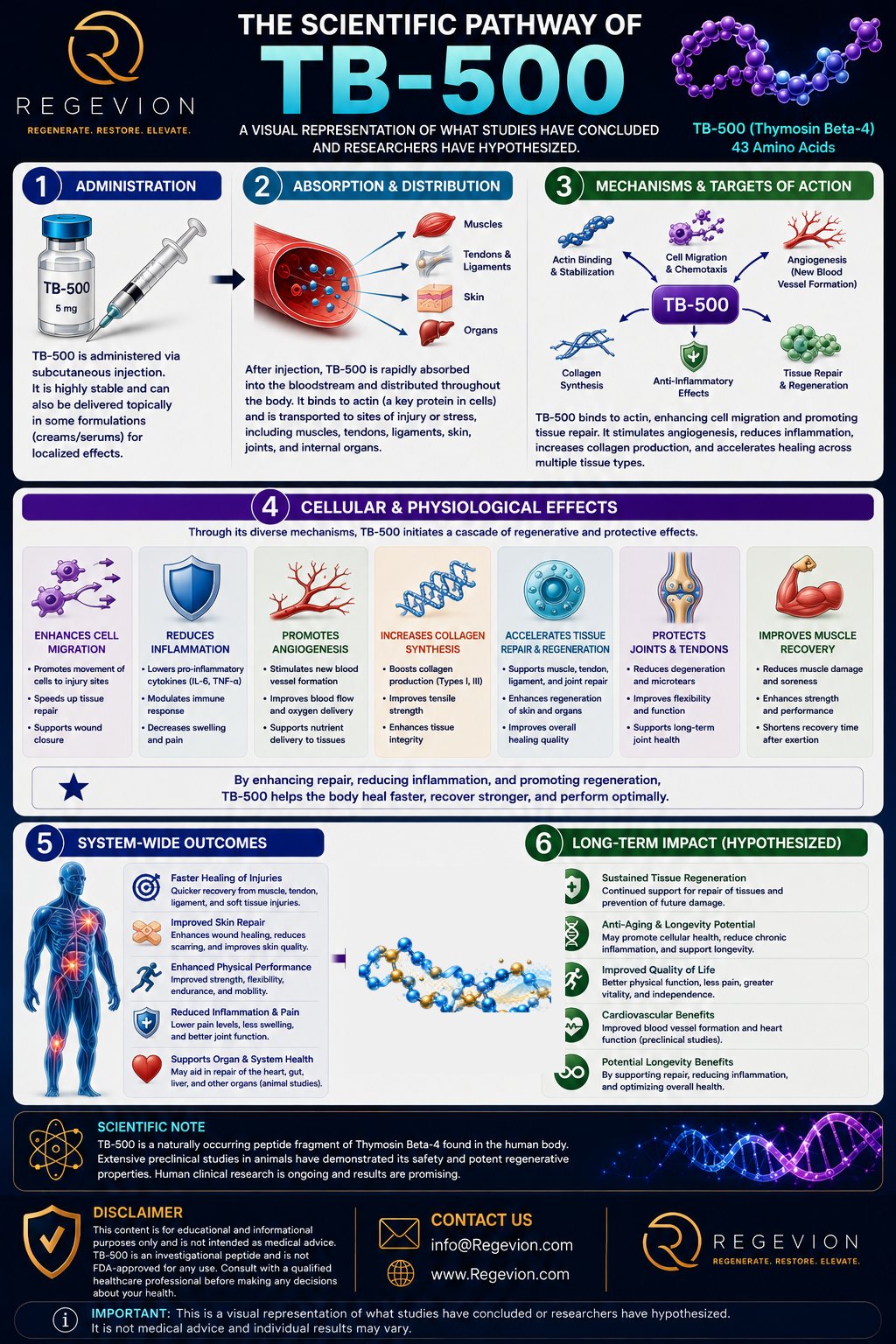
TB-500 is unusual among peptides because its proposed biology begins not with a conventional cell-surface receptor, but with one of the cell’s most fundamental structural proteins: actin.
TB-500 is the synthetic, N-acetylated seven-amino-acid sequence Ac-LKKTETQ, corresponding to residues 17–23 of the naturally occurring 43-amino-acid protein thymosin β4 (Tβ4). The fragment contains the region of Tβ4 associated with actin binding, cellular migration, and angiogenic activity. However, TB-500 and full-length thymosin β4 are not the same molecule, and this distinction matters when interpreting the science. Much of the mechanistic literature comes from Tβ4 rather than from TB-500 itself.
1. The Biological Architecture
To understand the proposed action of TB-500, it helps to start inside the cell.
Actin is a dynamic protein that forms the microfilament component of the cytoskeleton — the constantly remodeling internal framework that helps cells maintain shape, move, divide, and respond to their surroundings. Actin exists primarily in two functional states: individual G-actin monomers and assembled F-actin filaments.
Cells continually shift actin between these states. This process, sometimes described as actin filament turnover or treadmilling, allows a cell to extend protrusions, change shape, attach to extracellular surfaces, and migrate.
That becomes particularly important after tissue injury. A repairing cell must be able to move toward the damaged region, reorganize its cytoskeleton, interact with the extracellular matrix, and coordinate with neighboring cells. Endothelial cells must also migrate and reorganize to form new vascular structures.
Thymosin β4 is one of the major intracellular regulators of this actin pool. Rather than functioning primarily as a classical hormone-receptor signal, Tβ4 binds G-actin and helps regulate how much actin remains available for filament assembly.
This creates the basic biological architecture: actin regulation → cytoskeletal remodeling → cell movement → tissue remodeling.
TB-500 is proposed to reproduce at least part of this biology because it contains the central actin-binding region of Tβ4. The critical question, however, is how much of the full-length protein’s biology the isolated fragment actually reproduces in a living human.
2. Molecular Mechanism of Action
The best-established molecular relationship is between the Tβ4 actin-binding region and G-actin.
Full-length Tβ4 binds G-actin in approximately a 1:1 relationship, helping regulate the intracellular concentration of free actin available for polymerization. This changes the balance between actin assembly and disassembly and therefore influences the architecture of the cytoskeleton.
The TB-500 fragment LKKTETQ lies within this actin-binding region. Experimental work has shown that this short sequence can reproduce important actin-associated biological activities of Tβ4, including effects on endothelial-cell migration and vessel sprouting in experimental systems. Foundational research on the actin-binding domain identified this motif as important to the observed angiogenic activity, though direct confirmation that truncating this exact seven-residue sequence eliminates activity is limited to the broader actin-binding-domain literature rather than one definitive isolated experiment.
The proposed sequence is therefore: TB-500-related actin interaction → alteration of actin availability and cytoskeletal dynamics → changes in cell shape, adhesion and migration → greater capacity for cellular movement during tissue remodeling → potential effects on vascular formation and repair processes.
This is fundamentally different from the pharmacology of a peptide such as a receptor agonist. There is no established TB-500-specific GPCR or receptor tyrosine kinase through which its entire biological activity can be explained. That distinction is important: TB-500 should not be described as simply “activating a receptor.”
3. Receptor Biology & Cellular Signaling
No single conventional cell-surface receptor has been established as the primary receptor for TB-500 itself.
Instead, the strongest mechanistic foundation concerns the actin cytoskeleton. The parent protein Tβ4 also appears to influence additional signaling systems, including pathways associated with cell survival, inflammation, angiogenesis, and extracellular-matrix remodeling. Experimental literature has implicated signaling involving integrin-linked kinase (ILK), PINCH, Akt, and other intracellular mediators.
However, these pathways require careful interpretation. Evidence that full-length Tβ4 influences Akt signaling does not automatically demonstrate that the isolated TB-500 fragment produces the same signaling response in humans. Some biological effects attributed to Tβ4 may arise from regions of the protein that TB-500 does not contain.
This is one of the central scientific boundaries surrounding TB-500:
- Established: the fragment corresponds to the actin-binding region of Tβ4.
- Strongly supported: this sequence can influence actin-dependent cellular behavior in experimental systems.
- Proposed: some downstream regenerative, angiogenic, or signaling effects observed with Tβ4 may also occur with TB-500.
- Not established: that the complete pharmacology of full-length Tβ4 can be transferred directly to TB-500 in humans.
4. Pharmacology
TB-500’s pharmacology is therefore best described as incompletely characterized.
Its molecular size is approximately 889 Da for the free-base form, substantially smaller than the approximately 5 kDa (4,982 Da) full-length Tβ4 protein. FDA identifies TB-500 as Ac-Leu-Lys-Lys-Thr-Glu-Thr-Gln and notes that different salt forms can possess distinct physicochemical and pharmacokinetic properties.
The most important pharmacodynamic concept is exposure at the biologically relevant target. A dose does not directly equal a biological effect. The peptide must first enter circulation, survive long enough to reach relevant tissues, interact with its molecular target, and generate a sufficient biological signal.
For TB-500, the precise relationship between circulating concentration and biological response has not been established in humans. Consequently, there is currently no validated human potency curve, receptor-occupancy model, or clinically established exposure-response relationship for TB-500.
5. Pharmacokinetics: What Happens to the Peptide?
The pharmacokinetic picture is considerably clearer for the parent Tβ4 protein than for TB-500.
Human studies of intravenously administered synthetic Tβ4 have demonstrated measurable systemic exposure and dose-dependent increases in plasma concentration in a Phase I safety and pharmacokinetics study of healthy volunteers. These findings describe full-length Tβ4, not TB-500.
For TB-500 itself, FDA’s 2026 review found no human pharmacokinetic studies and no identified nonclinical pharmacokinetic studies via its nominated route of administration beyond a limited horse plasma-concentration dataset.
Experimental metabolism studies indicate that TB-500 can undergo C-terminal peptide cleavage, generating progressively shorter N-acetylated fragments. These metabolites have been detected in experimental animal systems and in vitro human biological matrices.
This raises an important mechanistic possibility: some observed biological activity may come from the parent TB-500 molecule, some from its metabolites, or from a combination of both. The relative contribution of each remains incompletely defined.
6. Dose, Exposure & Dose-Response
There is currently no clinically validated human dose-response relationship for TB-500.
This is an important distinction from full-length thymosin β4, for which a human Phase I study examined a range of intravenous doses and reported dose-proportional pharmacokinetic behavior over that study range. Those data cannot be converted into a TB-500 dosing schedule because the molecules are chemically and pharmacologically different.
Similarly, there is no established evidence showing that increasing TB-500 exposure progressively increases tissue repair, angiogenesis, muscle recovery, or another specific human outcome.
The scientifically appropriate model is: dose → systemic exposure → molecular availability → cellular response → physiological effect. For TB-500, several links in this chain remain incompletely characterized.
7. Does Body Weight Affect Dose?
There is currently insufficient human evidence to establish whether TB-500 should be administered according to body weight or as a fixed exposure.
No validated human pharmacokinetic model has established how body weight affects TB-500 distribution, clearance, or target exposure. Therefore, a weight-based dosing requirement cannot be scientifically inferred from its molecular size or from the fact that some experimental animal studies use doses normalized to body weight.
Animal dose units such as mg/kg are experimental research parameters — not evidence of an equivalent human dosing strategy.
8. Lower vs. Higher Exposure
A scientifically defensible lower-versus-higher exposure model for TB-500 cannot yet be established in humans.
At the cellular level, actin-regulating biology is inherently concentration-sensitive because the balance between free G-actin and polymerized F-actin changes as the available molecular pool changes. However, this does not establish a simple relationship in which more TB-500 produces proportionally more tissue repair.
Actin dynamics are tightly regulated biological processes. Excessive or prolonged alteration of cellular migration, vascular remodeling, or survival signaling could theoretically produce effects different from those observed at lower exposure.
The critical unanswered question is therefore not simply how much TB-500 is present, but what concentration reaches which tissue, for how long, and which molecular species is responsible for the resulting effect.
9. Connecting Molecular Mechanisms to Human Outcomes
The proposed connection between TB-500 biology and tissue repair can be visualized as a chain: actin interaction → cytoskeletal remodeling → improved cellular motility and organization → migration of reparative and endothelial cells → tissue remodeling and vascular responses → potential contribution to wound-repair processes.
Preclinical Tβ4 research supports this broader biological model. Tβ4 has been associated with endothelial migration, capillary formation, vascular remodeling, wound closure, and extracellular-matrix changes.
But the final step — from experimental mechanism to human clinical outcome — cannot currently be assumed for TB-500. FDA’s 2026 evaluation found no studies in which TB-500 itself had been administered to humans and no identified in-vivo studies directly demonstrating TB-500-induced wound healing.
The mechanistic story is therefore scientifically compelling but still predominantly preclinical.
10. Combination & Pathway Interaction
TB-500 does not appear to operate through a single isolated pathway.
Actin remodeling intersects with processes involving cell adhesion, extracellular-matrix organization, angiogenesis, inflammatory signaling, and tissue architecture. These systems are inherently interconnected. This means that changing cellular motility can influence several downstream biological processes simultaneously.
However, there is not sufficient controlled evidence to define clinically meaningful TB-500 interactions with other peptides or therapeutic agents. Claims that particular combinations produce predictable synergistic effects remain ahead of the available evidence.
11. What Scientists Still Do Not Fully Understand
The central unanswered question is surprisingly fundamental: does the isolated TB-500 fragment reproduce the clinically relevant biology of the complete thymosin β4 protein?
Full-length Tβ4 contains multiple biologically active regions, while TB-500 represents only the central seven-amino-acid actin-binding sequence. Research has identified additional Tβ4-associated activities outside this region, including effects related to inflammation, cell survival, and fibrosis.
Scientists also do not yet have a validated human PK/PD model for TB-500, a defined human exposure-response curve, or sufficient human evidence to determine which molecular species — parent peptide or metabolites — accounts for particular biological effects.
These gaps matter because the mechanistic evidence is often discussed as though TB-500 = thymosin β4. Scientifically, that equation is incorrect.
Why This Matters
TB-500 is best understood as a small molecular fragment derived from a much larger biological system.
Its scientific interest comes from the possibility that the Ac-LKKTETQ sequence can influence one of the cell’s most fundamental repair mechanisms: the dynamic remodeling of actin.
That creates a logical biological pathway: molecular interaction with actin → cytoskeletal remodeling → cellular migration → vascular and tissue remodeling → potential contribution to repair.
The intriguing part of the science is that a sequence only seven amino acids long may influence cellular behavior through a structural system as fundamental as the cytoskeleton.
The limitation is equally important: most of the deeper biological evidence belongs to thymosin β4, while the human pharmacology of TB-500 itself remains largely undefined.
Understanding that distinction is what separates the established biology from the hypothesis — and makes the current research worth following.
Disclaimer
TB-500 is an investigational peptide and is not currently FDA approved. The information presented in the Regevion Educational Library is intended for educational purposes only and is based on current scientific research and publicly available information. This content is not medical advice and should not be interpreted as a recommendation for use or as a substitute for guidance from a qualified healthcare professional.
References
- Low TLK, Hu SK, Goldstein AL. Complete amino acid sequence of bovine thymosin beta 4. Proc Natl Acad Sci U S A. 1981;78(2):1162-1166. PMID 6940133.
- Sanders MC, Goldstein AL, Wang YL. Thymosin beta 4 (Fx peptide) is a potent regulator of actin polymerization in living cells. Proc Natl Acad Sci U S A. 1992;89(10):4678-4682. PMID 1584803.
- Philp D, Huff T, Gho YS, Hannappel E, Kleinman HK. The actin binding site on thymosin β4 promotes angiogenesis. FASEB J. 2003. PMID 14500546.
- Bock-Marquette I, Saxena A, White MD, Michael DiMaio J, Srivastava D. Thymosin β4 activates integrin-linked kinase and promotes cardiac cell migration, survival and cardiac repair. Nature. 2004;432(7016):466-472. PMID 15565145.
- Ho ENM, et al. Doping control analysis of TB-500, a synthetic version of an active region of thymosin β4, in equine urine and plasma by liquid chromatography-mass spectrometry. J Chromatogr A. 2012. PMID 23084823.
- Simultaneous quantification of TB-500 and its metabolites in in-vitro experiments and rats by UHPLC-Q-Exactive Orbitrap MS/MS and their screening by wound-healing activities in vitro. 2024. PMID 38382158.
- U.S. Food and Drug Administration. Pharmacy Compounding Advisory Committee briefing document, TB-500 free base and TB-500 acetate, July 2026.